COMING FALL 2026 THE FUTURE OF PET WASTE STATIONS Now Accepting Pre-Order and Distributor Inquiries

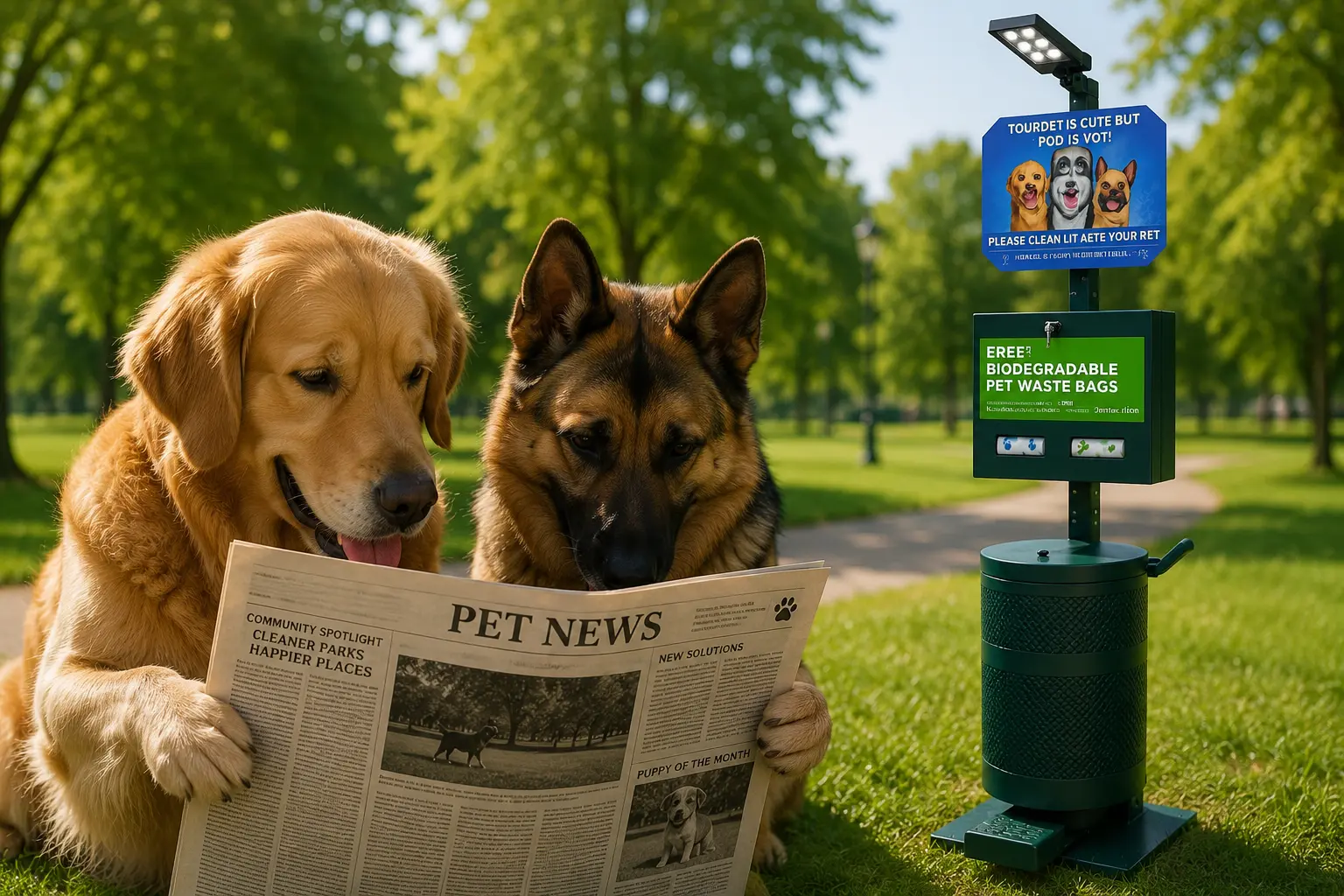

How thoughtful community design can encourage responsible pet ownership
Most conversations about pet waste begin in the same place: enforcement.
Communities post signs reminding residents to clean up after their dogs. Property managers send emails.
HOA newsletters repeat the rules. Some associations impose fines, while others rely on courtesy notices,
resident complaints, or increasingly strict policies. These measures all have a place, particularly when
someone repeatedly ignores community expectations. But enforcement usually begins after the problem
has already occurred.
There may be another question worth asking first: How can a community make responsible behavior
easier before enforcement becomes necessary?
Consider a familiar situation. A resident rushes out of the house with their dog while finishing a phone call.
Like many pet owners, they normally keep a small roll of waste bags attached to the leash. What they do
not realize is that the final bag was used during the previous walk.
Several minutes later, the dog stops along a neighborhood path. The resident remembers there is a pet
waste station just ahead and assumes they can take a bag from the dispenser as they pass. Instead, the
dispenser is empty. The receptacle is also nearing capacity, with tied bags pressed against a lid that no
longer closes properly.
What should have been a simple act of responsible pet ownership has become a decision. Does the
resident return home? Carry the waste until another receptacle appears? Use a homeowner’s private
trash container and risk upsetting a neighbor? Or, in the least responsible outcome, leave it behind?
The resident remains responsible for the choice. Yet the situation illustrates something community
managers encounter every day: good intentions are easier to follow when the environment supports them.
What Behavioral Science Says About Making the Right Choice Easier
Dr. BJ Fogg of Stanford University’s Behavior Design Lab has spent decades examining why people
perform a behavior at a particular moment. The Fogg Behavior Model identifies three elements that must
come together: motivation, ability, and a prompt. In that model, “ability” is closely tied to simplicity—the
easier an action is to perform, the more likely it becomes. When a desired behavior does not occur, the
problem may not always be a lack of motivation. The action may simply have become too difficult,
inconvenient, or easy to postpone.
That principle applies naturally to community management. Most pet owners understand that they should
clean up after their animals. The basic motivation already exists. A dog stopping during a walk supplies
the prompt. What remains is ability: Is a bag available? Is the station nearby? Is the receptacle usable?
Can the owner operate it while holding a leash, managing another dog, supervising a child, or using a
mobility aid?
Every unnecessary obstacle weakens the connection between intention and action. An empty dispenser
creates friction. An overflowing receptacle creates more. A dirty lid that must be lifted by hand adds
another reason to hesitate. Poor placement, difficult bags, and inconsistent servicing all turn a
straightforward task into something less convenient than it should be.
None of these obstacles excuses irresponsible conduct. Some people will disregard rules regardless of
how easy a community makes compliance. But treating every incident as a character problem overlooks
the much larger group of residents who generally want to cooperate and occasionally encounter a
preventable barrier.
Communities Often Experience the Same Problems Repeatedly
Community associations have documented these challenges in practical terms. A June 2024 guide
published by the Utah Chapter of the Community Associations Institute identified unattended pet waste
and overflowing stations among common resident complaints. Its recommendations included surveying
residents, identifying high-traffic problem areas, placing stations strategically, keeping dispensers well
stocked, emptying receptacles regularly, and maintaining a clear service schedule. It also encouraged
education, simple reporting systems, and positive reinforcement rather than relying exclusively on
penalties.
That advice reflects a broader truth: a pet waste station is not merely a container placed beside a walking
path. It is part of a community system. Its placement, appearance, capacity, maintenance, and ease of
use all influence whether residents view it as a useful amenity or another neglected fixture.
A well-positioned station makes the responsible choice more convenient. A stocked dispenser gives
residents a solution when they forget or exhaust their own bags. A receptacle with available capacity
gives them an appropriate place to dispose of the waste. Clear signage establishes expectations, while
reliable maintenance demonstrates that the community takes those expectations seriously.
When any of these elements breaks down, the consequences extend beyond a single dog walk. One
empty dispenser may affect dozens of residents before it is refilled. One overflowing receptacle may
discourage use, produce odors, attract insects, and generate multiple complaints. A station intended to
support community cleanliness can quickly become the focus of the problem.
Capacity and Maintenance Affect Behavior
Property managers know that maintenance rarely occurs under ideal conditions. Employees become sick.
Storm cleanup takes priority. Irrigation systems fail. Emergency repairs arise. A staff member expected to
service a station every other day may be pulled away, turning a two-day interval into three or four days.
The question is not whether those interruptions will occur. They will. The question is whether the station
has enough reserve capacity to continue functioning when they do.
An official April 2026 notice from Inspiration Residential HOA in Texas provides a useful example. The
association reported that some residents were bringing pet waste collected from their private lots to
common-area stations. According to the notice, this was causing receptacles to overflow more quickly
than intended and was damaging the containers. The HOA asked residents to reserve the community
stations for waste collected while walking in shared areas.
The notice addressed resident behavior appropriately, but it also illustrates how real-world usage can
exceed the assumptions behind a station’s original service plan. Communities can establish rules, but
equipment must still handle what happens between the moment a rule is ignored and the next
maintenance visit.
This is why convenience and capacity are connected. A stocked dispenser and an available receptacle
allow a resident to complete the entire responsible action in one place. When either side of that system
fails, the community has made compliance less convenient precisely when it matters most.
Clean and Modern Amenities Communicate Community Expectations
The condition of an amenity also sends a message.
Residents are more likely to respect equipment that appears clean, functional, and cared for. A station
surrounded by scattered bags, stained surfaces, or an overflowing container communicates neglect.
Even responsible residents may begin to view it as something to avoid rather than use.
This matters particularly in communities where residents have chosen their neighborhood because of its
appearance and quality of life. Homeowners notice landscaping, walking paths, entry features,
clubhouses, lighting, and recreational amenities. They expect shared equipment to reflect the same level
of thoughtfulness.
A pet waste station does not need to resemble a luxury monument, but it should feel consistent with a
modern, well-managed environment. It should be clean, approachable, easy to understand, and
dependable. The bag should be simple to remove and open. The disposal method should not require
unnecessary contact with a dirty lid. The equipment should look as though it belongs in the community
rather than appearing like an afterthought.
An inviting station cannot force a person to act responsibly. What it can do is reinforce a social
expectation: this community provides the tools, maintains the amenity, and expects residents to use it.
Better Design Removes Avoidable Excuses
These ideas influenced the development of PooStation, but the objective was not to claim that equipment
alone could change human nature. The goal was more practical: remove as many avoidable barriers as
possible.
The dispenser holds 1,200 bags, providing a larger reserve when usage increases or servicing is
delayed. The 20-gallon waste collection bin offers approximately twice the capacity commonly found in
standard pet waste stations reviewed during development. Those decisions were intended to reduce two
of the most visible failures residents encounter: an empty dispenser above and a full receptacle below.
The bags themselves were also treated as part of the user experience rather than a disposable
afterthought. Their larger dimensions provide more room to grip, close, and tie the bag securely. This is
especially helpful for someone holding a leash, managing multiple dogs, or using only one hand
comfortably. Custom two-color printing makes the bag more appealing and consistent with the larger
effort to modernize an amenity that has traditionally received little design attention.
Hands-free foot-pedal operation reduces the need to touch a public waste lid. An accessible hand lever
provides another operating method for people who cannot comfortably use a foot pedal. A visible EMPTY
indicator allows maintenance personnel to recognize a depleted roll quickly, even while passing the
station in a maintenance cart. Oversized drawstring liners allow staff to close and remove the waste liner
more cleanly, extending the same attention to the employee servicing the station that was given to the
resident using it.
No single one of these decisions guarantees responsible behavior. Together, however, they reduce
inconvenience, support maintenance, improve the appearance of the amenity, and make the expected
action easier to complete.
Enforcement Still Matters—but It Should Not Work Alone
Communities still need clear rules. Residents should understand their responsibilities, repeated violations
should have consequences, and property managers need a fair process for addressing complaints.
Enforcement becomes especially important when someone knowingly and repeatedly refuses to comply.
The problem arises when enforcement is treated as the entire strategy.
Another warning sign, another email, or another fine may remind residents what is expected, but those
measures do not refill an empty dispenser, create room in an overflowing receptacle, improve poor
station placement, or make a dirty lid more appealing to touch. Rules can establish the standard. The
physical environment determines how easy that standard is to meet.
A more effective approach combines expectations with support. Communities can place stations along
the routes residents already use, monitor high-traffic locations, maintain a dependable refill and collection
schedule, and make it simple for residents to report a station that needs attention. They can explain why
proper disposal matters, reinforce the behavior they want to see, and respond consistently when
someone ignores the rules.
This is not about rewarding irresponsibility or lowering expectations. It is about recognizing that
management works best when residents are given both a clear responsibility and a practical way to fulfill
it.
What Communities Can Do Now
Before adding more signs or increasing fines, HOA boards and property managers may benefit from
reviewing the experience they currently provide.
Are stations located near the paths where residents actually walk their dogs? Do dispensers regularly
remain stocked through weekends and holidays? Is there enough receptacle capacity to accommodate
an unexpected maintenance delay? Can the station be used comfortably by someone holding two
leashes, supervising a child, carrying a phone, or using a mobility aid? Does the equipment look clean
and cared for, or does it appear neglected?
Communities can also look beyond the equipment itself. A short resident survey may identify areas
where pet waste is most frequently reported. Maintenance records can reveal which stations empty or fill
more quickly than others. A simple reporting method can allow residents to alert management before a
minor problem becomes an overflow, odor complaint, or neighborhood dispute.
Positive communication can help as well. Instead of contacting residents only when something goes
wrong, communities can periodically explain where stations are located, remind pet owners that bags are
available, and thank residents for helping keep shared spaces clean. Social expectations become
stronger when responsible behavior is treated as the community norm rather than discussed only in the
context of violations.
The most successful approach is neither convenience alone nor enforcement alone. It is a combination of
clear standards, thoughtful placement, reliable maintenance, appropriate capacity, and equipment
designed around the way people actually behave.
Making Responsible Behavior the Natural Choice
There will always be a small number of people who ignore the rules despite every convenience a
community provides. Better bags, cleaner stations, and larger receptacles will not persuade everyone.
That reality should not prevent communities from improving the experience for the much larger group of
residents who generally want to be responsible.
Behavioral science does not suggest that people bear no responsibility for their choices. It suggests that
the environment surrounding those choices matters. When a desired action is easy, visible, convenient,
and consistent with the standards of the community, more people are likely to follow through. When that
action becomes inconvenient, unpleasant, or uncertain, compliance becomes less dependable.
That principle applies far beyond pet waste. Communities use it when they place recycling containers
where people naturally need them, provide clear traffic patterns, illuminate walking paths, or make online
payments easier to complete. Pet waste management deserves the same level of practical thinking.
The real choice for community leaders is not between responsibility and convenience.
Responsible behavior is often strengthened by convenience.
Communities may never eliminate every instance of pet waste being left behind. They can, however,
reduce the number of times a responsible resident encounters an empty dispenser, a full receptacle, an
unsanitary lid, or no appropriate place to dispose of a bag. They can provide equipment that reflects the
quality of the community, support maintenance personnel with better tools, and create a system that
works under real conditions rather than only under ideal ones.
In the end, stricter enforcement may tell residents what they are required to do. Thoughtful community
design helps them actually do it.
When the responsible choice is also the simplest, cleanest, and most convenient choice, better habits
become easier to build—and easier to sustain.