COMING FALL 2026 THE FUTURE OF PET WASTE STATIONS Now Accepting Pre-Order and Distributor Inquiries


Why reserve capacity may be the most overlooked feature of every pet waste station.
Most community amenities are appreciated because they are noticed.
A beautiful entrance creates a strong first impression. Well-maintained landscaping reflects pride of ownership. Attractive walking trails encourage residents to spend more time outdoors, while a clean clubhouse becomes a gathering place for neighbors and guests.
Pet waste stations are different.
When they are functioning properly, most residents hardly notice them at all. They simply remove a bag, clean up after their dog, dispose of the waste, and continue their walk. The entire interaction lasts less than a minute. There is nothing memorable about the experience, and that is exactly how it should be.
Ironically, the true measure of a pet waste station is not how well it performs when everything is going according to plan.
It is how well it performs when nothing is.
Imagine a large residential community on the Friday afternoon before Memorial Day weekend. Residents are preparing for family barbecues. Children are arriving home from college. Grandparents are welcoming visiting grandchildren. Friends from out of town have come for the holiday, and many have brought their dogs with them. The walking trails that normally see a comfortable flow of residents become noticeably busier, and common areas remain active well into the evening.
For most homeowners, it is exactly what community living is supposed to feel like.
For the maintenance department, however, it is often one of the busiest weekends of the year.
Earlier that afternoon, one maintenance employee had already left for a scheduled vacation. Another called in sick the following morning. Before lunch on Saturday, an irrigation pipe burst near the community entrance, requiring immediate attention. Suddenly, the routine schedule had changed. Tasks that normally happened automatically were pushed back a day, and then another. The pet waste stations that would ordinarily have been serviced over the weekend would now have to wait until Tuesday morning.
No one noticed at first.
Residents continued walking their dogs exactly as they always had. Families strolled through the neighborhood after dinner. Children rode bicycles around the lake while neighbors stopped to talk along the sidewalks. Visitors admired the landscaping, the clubhouse, and the peaceful walking paths that made the community feel welcoming.
Then, almost without anyone realizing it, small problems began to accumulate.
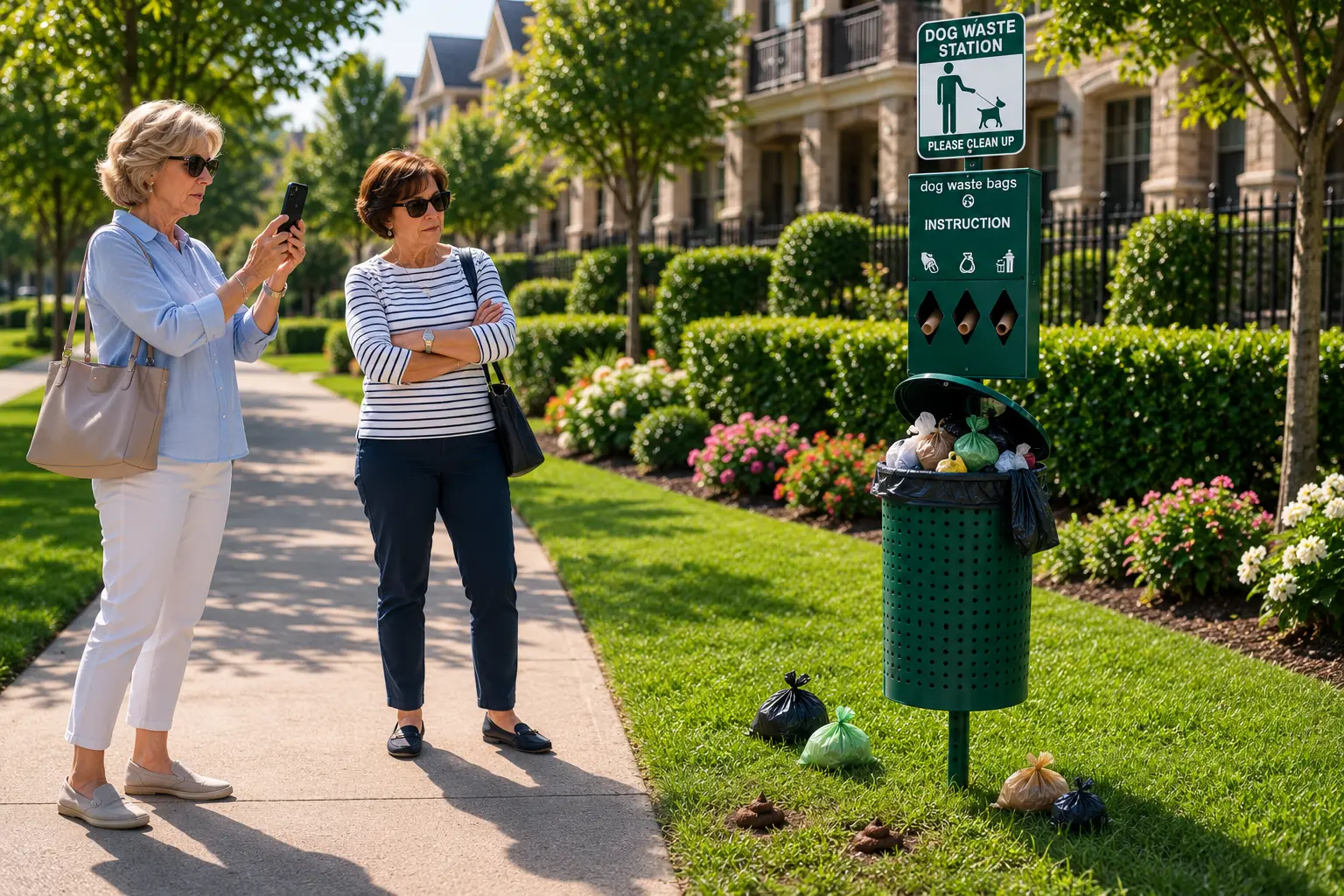
One dispenser quietly ran out of bags late Saturday afternoon. By Sunday evening another was nearly empty. On Monday, one of the waste receptacles had finally reached capacity, leaving tied bags pressed against a lid that no longer closed completely. Nothing had broken. No equipment had failed. The station had simply reached the limit of what it had been designed to handle.
Residents responded in different ways. Some carried the waste until they found another station. Others searched the property hoping another dispenser still had bags available. A few tossed the bag into the nearest trash receptacle they could find. Unfortunately, some simply left the waste behind.
By Tuesday morning, the property manager wasn’t hearing complaints about dispenser capacity or waste receptacles.
The complaints were about the community.
Residents noticed overflowing stations. They mentioned unpleasant odors near walking paths. Some questioned why bags weren’t available during one of the busiest weekends of the year. Visitors formed impressions about how well the property was maintained. None of those conversations centered on gallons or bag counts. They focused on something much broader—the overall experience of living in, or visiting, the community.
That distinction is more important than it may first appear.
Most manufacturers describe capacity using specifications. A brochure might list the number of bags a dispenser holds or the size of a waste receptacle, and while those figures are certainly useful for comparison, they rarely explain what capacity actually means to the people responsible for managing a neighborhood.
Property managers rarely think in gallons.
They think in time.
How much longer before a dispenser runs empty?
How much longer before a receptacle reaches capacity?
How much flexibility exists when a maintenance employee calls in sick, a storm changes priorities, or an unexpected repair consumes the afternoon?
In community management, capacity is measured not by what a station holds on the day it is installed, but by how long it continues serving residents when life refuses to follow a schedule.
Interestingly, community associations have been discussing these same challenges for years. The Community Associations Institute has encouraged boards and managers to look beyond enforcement alone by identifying high-traffic areas, strategically placing stations where residents naturally walk their dogs, keeping dispensers consistently stocked, maintaining dependable service schedules, and making it easy for residents to report maintenance issues before they become larger problems. Those recommendations recognize a practical reality that every experienced property manager already understands: even the best-maintained communities occasionally face unexpected interruptions, and the systems residents rely upon must be able to withstand them.
Municipal park systems have reached similar conclusions.
Earlier this year, Manchester, England, announced the replacement of hundreds of litter receptacles throughout its parks with larger-capacity units. The city’s reasoning was straightforward. Larger receptacles remain usable longer, reduce overflowing bins, and make it easier for visitors to dispose of waste properly between maintenance crews return. While those receptacles serve a broader purpose than pet waste alone, the underlying principle is exactly the same. Capacity extends the amount of time an amenity continues functioning under real-world conditions.
Behavioral science helps explain why this matters.
Researchers have long found that people are more likely to complete a desired behavior when it is simple, convenient, and immediately achievable. Dr. BJ Fogg’s work at Stanford University emphasizes that motivation alone is rarely enough. Even when people want to do the right thing, unnecessary friction—a missing bag, an overflowing receptacle, an inconvenient location—can interrupt otherwise responsible behavior. The easier an action becomes, the more consistently people perform it.
Environmental psychology reaches a similar conclusion from a different perspective.
Studies examining public spaces have shown that people form impressions from dozens of small environmental cues rather than from one dramatic feature. Clean, well-maintained surroundings communicate care, attention, and quality. Conversely, neglected amenities—even relatively small ones—can influence how visitors perceive the environment as a whole. A single overflowing pet waste station is unlikely to determine whether someone purchases a home, signs a lease, or renews a contract, but it becomes one of many details that collectively shape the way people experience a community.
That is why capacity is about much more than maintenance.
It is about protecting the community during the moments when the community is being noticed the most.
The operational challenges created by limited capacity are rarely caused by a single event. More often, they develop gradually as several ordinary circumstances overlap. A busy holiday weekend brings more residents and guests into the community. A maintenance employee is reassigned to an urgent repair. Weather delays routine servicing. Before long, a station that functioned perfectly on Friday morning is no longer keeping pace by Monday afternoon. The problem is not that anyone stopped doing their job. The system simply exhausted the reserve time built into it.
That idea—thinking of capacity as reserve time rather than as a specification—is rarely discussed, yet it may be one of the most important considerations for any community amenity. Every additional bag inside a dispenser extends the amount of time before maintenance must return. Every additional gallon of waste capacity provides flexibility when schedules change unexpectedly. In many ways, reserve capacity acts as a buffer between a perfectly planned maintenance schedule and the unpredictable realities of managing a community.
This becomes particularly important because overflowing stations affect much more than cleanliness.
Residents often interpret what they see as evidence of how carefully the property is managed. Researchers studying environmental psychology have consistently found that people form impressions through a collection of small environmental cues rather than through one dramatic observation. Attractive landscaping, clean sidewalks, functioning amenities, lighting, signage, and the overall condition of shared spaces all contribute to a person’s perception of quality. Hospitality researchers have reached similar conclusions, finding that perceptions of cleanliness significantly influence how people evaluate an environment.
Residential communities are no different.
Prospective buyers, future tenants, visitors, and even current residents rarely separate one amenity from another. They experience the property as a whole. An entrance monument, a walking trail, a clubhouse, and a pet waste station all become part of a single impression. While one overflowing receptacle will not determine whether someone purchases a home, it contributes to an overall perception that maintenance may not be keeping pace with the community’s needs. Conversely, clean, fully functioning amenities quietly reinforce confidence that the property is being cared for.
Perhaps that explains why public discussions among homeowners’ associations so often return to the same themes. Residents rarely complain that a receptacle is only a certain number of gallons or that a dispenser holds too few bags. Instead, they describe overflowing stations, unpleasant odors, insects, empty dispensers, and the frustration of arriving prepared to clean up after their dog only to discover that the station cannot support them. The complaints are operational, not technical. They reflect the experience of living in the community rather than the specifications printed in a manufacturer’s brochure.
Interestingly, municipalities have begun approaching public waste management in much the same way. When the City of Manchester announced the installation of larger-capacity litter receptacles throughout its parks, officials explained that the objective was not simply to replace older bins. Larger-capacity receptacles would remain usable longer, reduce overflow, and make it easier for visitors to dispose of waste responsibly between maintenance visits. Their decision recognized a simple operational reality: people cannot use a receptacle that is already full.
The same principle applies to pet waste stations.
Communities often devote considerable attention to enforcement. They post signs reminding residents to clean up after their pets. HOA newsletters repeat community rules. Property managers send reminders, and in some cases associations issue warnings or fines. Those measures certainly have their place, particularly when someone repeatedly ignores community expectations.
But enforcement alone cannot refill an empty dispenser.
It cannot create additional room inside a full receptacle.
It cannot compensate for equipment that reaches capacity before maintenance returns.
Behavioral science suggests that people are more likely to complete a desired action when it is simple, convenient, and immediately available. Rules establish expectations. Good design helps people meet them.
Those ideas became some of the guiding principles behind the development of PooStation.
Rather than beginning with the question, “How can we build another pet waste station?” the design process started somewhere else entirely.
What obstacles could be removed?
If maintenance schedules occasionally change, increase the dispenser capacity. If communities experience heavier use during holidays and special events, increase the waste collection capacity. If maintenance teams spend unnecessary time opening dispensers simply to determine whether they need refilling, create a highly visible EMPTY indicator that can be recognized at a glance while driving through the property. If servicing waste liners is unpleasant, design oversized drawstring liners that can be closed before removal, making the process cleaner and more sanitary for maintenance personnel.
Even the bags themselves became part of the solution. Larger biodegradable bags were designed to be easier to grip, easier to open, and easier to tie securely, while custom two-color printing transformed what had traditionally been a plain disposable bag into something that felt cleaner, more inviting, and more consistent with a premium community amenity.
Accessibility also influenced the design. A sanitary foot pedal reduces unnecessary hand contact, while an ADA-accessible hand lever provides an alternative operating method for residents who cannot comfortably use a foot pedal. Each feature addressed a practical challenge observed in everyday use rather than adding complexity for the sake of innovation.
Individually, none of these decisions guarantees responsible behavior.
Together, however, they remove many of the unnecessary obstacles that communities and residents encounter every day.
That may ultimately be the most important lesson.
Communities cannot predict every staffing shortage, every holiday weekend, every severe storm, or every unexpected maintenance emergency. They cannot control every decision a resident makes.
What they can do is create an environment that continues supporting responsible behavior when everyday routines are interrupted.
Capacity, therefore, should never be viewed as just another number on a specification sheet.
It is reserve time.
It is operational flexibility.
It is protection against the unexpected.
And perhaps most importantly, it is one of the quiet details that helps preserve the appearance, reputation, and resident experience of a community long after the brochure has been put away.
Because in the end, communities are rarely remembered for how they perform when everything goes according to plan.
They are remembered for how well they respond when it doesn’t.