COMING FALL 2026 THE FUTURE OF PET WASTE STATIONS Now Accepting Pre-Order and Distributor Inquiries


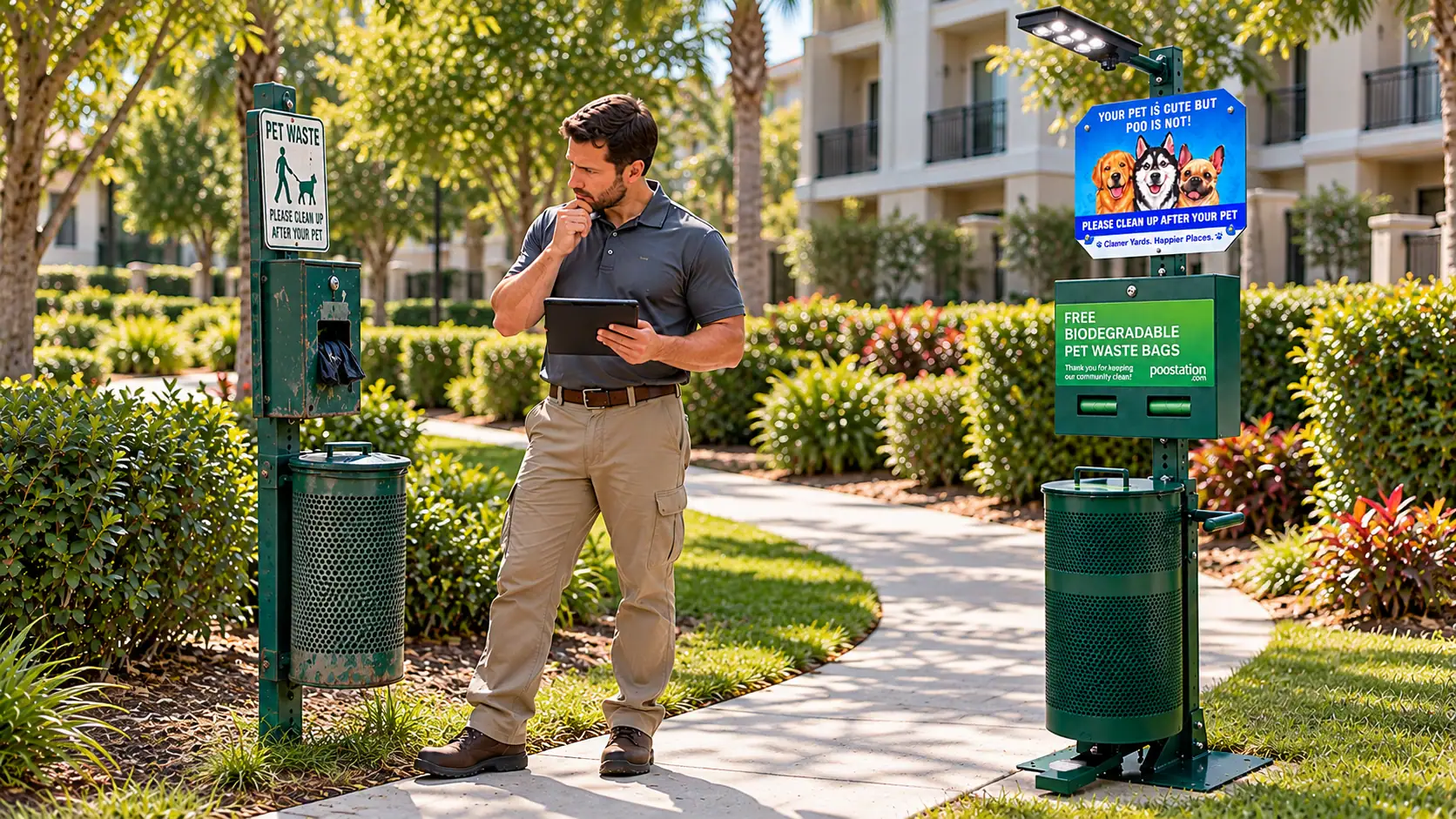

The warning signs that an aging station may be costing a property more than it appears
By Avi Kosch
Founder & CEO
NEXGEN DNA, Inc
A commercial pet waste station rarely fails all at once. More often, it deteriorates gradually. Rust appears around a hinge, the finish begins to fade, a lid no longer closes properly or a lock becomes difficult to operate. None of those problems necessarily takes the station out of service, so maintenance continues to refill the bags, replace the liner and move on.
That raises an important question for property managers, HOA boards, apartment operators and parks departments: When does a pet waste station stop being worth maintaining, even though it technically still works?
The answer may have less to do with whether the station is still standing and more to do with what it is asking the property to spend in maintenance time, repairs, service frequency and appearance. There comes a point when repairing yesterday’s station stops being maintenance and starts becoming an argument for replacement.
Still Working Is a Very Low Standard
Commercial outdoor equipment has a difficult life. It remains outside through rain, humidity, sunlight and temperature changes while being opened, closed, refilled and emptied repeatedly. Eventually, that exposure can show in worn finishes, corrosion, difficult hinges and locks, faded signage and components that no longer operate as smoothly as they once did.
Because bags can still be pulled from the dispenser and waste can still be deposited in the receptacle, a station may remain in place for years. That’s understandable; functioning equipment naturally receives less attention than broken equipment. But functional and effective are not necessarily the same thing. A station can still work while requiring too much maintenance, looking neglected, holding too few bags or overflowing too frequently. Replacement should sometimes begin before equipment becomes unusable.
Look at the Station the Way a Resident Does
Property managers naturally see equipment through an operational lens: Is it broken? Does it need a work order? Is there money in the budget to replace it? Residents experience it differently. They notice whether the receptacle is overflowing, whether the finish is rusted or faded, whether bags are available and whether the equipment is comfortable to use.
Pet waste stations are highly visible infrastructure. They sit along sidewalks, beside parks, near apartment buildings and throughout landscaped common areas, so deterioration becomes part of the property’s appearance. Appearance and function can overlap as well: a damaged lid can affect performance, faded signage communicates less effectively, and corrosion can eventually affect moving components.
The Maintenance Department Usually Knows First
If you want to know whether a station is approaching the end of its useful life, ask the people who service it. Maintenance workers know which door sticks, which lock requires extra effort, which lid needs repositioning and which dispenser always seems to need bags. They also experience something less obvious: the cumulative cost of inconvenience.
One awkward lock may add only seconds to a service call. A small dispenser may require more frequent replenishment, while a receptacle that fills quickly may create another trip. Those moments seem insignificant in isolation, but maintenance is repetitive. A task performed hundreds of times becomes an operating cost. The replacement calculation should therefore ask not only, “How much will the replacement cost?” but also, “What is the existing station costing us to keep?”
Capacity Can Make an Older Station Obsolete Before It Breaks
Capacity provides a good example. Commercial stations with approximately 400-bag dispensers remain common in the marketplace. For some properties, that may be entirely adequate. But when replacement becomes necessary, there is an opportunity to ask whether adequate is still the right standard.
PooStation was designed with approximately 1,200 bags—three times the capacity of a typical 400-bag commercial dispenser—and a 20-gallon covered receptacle. Those numbers aren’t simply specifications. Additional capacity creates reserve, giving maintenance more room between replenishment cycles and reducing the likelihood that a busy weekend, holiday or interruption in the normal schedule leaves residents facing an empty dispenser.
Capacity also affects the cost of ownership. A smaller dispenser that requires more frequent replenishment doesn’t just consume more maintenance time; it can create additional service visits over the life of the station. In our five-year ownership modeling, reducing a station from two full service visits per week to one reduced modeled recurring station-service costs by approximately 50 percent. That doesn’t mean every property will realize the same savings, but it demonstrates why replacing an aging, lower-capacity station with a modern, higher-capacity system such as PooStation can be an operating-cost decision—not simply an equipment purchase.
Bag and waste capacity do not necessarily move together. A property may need to empty the receptacle without replenishing 1,200 bags, making a waste-only service quicker than a complete station service. The question is whether replacement should simply duplicate the limitations of the equipment already there.
Replacement Should Be an Upgrade, Not a Reset
This is where many replacement decisions miss an opportunity. An old station reaches the end of its useful life, someone searches for a replacement, and the property purchases essentially the same thing again: new paint and new hardware, but similar capacity, functionality and maintenance requirements. The clock simply starts over.
When we developed PooStation, we approached the problem differently. We asked why approximately 400 bags had become normal, why receptacles needed to remain relatively small, why someone should have to touch a waste lid by hand, why accessibility should be treated as an afterthought, and why maintenance should discover an empty dispenser only by physically checking it.
Those questions led to approximately 1,200 bags, a 20-gallon covered receptacle, a hands-free foot pedal, an accessible hand lever, an EMPTY indicator, integrated LED lighting and a self-locking access door that automatically secures when closed. The objective wasn’t to create a longer specification sheet. It was to reconsider the experience of owning, servicing and using a commercial pet waste station.
Durability Belongs in the Ownership Equation
Capacity and convenience matter, but outdoor commercial equipment also has to survive being outdoor commercial equipment. The meaningful durability comparison isn’t how two stations look when they’re new. It is how they look and perform several years later after exposure to moisture, sunlight and repeated servicing.
Galvanizing is a well-established method of protecting steel against corrosion, and the American Galvanizers Association describes the combination of galvanizing with an organic coating such as powder coating as a “duplex system” that can provide enhanced corrosion protection when properly specified and applied.
That durability thinking is part of PooStation’s design. We use galvanized steel and a durable powder-coated finish because the product isn’t being designed for a showroom. It is being designed for years of weather, repeated servicing and everyday commercial use. No outdoor finish is indestructible, but material selection matters when equipment is expected to remain part of a property’s landscape year after year.
Sometimes the Cheapest Decision Is to Stop Repairing
There is a familiar temptation with aging equipment: if we’ve already spent money maintaining it, perhaps we should get another year out of it. Sometimes that is exactly the right decision. A sound station with a minor replaceable component shouldn’t necessarily be discarded.
The problem begins when a property repeatedly spends small amounts of money and labor without totaling them. A hinge, lock, touch-up, extra maintenance visit or emergency bag refill can quietly become part of the operating routine. Eventually, the comparison is no longer repair cost versus replacement price; it is the cost of continuing the old operating model versus moving to a better one. If new equipment increases capacity, simplifies servicing and improves accessibility, replacement becomes an operational decision as well as a capital expense.
There Is No Universal Replacement Date
It would be convenient to say every commercial pet waste station should be replaced after five, seven or ten years, but that isn’t credible. Climate, usage, materials, installation quality and maintenance practices all differ. The condition of the individual station matters more than an arbitrary birthday.
Management should instead look for a pattern: meaningful corrosion, unreliable components, repeated repairs, deteriorated signage, frequent overflows or empty dispensers, difficult servicing, poor accessibility or an appearance that no longer matches the property. One issue may justify repair. Several together may mean that although the station still works, the case for keeping it no longer does.
The Best Time to Ask Is Before It Fails
Waiting for complete failure makes replacement easy to justify, but it also makes the decision urgent. Residents may temporarily lose access to bags or disposal, maintenance may need a temporary solution, and purchasing becomes reactive. Urgency has a way of turning thoughtful capital decisions into “just order another one.”
A planned replacement gives management time to inspect existing stations, understand usage and maintenance patterns, compare alternatives and decide whether the next equipment should merely replace what was there or improve upon it. A better question is: “If we were buying this station today, knowing what we know now, would we buy the same thing again?” If not, that may be the clearest replacement signal.
Don’t Buy the Same Limitations Again
I created PooStation because I kept coming back to a simple idea: mature product categories deserve innovation too. A pet waste station doesn’t have to be technologically revolutionary to be meaningfully better. Sometimes innovation begins by looking at something familiar and asking why its limitations still exist.
Replacement ultimately presents a choice: spend money recreating what the property already had, or use the moment to reconsider what the next station should do better. Repair will sometimes make sense, and a basic station may remain adequate for some properties. But when replacement becomes necessary, don’t spend new money buying the same old limitations all over again.
The best replacement isn’t necessarily the station that looks most like the one being removed. It’s the one you won’t wish you had replaced differently five years from now.
Cleaner Spaces Happier Places™
Sources
American Galvanizers Association — Guidance regarding galvanized steel, powder coating and duplex corrosion-protection systems.
DOGIPOT — Commercial pet waste station product specifications and capacity information.
Barco Products — Current commercial pet waste station configurations and capacity specifications.
PooStation / NEXGEN DNA, Inc. — Product specifications and internal ownership-cost modeling covering bag capacity, receptacle capacity, materials, service frequency, accessibility, lighting, EMPTY indicator and self-locking access.
About the Author
 | Avi Kosch is the founder and CEO of NEXGEN DNA, Inc., an innovation company focused on practical solutions for pet-friendly communities and the built environment. Drawing on more than two decades of entrepreneurial experience in product development and manufacturing for hospitality and commercial environments, Kosch believes a well-designed commercial product should not only look and perform as intended on the day it is installed, but should be engineered to preserve that appearance and performance through the realities of everyday use His approach to product development begins with observing how people actually interact with products and questioning limitations that have simply become accepted. His work includes the development of PooStation, a next-generation pet waste management system inspired in part by his personal experience with accessibility following a serious accident. |