COMING FALL 2026 THE FUTURE OF PET WASTE STATIONS Now Accepting Pre-Order and Distributor Inquiries

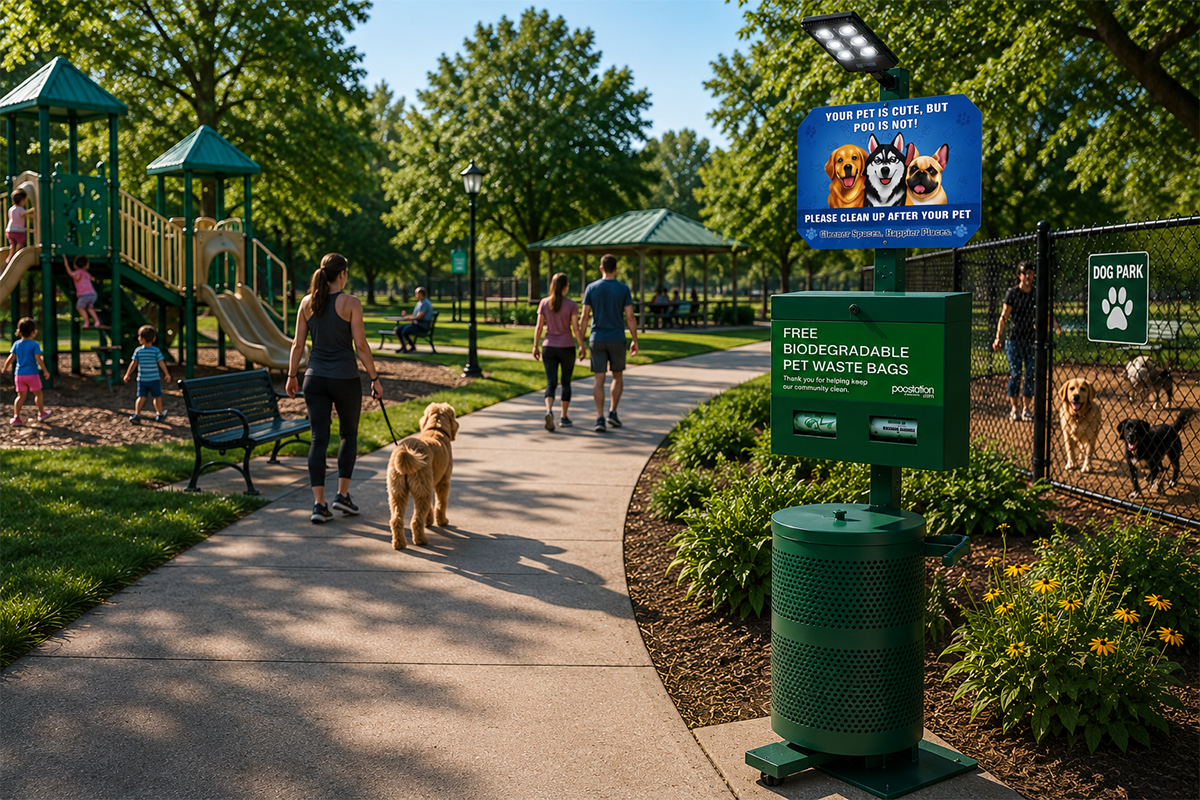

Why some of the busiest public spaces reveal exactly what a modern commercial pet waste station should become.
By Avi Kosch
Founder, PooStation
A NEXGEN DNA, Inc. Company
Spend a Saturday morning in almost any public park, and you’ll witness one of the best examples of a community at work. Families gather around playgrounds while children race from one activity to the next. Joggers settle into familiar routines along winding walking trails. Cyclists glide beneath mature trees. Friends meet under shaded pavilions, and throughout it all, dog owners stroll quietly through open green spaces before making their way toward favorite grassy areas and nearby dog parks.
At first glance, it looks like an ordinary weekend.
Look a little closer, however, and parks begin teaching lessons that extend far beyond recreation.
Unlike apartment communities or homeowner associations, parks welcome an entirely different group of visitors every day. Residents, tourists, athletes, maintenance crews, school groups, families, cyclists, and dog owners all rely on the same public amenities. Every bench, trail, drinking fountain, playground, trash receptacle, and commercial pet waste station is expected to perform consistently regardless of who happens to use it. That constant turnover makes parks remarkably honest. They don’t hide design weaknesses. They expose them.
Heavy weekend traffic, changing weather, seasonal events, and longer maintenance intervals quickly reveal which public amenities continue performing year after year and which ones quietly become frustrating to use. If an outdoor product succeeds in one of these environments, there is a good chance it will succeed almost anywhere.
Commercial pet waste stations are no exception.
One of the first lessons begins with the dogs themselves. Anyone who regularly walks a dog quickly realizes that dogs rarely choose where to relieve themselves randomly. My own dog certainly doesn’t. Morning after morning she returns to many of the same grassy areas, particularly around trees, trail intersections, and fire hydrants where other dogs have clearly stopped before. What initially appears to be random behavior gradually reveals itself as a remarkably predictable routine repeated by hundreds of different dogs every day.
Interestingly, guidance published by the United States Environmental Protection Agency reaches much the same conclusion. Rather than recommending that pet waste stations simply be installed wherever unused space happens to exist, the EPA encourages locating them along common walking routes and in places where dogs naturally congregate. Successful pet waste management begins by understanding existing behavior instead of attempting to change it.
That philosophy extends far beyond deciding where a station should be installed.
Every successful park quietly influences behavior through thoughtful design. Sidewalks encourage certain walking routes. Benches invite visitors to stop and enjoy the scenery. Shade structures become gathering places during warmer afternoons. Landscaping subtly guides movement throughout the property. Lighting makes evening walks feel safer and more inviting. None of these amenities forces people to behave differently. Instead, they remove small obstacles and make the desired behavior feel natural. Commercial pet waste stations work according to exactly the same principle.
Dog parks place even greater demands on that philosophy.
Unlike neighborhood sidewalks where activity spreads naturally throughout an entire community, dog parks concentrate dozens of dogs and owners within relatively small spaces. During a busy weekend morning, a single commercial pet waste station may be used repeatedly within only a few minutes. Bags disappear faster. Waste receptacles fill more quickly. Maintenance intervals become increasingly important. Capacity becomes more important. Durability becomes more important. Engineering decisions that might seem insignificant in lighter-use environments suddenly become critical under continuous public use.
The same challenge extends throughout larger park systems. Many municipalities maintain miles of walking trails connecting playgrounds, athletic fields, lakes, picnic areas, and dog parks. Maintenance personnel often spend an entire day servicing facilities spread across large geographic areas. Unlike an apartment community where equipment may be checked daily, park maintenance crews may service dozens of stations during a single route. Every unnecessary service visit consumes valuable time. Every empty bag dispenser generates avoidable complaints. Every overflowing receptacle requires attention that could have been devoted elsewhere. Good engineering therefore respects not only residents and visitors, but also the people responsible for maintaining these public spaces every day.
Parks also reveal another lesson that often goes unnoticed.
Because people spend hours enjoying concerts, sporting events, festivals, picnics, and recreational activities, ordinary trash naturally accumulates throughout the day. Beverage bottles, coffee cups, sandwich wrappers, snack packaging, and disposable containers become part of everyday park life. When nearby trash receptacles become full—or simply aren’t conveniently located—people naturally look for the nearest available container.
Many traditional commercial pet waste stations used in parks rely on permanently open waste receptacles. While functional, these designs often encourage ordinary garbage to occupy valuable space intended for pet waste. It isn’t necessarily poor maintenance. It is predictable human behavior. An uncovered receptacle communicates something very different than a covered one.
That simple observation helps explain why thoughtful engineering matters.
An overlapping receptacle lid does more than improve appearance. It helps discourage ordinary trash while reducing exposure to rainwater, leaves, insects, and wind-blown debris. Instead of inviting misuse, it reinforces the purpose of the receptacle. Small design decisions quietly influence behavior without requiring additional rules or enforcement.
Sanitation deserves equal consideration.
Cleaning up after a dog has never been the enjoyable part of a walk, yet millions of responsible owners willingly perform that task every day. Surprisingly, many traditional commercial pet waste stations still require users to lift the waste receptacle lid using the same hand that has just handled a used waste bag. While proper hand hygiene remains essential regardless of equipment design, reducing unnecessary contact wherever practical represents thoughtful engineering rather than unnecessary complexity.
That observation became one of the guiding principles behind PooStation. Instead of relying upon a single method of operation, the station incorporates both an ADA-accessible hand lever and a foot-operated pedal. Some people naturally prefer operating the receptacle with their foot. Others—including wheelchair users or individuals who find the hand lever easier to use—benefit from an equally accessible alternative. Accessibility, in this case, improves convenience for nearly everyone.
Walking trails introduce another consideration that deserves greater attention. Many people walk their dogs before sunrise during the summer months or after work in the evening. Mature tree canopies and winding trails often become considerably darker than surrounding open areas. In those moments, a motion-activated LED light becomes more than another product feature. It helps visitors locate the station, identify the bag dispenser, and comfortably dispose of waste whenever natural lighting is limited.
The more time I spent observing parks, the more I realized that successful public amenities rarely depend upon one dramatic innovation. Instead, they succeed because dozens of thoughtful design decisions work together over many years of continuous public use. Larger biodegradable pet waste bags—approximately twenty-eight percent larger than many standard commercial bags—become easier to open, easier to grip, easier to scoop with, and easier to tie closed. A twenty-gallon receptacle accommodates heavier public use. Biodegradable maintenance liners support long-term sustainability. Maintenance-friendly servicing reduces unnecessary labor. Individually, each improvement appears relatively modest. Together, they remove small frustrations repeated thousands of times throughout the life of a community.
Today’s parks have evolved dramatically. Communities invest millions of dollars creating architecturally designed playgrounds, landscaped walking trails, outdoor fitness areas, splash pads, modern dog parks, public art, and gathering spaces that reflect the expectations of today’s residents. These investments recognize that public spaces contribute directly to quality of life, community pride, and the overall visitor experience. It seems only natural that the modern commercial pet waste station should evolve alongside them rather than remain one of the few outdoor amenities that has changed very little over the years.
That realization ultimately became one of the driving ideas behind PooStation. Rather than beginning with a list of product features, the design process began by carefully observing how dogs, residents, maintenance professionals, and public spaces interact every day. Every engineering decision—from the overlapping lid and larger twenty-gallon receptacle to the oversized biodegradable bags, biodegradable liners, ADA-accessible operation, maintenance-friendly servicing, and motion-activated LED lighting—grew from solving practical problems observed in real-world environments.
Looking back, I realized this article was never really about parks or dog parks alone. It was about understanding how thoughtful design quietly shapes everyday behavior. Parks simply provide one of the clearest windows into that process because they bring together so many different people, activities, and expectations within the same shared environment. They remind us that engineering is measured not simply by capacity, durability, or appearance, but by how effectively it removes unnecessary friction from everyday life.
In the end, the busiest public spaces teach us something remarkably simple. Cleaner communities are rarely created through enforcement alone. They are created when thoughtful planning, good maintenance, and well-designed amenities make responsible behavior feel effortless. When engineering quietly removes obstacles instead of creating them, everyone benefits—from maintenance professionals and property managers to residents, visitors, and the dogs who bring them there.
Cleaner Spaces Happier Places™
Sources
1. U.S. Environmental Protection Agency (EPA).
2. National Recreation and Park Association (NRPA).
3. NRPA 2025 Engagement With Parks Report.
4. Project for Public Spaces (PPS).
5. International Facility Management Association (IFMA).
6. Original field observations by the author.