COMING FALL 2026 THE FUTURE OF PET WASTE STATIONS Now Accepting Pre-Order and Distributor Inquiries


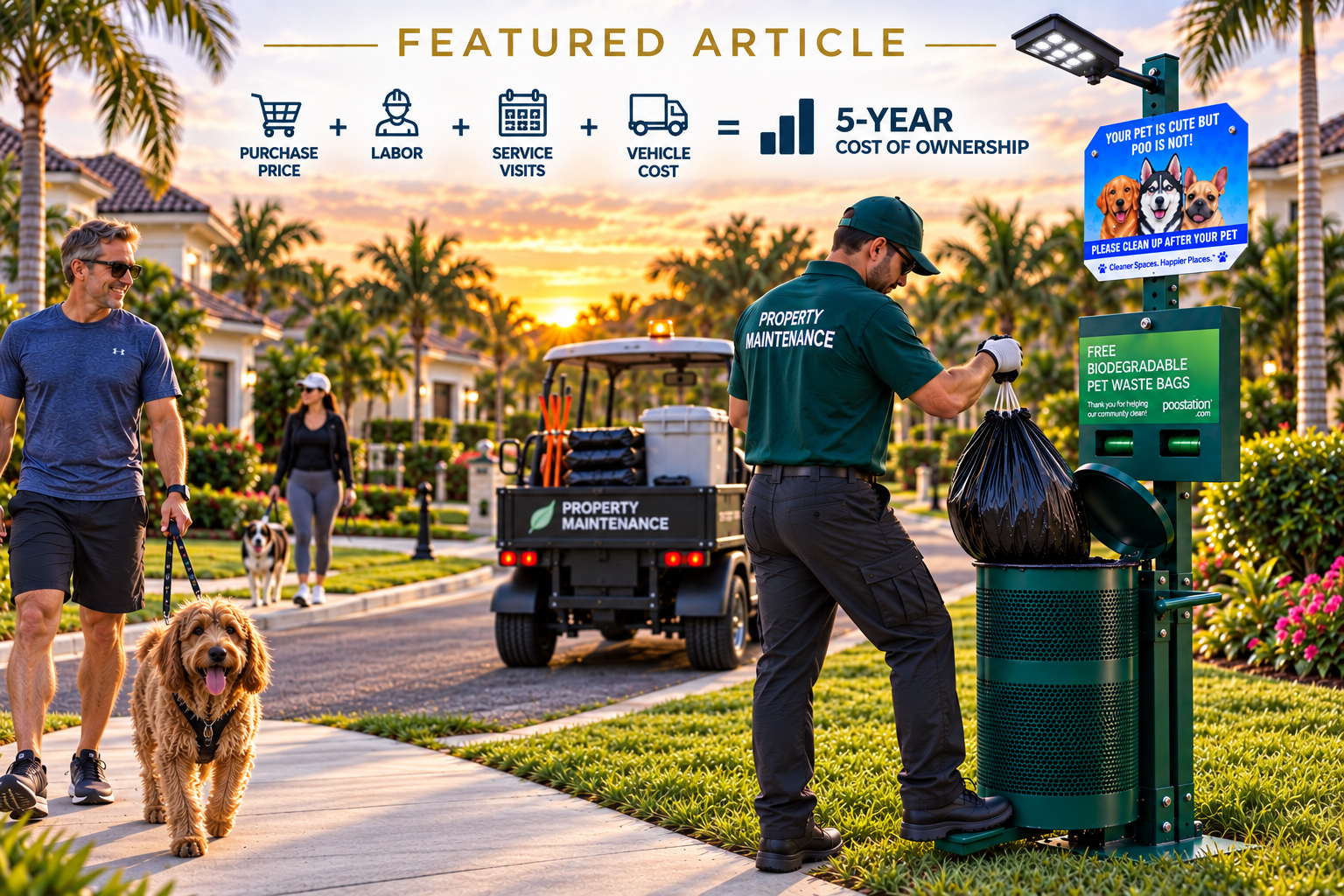

The Real Cost of a Pet Waste Station
Why the purchase price may be the smallest number in the five-year equation
By Avi Kosch
Founder & CEO
NEXGEN DNA, Inc.
A pet waste station can cost less than $200. It can also cost $250, $400, $500 or more. Put those numbers side by side on a spreadsheet and the purchasing decision can appear almost embarrassingly simple: Why spend nearly $600 for something you can buy for less than $200?
It is a fair question. But it may be the wrong question if the comparison ends there.
A pet waste station is purchased once. Over the next five years, someone may return to that station hundreds of times to empty it, replace a liner, replenish bags, inspect it and keep it usable. The original purchase price is therefore only one part of the equation. The larger expense may be everything that happens afterward.
That is why communities should consider evaluating pet waste equipment the same way businesses evaluate other operating equipment: not simply by asking what it costs to buy, but what it costs to own.
Seven Minutes Multiplied by Five Years
Pet waste station maintenance isn’t particularly complicated. Based on my experience, a normal full service—emptying the receptacle, replacing the liner, replenishing bags and checking the equipment—should take roughly seven to seven and a half minutes. If an employee is simply emptying the receptacle and replacing the liner, the hands-on portion may be closer to three minutes.
Seven and a half minutes doesn’t sound like much until it is multiplied by several stations, multiple visits each week, 52 weeks a year and five years. Then minutes become hours, and hours become payroll.
Payroll itself is only part of the cost. Recent Bureau of Labor Statistics data for administrative and waste-services workers puts average employer compensation at approximately $35 per hour when wages and benefits are combined. Those benefits can include paid leave, insurance, retirement contributions and legally required employer expenses.
There is another cost that rarely appears in a pet waste station comparison. The maintenance employee has to get to the station. On a large HOA, apartment community or municipal park, that may involve a golf cart, utility vehicle or pickup. The vehicle has to be purchased, fueled or charged, maintained, insured and eventually replaced. Time spent traveling between stations is paid time too.
The true cost of servicing a station, therefore, isn’t simply the seven and a half minutes someone’s hands are touching it. It is the cost of putting an employee and the necessary equipment at that location every time the station requires attention.
Capacity Creates Reserve
This is where an ordinary product specification begins to have financial consequences.
Many traditional commercial pet waste stations hold approximately 400 bags and use receptacles in the 10- to 12-gallon range. PooStation was designed to hold approximately 1,200 bags and incorporates a 20-gallon covered receptacle.
That doesn’t mean PooStation causes residents to use fewer bags, and it certainly doesn’t mean their dogs produce less waste. The difference is reserve.
A 1,200-bag dispenser has three times the bag reserve of a 400-bag dispenser. A 20-gallon receptacle provides substantially more waste capacity than a conventional 10- or 12-gallon receptacle. Depending on usage, that additional reserve may allow a community to go longer before bags must be replenished or capacity forces another visit.
The economic value of capacity isn’t simply that one station holds more. It is what that additional capacity may do to the maintenance schedule. Every responsible service visit that can be eliminated gives an employee time to do something else.
When a $200 Station Costs More Than a $600 Station
There are inexpensive pet waste stations on the market today. Current products begin below $200, although some of the least expensive configurations do not include all the components found in a complete commercial station. Other basic systems are available in the $200-to-$300 range, while more substantial commercial stations commonly move into the $400-to-$500 range.
PooStation does not pretend those products don’t exist. At smaller quantities, our initial purchase price is higher.
But now extend the comparison beyond the day the equipment arrives.
For this article, we modeled five years of ownership using approximately seven and a half minutes for normal station service, a modest allowance for movement between locations, employer compensation rather than wages alone, and a conservative allowance for vehicle usage.
We also charged PooStation for an expense a traditional station doesn’t have: its integrated LED. The LED carries a two-year warranty, so our model assumes approximately $70 for a replacement light and installation every two and a half years and charges two replacements during the five-year period.
In an illustrative scenario where a conventional station required service twice each week while the larger-capacity PooStation could responsibly operate with weekly full service, the modeled five-year ownership cost was approximately 38 percent lower for PooStation.
That percentage is not a promise. A busy dog park will not behave like a quiet residential walking path. A 500-unit apartment community will not have the same usage as a 100-home HOA. Labor costs, property layouts, pet populations and maintenance practices differ.
But the exercise exposes something purchase price alone cannot show: a station can be cheaper on the day it is purchased and considerably more expensive over the years it is owned.
Someone Is Already Charging for Every Trip
We can test that principle against the real marketplace.
A Tampa Bay company that maintains pet waste stations for HOAs, apartment communities and municipal properties publicly prices its service at approximately $7 to $9 per station stop, depending on route size.
One example published by the company involves 21 pet waste stations serviced three times weekly. Including bag supply, the monthly price is approximately $2,500—or $30,000 a year.
The point isn’t that every community pays that amount or every maintenance contractor charges the same rates. The important part is that an independent service business has placed an actual market price on something communities often overlook: every return trip costs money.
Once a property begins spending thousands of dollars servicing a network of stations, the difference between paying $250 and $500 for the equipment itself becomes a much smaller part of the five-year equation. The station may be the most visible expense. It isn’t necessarily the largest one.
What If There Is No Station to Replace?
For many communities, none of these comparisons initially seem relevant because they don’t have pet waste stations at all.
Across the country are established residential communities built 20, 30 or 40 years ago, long before today’s emphasis on pet-friendly amenities. They may have mature landscaping, beautiful clubhouses, swimming pools, walking paths and recreation areas, yet not one dedicated pet waste station.
Maybe nobody ever considered installing them. Perhaps a board looked at them years ago and decided they would become another maintenance headache. Management may have assumed the dispensers would constantly run out of bags or the receptacles would overflow.
Those concerns aren’t unreasonable. But they may deserve to be reconsidered.
The absence of a pet waste station doesn’t mean the absence of pet waste. Dogs are already being walked through these communities every day. Responsible residents bring bags and dispose of them in an available trash receptacle or carry them home. But convenient, strategically located pet waste stations make responsible pickup and disposal easier precisely where people are walking their dogs.
There is an environmental reason to care about what gets left behind as well. The U.S. Environmental Protection Agency identifies improperly disposed pet waste as a potential source of nitrogen, phosphorus, parasites and bacteria in waterways. Stormwater can carry pollutants across streets, sidewalks and other hard surfaces into storm drains, and in many places that runoff can reach local waterways without first passing through a treatment facility.
For an established community, installing pet waste stations isn’t simply about adding another amenity. It can be part of a broader conversation about cleanliness, responsible pet ownership, resident convenience and protecting common areas.
The question isn’t why the community didn’t install stations 20 years ago. The question is whether the assumptions behind that decision still make sense today.
Doing Nothing Isn’t Necessarily Free
There is no purchase order for doing nothing, which makes the status quo appear free.
But the work associated with pet waste doesn’t disappear simply because a community hasn’t purchased a station. Communities already pay to maintain landscaping, sidewalks, walking trails and common areas. Grounds crews encounter waste left behind. Maintenance personnel respond to complaints. Residents rely on whatever common-area trash receptacles happen to be nearby, even when those receptacles are nowhere near the routes where dogs are actually walked.
Not every one of those costs can be neatly assigned to a pet waste spreadsheet, and they shouldn’t be artificially turned into numbers just to justify a purchase. But they are part of the operating reality a community should consider.
There is also the resident experience. A property can invest heavily in landscaping, pools, clubhouses and recreation areas, yet dog waste beside a walking path can quickly undermine the impression those investments were intended to create.
Pet waste stations aren’t glamorous amenities. Few people will choose a home because they were impressed by the dog-waste receptacle. But some of the best community infrastructure is almost invisible when it works properly. A resident needs a bag and one is there. Disposal is nearby. The station is sanitary and accessible. Maintenance isn’t constantly rushing back because the bags are gone or the receptacle has reached capacity.
The system simply works.
Why We Built PooStation Differently: The Potential for 50% Fewer Routine Service Visits
There will always be a market for an inexpensive pet waste station. There will also be communities for which a basic dispenser and receptacle are entirely adequate. PooStation wasn’t designed around the idea that every property needs the most expensive option or that every traditional station is inefficient.
We started with a different question: What would happen if we reconsidered the things the industry had learned to accept?
That is why PooStation was designed to hold approximately 1,200 bags—roughly three times the capacity of many commonly installed 400-bag stations. It is why the waste collection bin was increased to 20 gallons, approximately twice the capacity of the 10-gallon receptacles identified during our review of leading commercial stations.
Capacity is not simply a specification on a product sheet. It affects what happens after the station is installed.
Consider a representative community in which a traditional 400-bag dispenser requires replenishment approximately three times per week. At the same level of bag usage, a 1,200-bag dispenser could reduce that requirement to approximately once per week.
That represents approximately 67% fewer bag-refill events.
The same principle applies below the dispenser. If a traditional 10-gallon receptacle requires servicing four times per week under a particular property’s waste volume, doubling the receptacle capacity to 20 gallons could allow that same volume to be accommodated with approximately two collections per week.
Because the weekly bag refill can occur during one of those scheduled collection visits, a station that previously required approximately four routine visits each week could potentially be serviced in approximately two.
That is a modeled 50% reduction in routine station service visits.
Actual results will naturally vary according to usage, property size, maintenance schedules and resident behavior. But the principle illustrates something often overlooked when communities compare equipment: the purchase price is only one part of what a pet waste station ultimately costs.
Every service visit requires time. Someone has to travel to the station, inspect it, refill bags, remove waste, install a new liner, clean the surrounding area when necessary and move to the next location. Across dozens—or hundreds—of stations, those minutes become labor hours. Labor hours become operating expense.
That is why PooStation was designed not only for the person walking the dog, but also for the person responsible for maintaining the station.
The visible EMPTY indicator helps maintenance personnel identify a depleted roll without unnecessarily opening the dispenser. Oversized drawstring liners simplify waste removal. The self-locking access door automatically secures when closed, eliminating another step the maintenance employee has to perform—and remember—during every full service. Hands-free foot-pedal operation and an accessible hand lever provide cleaner, more convenient ways for residents to dispose of waste. The integrated LED improves visibility after dark. And the larger bag and waste capacities provide additional operating reserve when weekends, holidays, storms, staffing shortages or unexpected maintenance demands interrupt the normal service schedule.
None of those features was added simply to make a longer specification sheet. They were engineered into PooStation because over hundreds of service visits and years of ownership, capacity, durability, time and even small efficiencies can add up.
Those details may appear small individually.
Together, they change the economics and experience of maintaining a pet waste program.
Traditional pet waste stations were largely designed around one question:
Where can someone get a bag and dispose of pet waste?
We believed there was a better question:
How can the entire experience work better—for the pet owner, the maintenance employee and the community paying for it?
That question ultimately became PooStation.
Not another pet waste station.
A pet waste station designed around the realities of how communities actually operate.
That is why the purchase price should be the beginning of the conversation, not the end of it.
After asking, “What does this station cost?” ask one more question:
“What will it cost us to keep it working?”
Because the station may be purchased once, while the maintenance route may visit it hundreds of times.
And sometimes the most expensive station isn’t the one with the highest price tag.
It’s the one that keeps asking you to come back.
Cleaner Spaces Happier Places™
Sources
U.S. Bureau of Labor Statistics — Employer Costs for Employee Compensation, June 2026. BLS reports total employer compensation of $34.94 per hour in the administrative and waste-services industry, consisting of $26.07 in wages and $8.87 in benefits.
U.S. Environmental Protection Agency — Sources and Solutions: In and Around the Home. EPA identifies improperly disposed pet waste as a contributor of nitrogen, phosphorus, parasites and bacteria to water bodies and explains that roadside storm drains can lead directly to waterways without treatment.
Internal Revenue Service — 2026 Standard Mileage Rates. The IRS business mileage rate is 76 cents per mile for July 1 through December 31, 2026, providing a current benchmark for business vehicle use.
Mutt Mitt — Current Commercial Pet Waste Station Pricing. Current listings include a Starter Station with 400 bags at $189.99, a Mini Station at $249.99, and a complete Dog Waste Station with 400 bags at $379.99. The $189.99 Starter Station does not list a waste receptacle among its included components.
Happy Family Cleaning Solutions — Pet Waste Station Maintenance, Tampa Bay. Published pricing is $9 per stop for 1–10 stops, $8 for 11–20, and $7 for 21–35. Its published 21-station example, serviced three times weekly, shows a flat monthly cost of $2,500 including bag supply, or $30,000 annually.
PooStation / NEXGEN DNA, Inc. — Product and Cost Assumptions. PooStation specifications, pricing, LED warranty and the illustrative LED replacement allowance used in the five-year model are based on current product specifications and internal pricing assumptions. The 38% five-year ownership-cost figure and 50% routine-service-visit reduction are illustrative modeled scenarios, not guaranteed savings. Actual results depend on usage, service frequency, labor costs, property layout and maintenance practices.
About the Author
 | Avi Kosch is the founder and CEO of NEXGEN DNA, Inc., an innovation company focused on practical solutions for pet-friendly communities and the built environment. Drawing on more than two decades of entrepreneurial experience in product development and manufacturing for hospitality and commercial environments, Kosch believes a well-designed commercial product should not only look and perform as intended on the day it is installed, but should be engineered to preserve that appearance and performance through the realities of everyday use. His approach to product development begins with observing how people actually interact with products and questioning limitations that have simply become accepted. His work includes the development of PooStation, a next-generation pet waste management system inspired in part by his personal experience with accessibility following a serious accident. |