COMING FALL 2026 THE FUTURE OF PET WASTE STATIONS Now Accepting Pre-Order and Distributor Inquiries



In commercial construction, the most expensive decisions are not always the largest ones.
Developers, architects and contractors devote enormous attention to HVAC, roofing, elevators, plumbing and other major systems. They should. Those systems carry large capital costs, and mistakes can be expensive.
But smaller site amenities can quietly create operating costs for years. A trash receptacle, dispenser, outdoor fixture or pet waste station may represent a tiny fraction of a project budget. Yet if it requires unnecessary service visits, holds too little material, is difficult to maintain or was placed without considering how people actually use the property, its purchase price can become almost irrelevant.
The better question is not simply, “What does this product cost?”
It is, “What will this decision require from the property every week for the next five or ten years?”
Capacity Is an Operating Decision
Capacity is easy to treat as a line on a specification sheet. In practice, it can determine how often an employee has to return to the same location.
Consider a pet-friendly multifamily community, mixed-use development, hotel, campground or public space. A traditional pet waste station may hold approximately 400 bags. A higher-capacity design may hold 1,200.
Three times the bag capacity does not automatically mean one-third the maintenance. Waste-bin usage, pet population and property practices all affect service frequency. But capacity can materially change how often staff must inspect and replenish supplies.
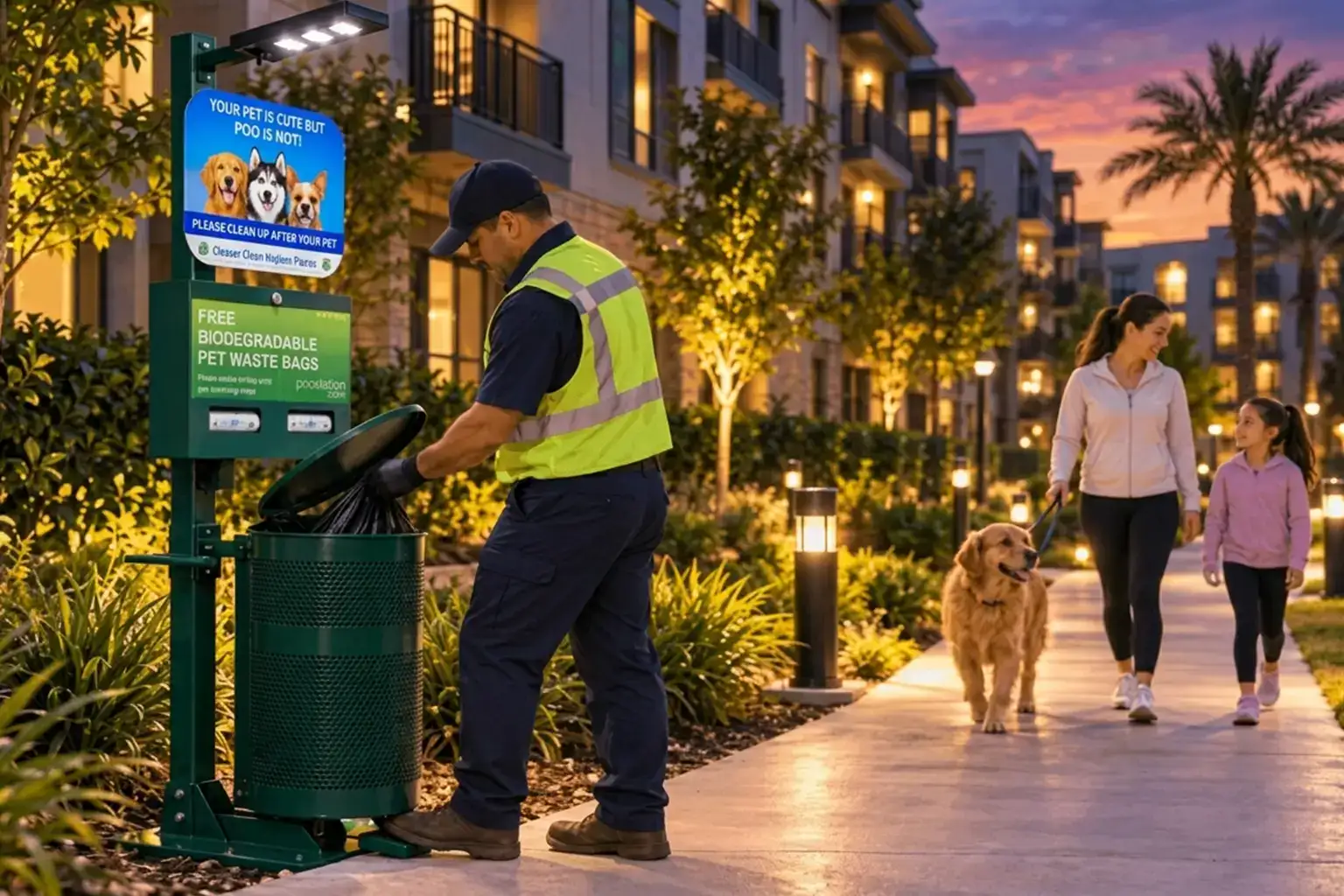
That was one of the questions behind PooStation, designed with a 1,200-bag dispenser and a 20-gallon waste receptacle. The larger lesson applies to almost any frequently serviced amenity: capacity should be evaluated as part of the labor equation, not simply as a product feature.
Put the Labor Cost on Paper
The difference becomes clearer when the service routine is translated into time.
Consider an illustrative community operating 20 pet waste stations. Assume its existing 400-bag stations are serviced three times per week. Now assume a higher-capacity configuration allows the schedule to fall to an average of 1.5 visits per station per week.
This is not a promise of savings or a field-performance claim. Actual results will vary by property. It is a model showing what a change in service frequency can mean.
At three visits per week, 20 stations generate 3,120 station visits annually. At 1.5 visits per week, they generate 1,560. The difference is 1,560 avoided visits each year.
If servicing a station takes an average of 7.5 minutes and moving between stations adds another two minutes, each avoided visit represents approximately 9.5 minutes of labor and travel time.
Multiply 1,560 avoided visits by 9.5 minutes and the result is 14,820 minutes, or 247 hours, annually.
The U.S. Bureau of Labor Statistics reports that the median hourly wage for grounds maintenance workers was $19.27 in May 2025. At that wage, 247 hours represents approximately $4,760 in direct labor time each year.
That is before payroll taxes, benefits, supervision, vehicles, fuel, equipment or other overhead.
The point is not that every 20-station property will save $4,760. It will not. The point is that a seemingly minor specification can create hundreds of hours of recurring activity, and the financial impact may be far larger than the difference between two purchase prices.
The station is a one-time purchase. Bags, liners and labor are recurring expenses.
Design for the Person Who Maintains It
Capacity is only one part of the operating equation.
The maintenance employee who will service a product for years may receive far less consideration than the purchaser or end user. How easily does it open? Are replacement supplies simple to load? Can components be accessed without unnecessary disassembly? Are locks, hinges and fasteners appropriate for repeated outdoor use? Can staff quickly determine whether supplies need replenishment?
Small inconveniences become meaningful when repeated hundreds or thousands of times.
Commercial construction teams routinely discuss maintainability when evaluating major equipment. Smaller site amenities deserve the same discipline. A product that costs less initially but adds minutes to every service visit may ultimately be the more expensive choice.
Accessibility Should Be Designed In
Pet-friendly properties serve people with different levels of mobility. A resident using a wheelchair, a person with limited balance or someone who cannot comfortably operate a conventional lid should not face an unnecessary barrier when using a community amenity.
For PooStation, that led to both hand and foot operation. But the broader question matters more than one mechanism.
Teams should consider how an amenity is approached, whether controls can be reached, how it is operated, what surface surrounds it and whether placement creates an unintended obstacle.
A product can technically be present and still be inconvenient to use.
Nighttime Use Is Still Use
Exterior amenities are sometimes specified as though they will only be used during daylight. Properties do not operate that way.
Residents walk dogs before sunrise and after dark. Hotel guests arrive at different hours. Campground visitors move through sites at night. Mixed-use developments remain active beyond the traditional workday.
If an amenity is intended to support behavior, people need to be able to find and use it when that behavior occurs.
That is why integrated LED lighting became part of our design. The broader principle is simple: nighttime conditions should be considered when selecting locations and specifications.
Placement Can Matter as Much as the Product
Even a well-designed product can fail when installed in the wrong place.
A pet waste station placed away from normal walking routes may be ignored. One that maintenance staff cannot reach efficiently may increase service time. A station added after landscaping and hardscape are complete may be forced into whatever space remains rather than where it would function best.
Architects, landscape architects, developers and property operators can evaluate pet infrastructure alongside pedestrian circulation, lighting, landscaping, accessibility and service access instead of treating it as a final accessory.
The later an operating need is considered, the fewer good options remain.
Question the Familiar Specification
“This is what we always specify” can be one of the most expensive sentences in construction.
A familiar product has advantages: an established supplier, known price and standard detail. But familiarity does not mean the specification still reflects current labor costs, user expectations or property operations.
When we began examining the conventional pet waste station, we asked basic questions. Why does the dispenser hold this number of bags? How often does someone refill it? What happens at night? How does someone with limited mobility use it? How large is the waste receptacle? Can servicing be simplified?
Those questions influenced our design, but the process applies far beyond pet infrastructure.
Innovation often begins by questioning specifications that have become invisible because everyone is accustomed to them.
Purchase Price Is Only the Beginning
None of this means the more expensive product is automatically the better product. It means purchase price should not be evaluated in isolation.
For frequently serviced amenities, teams can ask: How often will this require attention? How long does each visit take? How far must employees travel to service it? What consumables are required? What components are likely to wear? How many units will the property operate?
Those questions turn a product comparison into a lifecycle-cost discussion.
The same analysis applies to waste receptacles, dispensers, outdoor fixtures, site furniture and dozens of products that receive little attention during construction but years of attention after occupancy.
The Small Decisions Stay With the Building
When construction is complete, the project team eventually leaves.
The specifications stay.
Property managers, maintenance teams, residents and guests live with those decisions every day. Some of the smallest products on a site may be touched, opened, emptied, replenished or cleaned thousands of times during their service life.
The goal is not to overengineer every amenity. It is to recognize when a seemingly minor purchasing decision creates a recurring operational obligation.
Lifecycle performance is already part of the conversation around major building systems. Applying the same thinking to smaller specifications can reveal costs that are otherwise easy to miss.
Because sometimes the item that barely registers in the construction budget is the one the maintenance team will still be dealing with every Monday morning years after the project is finished.
By Avi Kosch, Founder & CEO, NEXGEN DNA, Inc.

Image Courtesy of NEXGEN DNA, Inc. / PooStation