COMING FALL 2026 THE FUTURE OF PET WASTE STATIONS Now Accepting Pre-Order and Distributor Inquiries


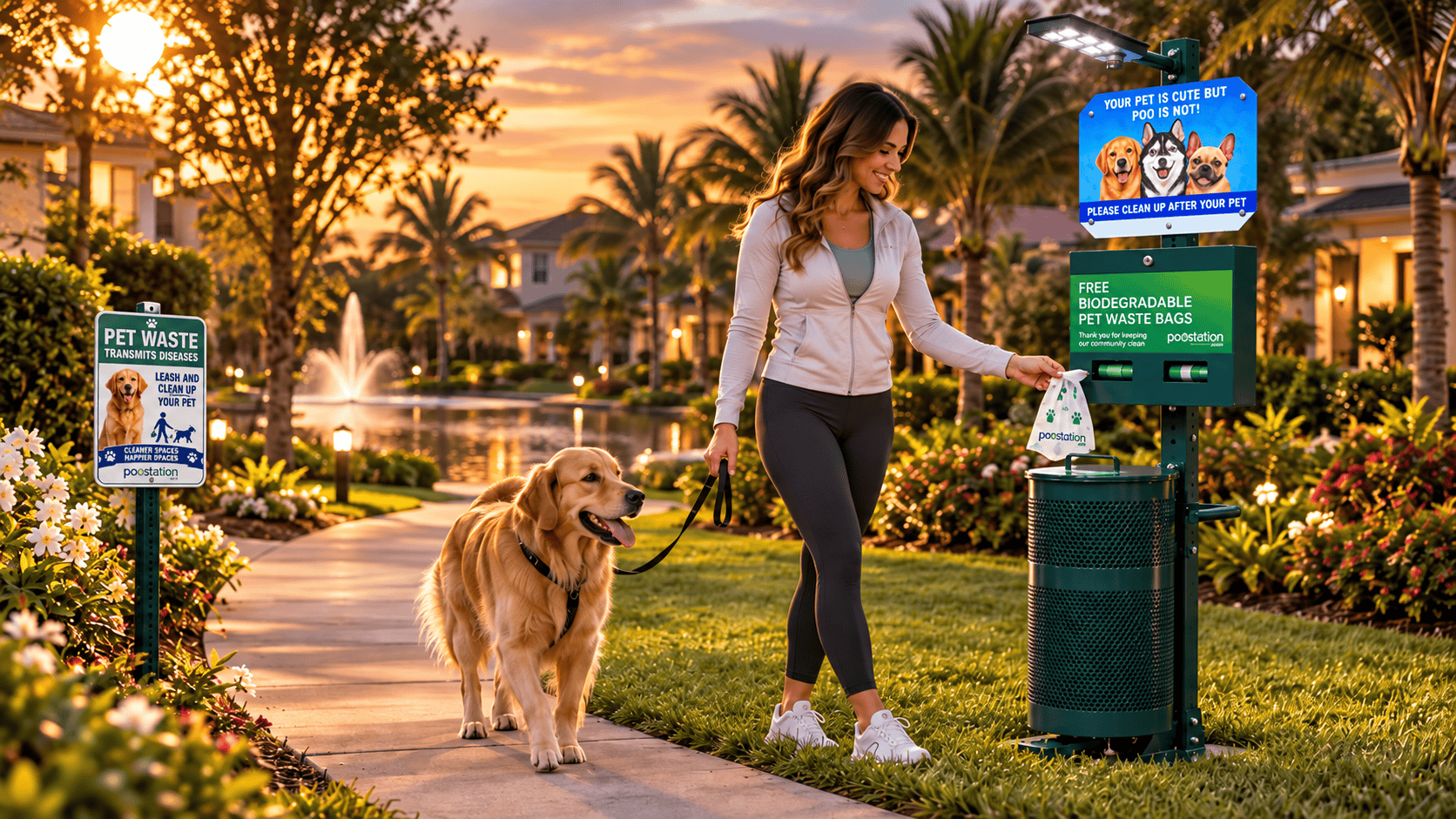

There is a familiar sequence of events in almost every pet-friendly community. Someone doesn’t pick up after a dog. A resident complains, management sends an email, a reminder goes into the community newsletter and another sign appears on the lawn. Eventually, someone suggests cameras, stronger enforcement or higher fines.
The instinct is understandable. Rules matter, and people who share a community have responsibilities to one another. But somewhere between the first complaint and the next warning sign, I think we often skip an important question: How easy have we made it for people to do the right thing?
That question reaches far beyond pet waste. Behavioral researchers have spent years studying the gap between what people know they should do and what they actually do. One recurring lesson is surprisingly simple: reducing friction can change behavior. The Behavioural Insights Team summarizes one of its core principles as “Make it easy,” while the Organisation for Economic Co-operation and Development has examined how seemingly small obstacles, sometimes called friction costs, can discourage otherwise desirable actions.
For HOAs, apartment communities, municipalities, parks, senior-living communities and other pet-friendly properties, that suggests a different way of looking at an old problem. Perhaps the first response to irresponsible pet-waste behavior shouldn’t always be stronger enforcement. Perhaps it should begin with better infrastructure.
The Last 50 Feet Matter
Imagine someone walking a dog through a residential community. The dog stops, and the owner realizes there is no bag in his pocket. The nearest dispenser is several blocks away, or the dispenser directly in front of him is empty. Perhaps he does have a bag and picks up the waste, only to discover there is nowhere nearby to dispose of it. The rule hasn’t changed, and neither has the person’s responsibility. What has changed is the amount of effort required to comply.
Researchers have studied this problem directly. A study published in the Journal of Park and Recreation Administration examined dog-waste behavior in Boulder’s Open Space and Mountain Parks through 541 direct observations at 10 locations and 386 surveys. Among the factors examined, perceived behavioral control—essentially whether people felt capable of easily performing the desired behavior—was the factor most strongly associated with the intention to dispose of dog waste properly.
Just as importantly, many respondents said additional receptacles and bag dispensers along trails would make them more likely to follow recommended disposal practices. The researchers ultimately recommended considering additional receptacles and bag dispensers at strategic locations. That moves the conversation beyond intuition: convenience doesn’t excuse irresponsible behavior, but the evidence suggests that convenience can influence responsible behavior.
A Sign Cannot Dispense a Bag
Communities need rules. Signs communicate expectations, fines establish consequences and resident education can explain why picking up after a pet matters. But none of those things can dispense a bag to someone who doesn’t have one, and a warning sign cannot provide a receptacle when someone is carrying a used bag hundreds of feet from the nearest trash can.
This is where infrastructure and enforcement should stop being treated as competing ideas. They should work together. The U.S. Environmental Protection Agency identifies improperly disposed pet waste as a source of nitrogen, phosphorus, parasites and bacteria that can reach waterways through stormwater runoff. The objective, therefore, isn’t to issue the greatest number of fines. It is to have less dog waste left on the ground—and those are not necessarily the same thing.
According to the American Pet Products Association’s 2026 Dog Report, approximately 71 million U.S. households own a dog, representing roughly 53 percent of American households. For developers and property managers, pet infrastructure can no longer be viewed as an obscure amenity serving a small group of residents.
Dogs are part of the daily traffic pattern of modern communities. Residents walk them before work, after dinner and throughout common areas, parks, sidewalks and trails. The infrastructure supporting that activity deserves more thought than a pole, a small box of bags and a garbage can placed wherever installation happens to be easiest. Location, capacity, visibility, accessibility and reliability all matter, because a conveniently located dispenser that is constantly empty isn’t convenient at all.
Convenience Has to Include Reliability
This is one of the reasons capacity became so important to me when we developed PooStation. Traditional commercial pet waste stations commonly hold approximately 400 bags. PooStation was designed to hold approximately 1,200 bags—three times that capacity. That isn’t simply a larger number for a specification sheet. It creates a substantial reserve between replenishment cycles and reduces the likelihood that a resident reaches a station precisely when the one thing needed to comply—a bag—is unavailable.
We paired that capacity with a 20-gallon covered waste receptacle, substantially larger than the 10- to 12-gallon receptacles commonly found on traditional stations. Again, the purpose isn’t size for the sake of size. If communities want people to use infrastructure, that infrastructure has to be ready when people need it.
That same philosophy extends through the rest of PooStation’s design. A hands-free foot pedal gives someone holding a leash another way to open the receptacle, while an accessible hand lever provides an alternative means of operation. The EMPTY indicator makes bag status visible, integrated LED lighting improves nighttime visibility, and the self-locking access door automatically secures when closed, eliminating another step from the maintenance process.
Individually, these may seem like small details. Collectively, they represent a design philosophy centered on reducing friction for both the dog owner and the person responsible for maintaining the station.
Accessibility Is Part of Convenience
There is another reason communities should be careful about defining convenience too narrowly: convenient for whom?
The Centers for Disease Control and Prevention reports that more than one in four U.S. adults has some type of disability. A person may be walking a dog while using a cane, have limited hand strength or mobility, or simply find a conventional motion more difficult than another resident would. Someone else may be controlling a leash while pushing a stroller or carrying something in the other hand.
Good design doesn’t need to know which person will arrive next. It should provide reasonable options. That’s why I believe accessibility and convenience belong in the same conversation. Foot-operated and accessible hand-operated options, good lighting, thoughtful placement and ease of disposal all contribute to whether infrastructure works for the people expected to use it.
Before Adding Another Rule, Audit the Friction
There is a practical exercise every property manager, board member or parks director can perform: walk the property as though you were walking a dog. Look at where dogs are actually being walked and consider the distance to the nearest station, whether it is visible after dark, whether the dispenser is stocked and whether the receptacle is full. Try operating the station while controlling a leash. Consider whether an older resident or someone with limited mobility could reasonably use it.
That is essentially a friction audit. Governments and behavioral-science researchers increasingly examine unnecessary friction—or “sludge”—because seemingly minor obstacles can materially affect whether people complete a desired action. There is no reason property operations shouldn’t apply the same thinking. Sometimes a behavior problem really is a behavior problem; sometimes it is partly a design problem. Knowing the difference can save a community considerable frustration.
Convenience and Enforcement Are Not Enemies
None of this means abandoning enforcement. There will always be someone who walks past a fully stocked dispenser, ignores a nearby receptacle and leaves waste behind anyway. Infrastructure cannot eliminate irresponsibility. Rules, education, social expectations and consequences all have a role when someone repeatedly refuses to follow community standards.
But enforcement should address the person who won’t comply—not compensate for a system that makes it unnecessarily difficult for everyone else to comply.
A well-designed pet-waste program makes the responsible choice straightforward. Stations are located where people need them, bags are available, receptacles have sufficient capacity, equipment is visible and easy to operate, and maintenance keeps everything ready for the next person. The community then communicates a clear expectation that residents use what has been provided. Only after those pieces are working properly should management conclude that the remaining problem is purely one of enforcement.
The Better Question
When we started developing PooStation, I didn’t want to build another version of a product that had existed for decades and simply change its appearance. I wanted to reconsider the experience from both sides of the station: what the dog owner needs, what the maintenance worker needs, what causes a dispenser to fail when someone needs it, what creates unnecessary service visits and what small obstacles good design could remove.
Those questions led us to higher bag capacity, a larger covered receptacle, hands-free operation, an accessible hand lever, an EMPTY indicator, integrated LED lighting and a self-locking access system. More importantly, they led me to a simple philosophy: Convenience over enforcement.
That doesn’t mean convenience instead of responsibility, rules or accountability. It means convenience before enforcement. Before a community spends more time figuring out how to catch the person doing the wrong thing, it is worth asking whether it has done enough to help more people do the right thing.
Because sometimes a cleaner community begins with something remarkably simple: making responsible behavior the easiest behavior.
Cleaner Spaces. Happier Places.™
Sources
Journal of Park and Recreation Administration — Amelia B. Romo, B. Derrick Taff, Ben Lawhon, Deonne VanderWoude, Peter Newman, Alan Graefe and Forrest Schwartz, Dog Owners’ Perceptions and Behaviors Related to the Disposal of Pet Waste in City of Boulder Open Space and Mountain Parks, Vol. 37, No. 2, 2019. The study included 541 direct observations and 386 surveys examining behavioral factors and potential management techniques affecting proper pet-waste disposal.
Organisation for Economic Co-operation and Development (OECD) — Tools and Ethics for Applied Behavioural Insights: The BASIC Toolkit, 2019; and OECD research examining friction and “sludge” in public systems and services.
The Behavioural Insights Team — EAST: Four Simple Ways to Apply Behavioural Insights. The framework identifies making desired behaviors “Easy” as a central principle of behavioral intervention.
U.S. Environmental Protection Agency — Sources and Solutions: In and Around the Home and Stormwater Best Management Practice: Pet Waste Management. EPA identifies improperly managed pet waste as a potential source of nutrients, parasites and bacteria in waterways.
American Pet Products Association — 2026 Dog Report / 2025 National Pet Owners Survey. APPA reports approximately 71 million U.S. households own dogs, representing approximately 53 percent of U.S. households.
Centers for Disease Control and Prevention — Disability Impacts All of Us. CDC reports that more than one in four U.S. adults has some type of disability.
About the Author
 | Avi Kosch is the Founder and CEO of NEXGEN DNA, Inc., the parent company of PooStation. Drawing on decades of experience in hospitality, property operations and product development, Kosch created PooStation after looking at the traditional commercial pet waste station not simply as a product to replicate, but as a system that could be reconsidered from the perspectives of residents, maintenance teams and property operators. His approach to PooStation centers on a straightforward principle: better design should make responsible pet ownership easier while helping communities reduce maintenance burdens and create cleaner, more accessible shared spaces. |