COMING FALL 2026 THE FUTURE OF PET WASTE STATIONS Now Accepting Pre-Order and Distributor Inquiries

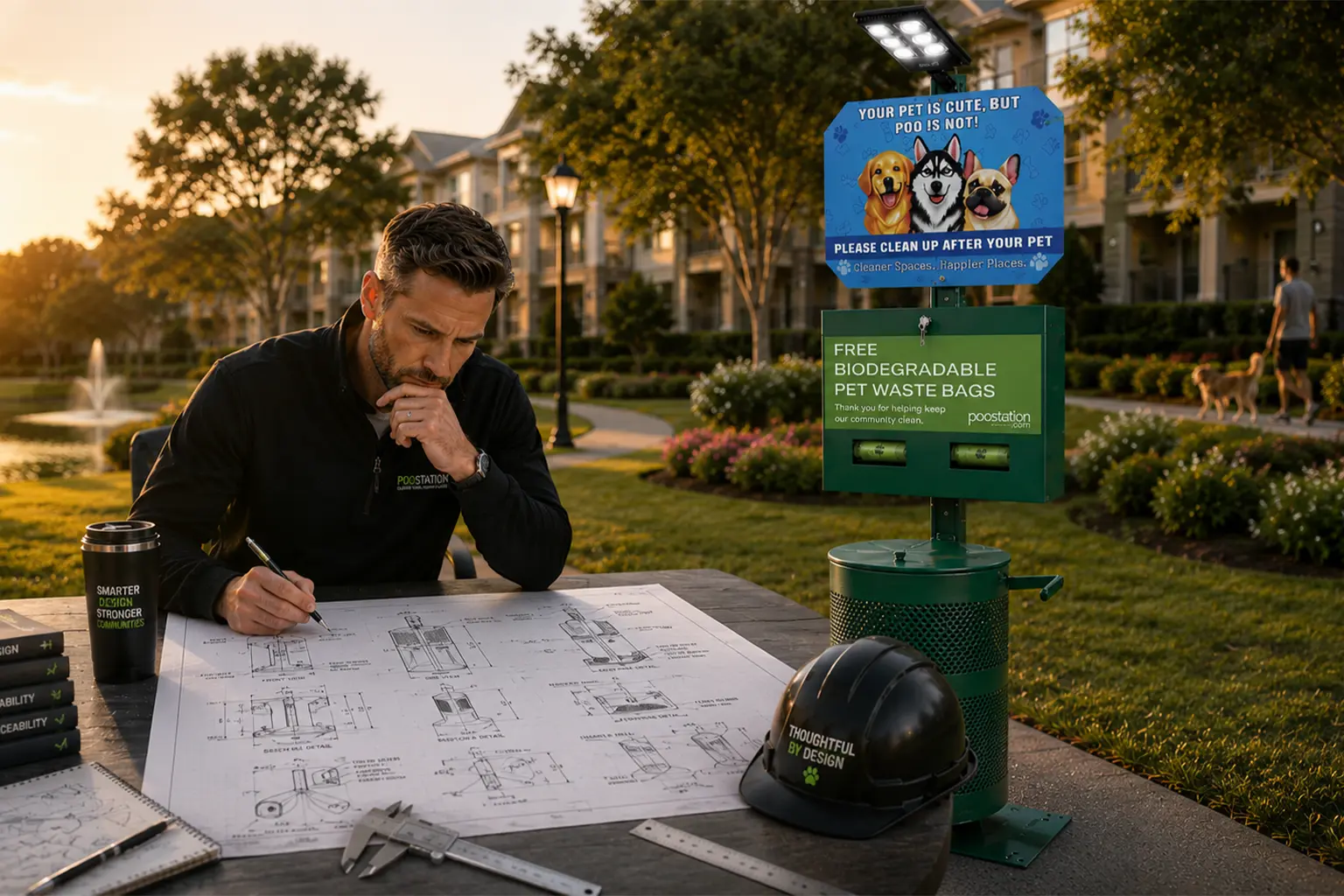

How thoughtful engineering can improve sanitation, maintenance, and everyday usability in commercial pet waste stations.
Every pet owner has experienced it.
You approach a commercial pet waste station, pull out a bag, clean up after your dog, and continue your walk. Like most people, you probably never think about how many hands have touched the station before you or how the equipment is maintained behind the scenes.
Maintenance professionals experience something very different.
They unlock the station, remove a full waste liner, install a new one, refill the bag dispenser, secure the access panels, and move on to the next location. They repeat this process dozens, sometimes hundreds, of times each month across apartment communities, homeowner associations, parks, municipalities, and commercial properties.
Although these two experiences are very different, they are connected by one important factor.
Design.
Small engineering decisions influence how sanitary a commercial pet waste station feels, how efficiently it can be serviced, and how convenient it is for residents to use every day. These details rarely appear in product brochures, yet they often determine whether a station consistently performs the job it was designed to do.
Good design should not simply hold bags and collect waste.
It should make every interaction cleaner, easier, and more intuitive.
Better Hygiene Begins with Better Design
Sanitation starts long before a maintenance professional empties the receptacle.
It begins with the engineering.
Public health organizations have long encouraged reducing unnecessary contact with frequently touched surfaces whenever practical while emphasizing proper hand hygiene after handling pet waste. Regular cleaning remains essential, but thoughtful design can help support cleaner everyday use.
One of the simplest examples is separating the bag dispenser from the waste receptacle itself.
Residents should be able to retrieve a pet waste bag without touching the lid or reaching near the waste container whenever possible. That seemingly minor design decision creates a cleaner and more comfortable user experience.
Good engineering continually asks a simple question.
Can this interaction be made cleaner?
More often than not, the answer is yes.
The Maintenance Route
Imagine a maintenance technician beginning the day’s route through a large apartment community.
Before most residents leave for work, dozens of community amenities require attention. Trash receptacles are emptied. Walkways are inspected. Common areas are cleaned. Pet waste stations are serviced.
At one station, the technician unlocks the cabinet, opens the receptacle, removes a full liner, installs a new one, refills the bag dispenser, secures the access door, and continues to the next location.
Five minutes later, the same process begins again.
Then again.
Then again.
By the end of the morning, those seemingly small movements—lifting, reaching, bending, twisting, unlocking, holding, replacing, and securing—have been repeated dozens of times.
Individually, none of these actions seems significant.
Collectively, they define the maintenance experience.
Human factors engineering and ergonomics research have consistently demonstrated that reducing repetitive motions and simplifying routine tasks improves both efficiency and usability. Good product design removes unnecessary work rather than expecting people to work around poor design.
That philosophy applies just as much to commercial pet waste stations as it does to any other frequently serviced equipment.
Thoughtful Engineering Makes Maintenance Easier
Maintenance professionals are perhaps the most overlooked users of a commercial dog waste station.
Residents interact with the station for only a few moments.
Maintenance personnel interact with it hundreds of times each year.
Every unnecessary motion becomes another repetitive task.
Every awkward movement becomes another opportunity for fatigue.
A foot-operated opening system, for example, allows a maintenance professional to keep both hands available while removing and replacing a waste liner instead of using one hand to support the lid.
The process becomes smoother.
Cleaner.
More efficient.
Likewise, a self-locking access system simplifies servicing while helping secure the dispenser once maintenance has been completed.
These improvements are not dramatic.
Most residents will never notice them.
Maintenance professionals almost certainly will.
The best engineering often solves problems people never realize existed.
Containment Is Part of Cleanliness
Good sanitation extends beyond cleaning schedules.
It also involves thoughtful containment.
Outdoor pet waste stations operate in rain, humidity, wind, heat, and changing environmental conditions throughout the year.
Small refinements in how a receptacle is enclosed can make a meaningful difference in day-to-day operation.
For example, designing a lid with additional overlap around the receptacle opening creates a more enclosed container, helping shield the opening from rain, wind-blown debris, and direct exposure while contributing to a cleaner overall appearance.
These refinements may appear insignificant during installation.
Over years of routine maintenance, they become part of how well the station performs every day.
Thoughtful engineering is often found in the details that receive the least attention.
Accessibility Improves Every Experience
Accessibility should not be viewed only through the lens of compliance.
It should be viewed as good product design.
Products that require less bending, lifting, twisting, reaching, or unnecessary effort benefit virtually everyone.
Older adults.
Parents pushing strollers.
Residents carrying groceries.
Individuals recovering from temporary injuries.
People living with permanent mobility limitations.
Maintenance professionals servicing multiple stations every day.
Universal design recognizes that products perform best when they accommodate the widest possible range of users.
Communities benefit when outdoor amenities are intuitive, comfortable, and convenient to use.
Small Decisions Create Better Communities
When evaluating a commercial pet waste station, buyers often compare visible specifications.
Bag capacity.
Material thickness.
Warranty.
Appearance.
Price.
Those factors certainly matter.
But many of the design decisions that most influence everyday performance are almost invisible.
Can residents retrieve a bag without unnecessary contact?
Can maintenance professionals replace liners quickly and comfortably?
Can routine servicing become more efficient?
Can the receptacle remain cleaner through better containment?
Can thoughtful engineering improve both sanitation and usability?
These questions rarely appear on a specification sheet.
Yet they often determine how successfully a station performs after installation.
Looking Beyond Features
The best commercial pet waste stations are not defined by the number of features they include.
They are defined by the problems they solve.
Reduce unnecessary contact.
Support cleaner operation.
Simplify maintenance.
Improve ergonomics.
Enhance accessibility.
Increase convenience.
Every engineering decision should have a purpose.
Every feature should solve a real-world operational challenge.
When product development begins with the daily experiences of residents, maintenance professionals, HOA boards, municipalities, parks departments, apartment communities, and property managers, innovation becomes more than adding features.
It becomes solving problems.
Many of these same principles guided the development of PooStation. Rather than beginning with a list of product features, the design process began by observing how commercial pet waste stations were actually used—and where they consistently created frustration. Every engineering decision was intended to make the station cleaner, easier to maintain, more intuitive to operate, and more enjoyable to use.
In our next article, we’ll share the story behind that process—from the earliest observations and sketches to the engineering decisions that ultimately shaped PooStation.
Cleaner Spaces Happier Places™
References
- Centers for Disease Control and Prevention (CDC). Hand hygiene and pet waste handling guidance.
- Occupational Safety and Health Administration (OSHA). Ergonomics and workplace sanitation guidance.
- Principles of Universal Design and inclusive design research.
- Human Factors and Ergonomics research on usability, maintenance, and product design.