COMING FALL 2026 THE FUTURE OF PET WASTE STATIONS Now Accepting Pre-Order and Distributor Inquiries


Why the Best Communities Prepare for Tomorrow Instead of Reacting to Yesterday
By late Friday afternoon, the community appears ready for the long Memorial Day weekend. The pool has been serviced, the grounds have been landscaped, common areas have been cleaned, and the maintenance team has completed one last walkthrough before the holiday begins. For most residents, it will simply feel like another beautiful weekend.
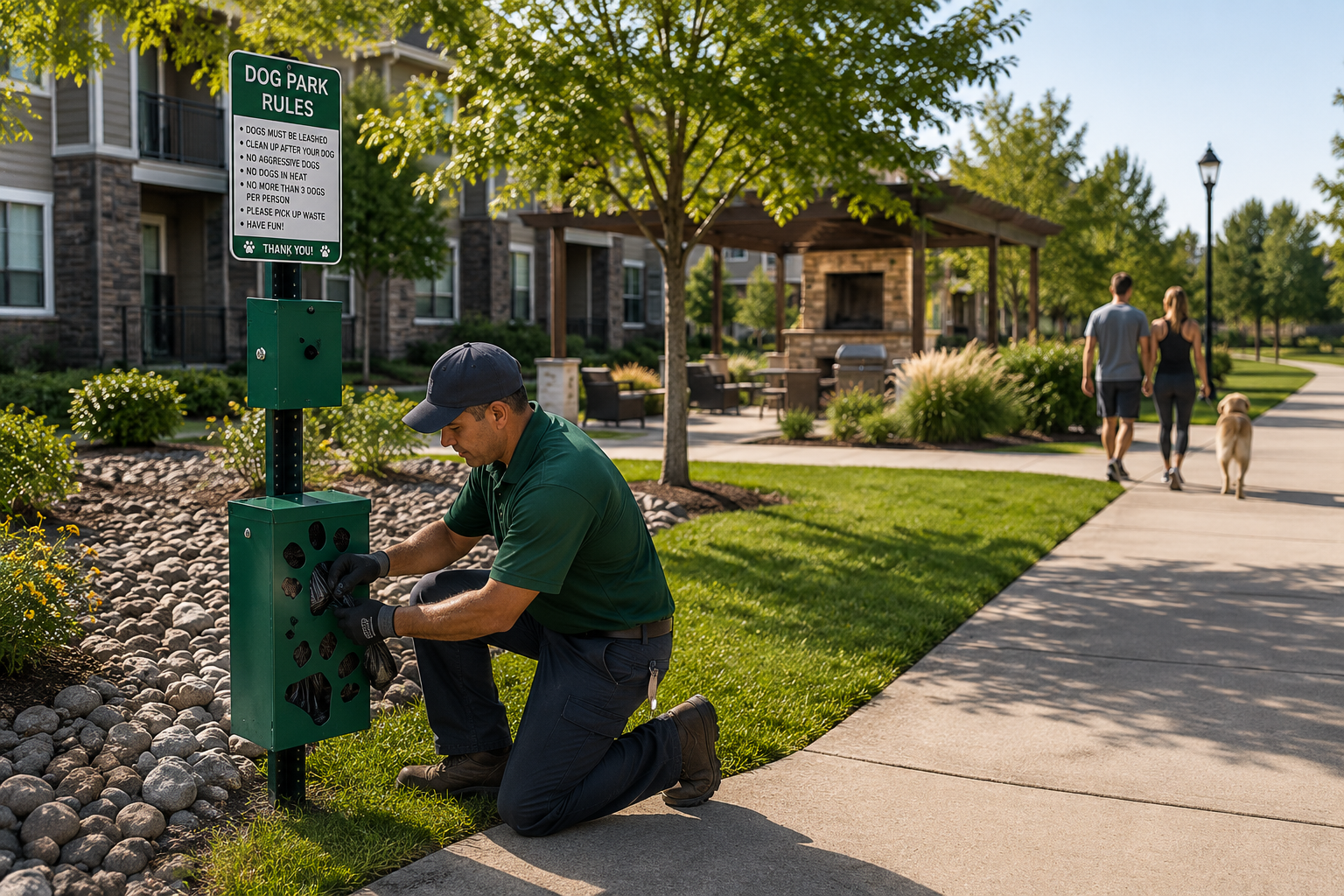
During that final inspection, a maintenance supervisor stops at one of the property’s pet waste stations. Opening the dispenser, he notices something that most people would overlook. The roll of bags is not empty. In fact, there are probably enough bags to last several more days.
On an ordinary week, he would close the dispenser and continue with the rest of his route.
But this is not an ordinary week.
Holiday weekends change the rhythm of a community. More residents stay home. Families spend additional time outdoors. Guests visit. Dogs are walked more frequently, often throughout the day instead of only before and after work. What would normally be an adequate supply may no longer be enough.
Without hesitation, he removes the partially used roll, replaces it with a full one, and returns the remaining bags to inventory to be used at another station later. Nothing is wasted. Nothing is broken. No resident requested service.
He simply recognized tomorrow before tomorrow arrived.
That quiet decision illustrates something fundamental about professional maintenance. The best maintenance programs are not defined by how quickly they respond after something goes wrong. They are defined by how often thoughtful preparation prevents problems from occurring in the first place.
Great maintenance is not simply reactive. Great maintenance begins with foresight.
Ironically, the highest compliment a maintenance department can receive is often silence.
Residents rarely notice that every light turned on at dusk, that irrigation operated exactly as scheduled, or that every amenity was clean and ready when they arrived. They seldom think about stocked dispensers, emptied receptacles, functioning elevators, or comfortable clubhouse temperatures. Those conditions simply become part of the expectation of living in a well-managed community.
The International Facility Management Association has observed that success in facilities management is often invisible. When everything functions as expected, few people stop to consider the planning, inspections, scheduling, and countless decisions that made that experience possible. Attention usually comes only when something fails.
An overflowing receptacle attracts attention. An empty dispenser attracts attention. A burned-out light attracts attention. The hundreds of small maintenance decisions that prevented those problems rarely do.
For decades, maintenance organizations have measured performance by response time. How quickly was the repair completed? How rapidly was the service request closed? How soon was the problem corrected?
Those are important measures, but they all begin after the resident has already experienced an interruption.
The more revealing question is different:
What predictable problem never occurred because someone anticipated it?
That shift in thinking changes the role of maintenance from reacting to events to managing risk before it becomes visible.
Of course, no maintenance department can prevent every equipment failure, weather event, plumbing emergency, or unexpected repair. Foresight is not about predicting the future with perfect accuracy. It is about recognizing patterns that repeat themselves and making practical adjustments before those patterns create unnecessary work.
The facilities profession has long recognized this distinction. Guidance from APPA encourages organizations to move as much work as possible from reactive maintenance toward planned and preventive maintenance. The objective is not simply better scheduling. It is to reduce avoidable interruptions, use labor more efficiently, and preserve resources for the problems that genuinely cannot be anticipated.
That last point is often underestimated.
Every unnecessary service call competes with something else that was already scheduled. Time spent responding to a preventable issue is time no longer available for inspections, repairs, preventive maintenance, resident requests, or property improvements.
One interruption may seem insignificant.
Across an entire property—and across an entire year—it rarely is.
Maintenance professionals understand something that residents seldom see. A day’s work is never limited to one responsibility. The same team may oversee HVAC systems, plumbing, electrical repairs, irrigation, lighting, pools, sidewalks, landscaping, inspections, clubhouses, playgrounds, resident work orders, waste collection, and countless unexpected issues that arise without warning.
The challenge is not merely completing every task.
The challenge is deciding which task deserves attention first.
A maintenance calendar provides structure, but it cannot exercise judgment. It can schedule inspections every Monday. It cannot recognize that a holiday weekend, a community event, or seasonal changes in occupancy may require additional preparation before the normal schedule resumes.
Only experienced professionals can make that decision.
That professional judgment is what transforms maintenance from a routine checklist into operational stewardship.
Preventive maintenance should never be static. Service schedules should evolve with occupancy, weather, staffing, equipment condition, seasonal demand, and the consequences of failure. Communities are dynamic environments, and maintenance plans must be equally adaptable.
Federal facility-management guidance similarly emphasizes preventive and predictive maintenance strategies that align maintenance activities with actual operating conditions rather than relying primarily on reactive repairs. While the scale may differ—from federal buildings to residential communities—the underlying principle remains remarkably consistent: maintenance is most effective when it reflects how a property is actually being used.
That is why the maintenance supervisor changed a roll of bags that wasn’t empty.
He wasn’t responding to a failure.
He was responding to changing conditions.
The distinction may appear subtle, but it represents one of the most important differences between routine maintenance and exceptional maintenance.
Preparation rarely attracts attention because successful preparation prevents the very events that would have made it visible.
Residents don’t remember the problems they never experienced. They simply remember a community that always seemed ready.
When maintenance professionals begin thinking this way, something else changes. They stop seeing equipment as something a community merely purchases and begin seeing it as something the maintenance team will live with every day.
The invoice may be approved once. The consequences of that decision can continue for years.
Every fixture placed on a property becomes part of someone’s route, someone’s schedule, and someone’s responsibility. It must be inspected, cleaned, refilled, adjusted, repaired, and eventually replaced. What appears to be a modest purchase can create hundreds—or thousands—of individual interactions over its useful life.
Over time, those interactions become the true cost of the equipment.
That cost is not measured only in replacement parts or repair invoices. It is also measured in minutes: the additional walk across the property, the return trip for supplies, the repeated opening and closing of a compartment, the interruption of another assignment, and the time required to address deterioration that better materials might have prevented.
None of those moments is especially dramatic. That is precisely why they are easy to underestimate.
A few unnecessary minutes rarely affect a single day. Repeated across multiple locations, service routes, and years, however, they begin to shape the workload of an entire maintenance department. The least expensive equipment to purchase can quietly become some of the most demanding equipment to own.
For the people responsible for long-term operations, the more useful question is therefore not simply what an item costs when it is ordered. It is what the item will ask of the property after it arrives.
Will it require constant attention? Will it perform reliably outdoors? Can it be serviced without unnecessary difficulty? Does its capacity reflect the amount of use it is likely to receive? Will it preserve maintenance time, or steadily consume it?
These are not purchasing questions alone. They are questions about stewardship.
Consider something as ordinary as a pet waste station. To most residents, it is a small fixture along a walking path: a dispenser, a receptacle, and a sign. Few would view it as a significant operational decision.
To the employee who services the property, however, that same station represents a recurring obligation. The waste must be removed. The bag supply must be checked and replenished. The exterior must be kept clean. The components must remain functional. The station must continue to look like part of a cared-for community rather than a neglected utility.
Each of those responsibilities is reasonable. The difficulty begins when the design of the equipment causes them to occur more often than necessary.
In many traditional stations, limited dispenser capacity means the bag supply may need to be replenished during nearly every service visit. The receptacle may still have room, the station may still be clean, and no repair may be needed, yet the employee must return with replacement rolls simply because the dispenser cannot hold enough bags to remain stocked between visits.
The task is small. Its repetition is not.
A higher-capacity dispenser changes the rhythm of that work. A station capable of holding approximately 1,200 bags does not eliminate routine inspections, nor should it. The receptacle must still be emptied regularly, cleanliness must still be monitored, and the equipment must still be checked for damage or misuse.
What changes is the need to replenish supplies during every visit.
A maintenance employee can empty the receptacle, inspect the station, confirm that an adequate bag supply remains, and continue along the route. The station is still being maintained. The standard of care has not been reduced. One repetitive requirement simply occurs less often.
That distinction matters because maintenance departments do not begin each morning with unlimited time. Every hour has already been claimed by scheduled work, resident requests, inspections, preventive tasks, and problems that no one could have anticipated.
Time recovered from one station may be measured in minutes. Across a community with several stations, it becomes more meaningful. Across a portfolio of properties and a full year, it can become a substantial amount of labor redirected toward work that requires greater skill, urgency, or judgment.
This is how operational improvement often happens—not through one sweeping change, but through the removal of small inefficiencies that have been accepted for so long that they are no longer questioned.
The same principle extends beyond capacity.
Outdoor equipment lives a difficult life. It is exposed to rain, sunlight, humidity, irrigation, temperature changes, repeated handling, and continuous public use. A finish that deteriorates prematurely does more than diminish appearance. It creates another assignment. A component that is awkward to access does more than frustrate the person servicing it. It adds time to every visit. A design that requires unnecessary bending, reaching, handling, or contact does more than inconvenience employees and residents. It introduces friction into a task that will be repeated for years.
Good design rarely announces itself. It is felt in the absence of difficulty.
A door opens as expected. A liner can be replaced without a struggle. Supplies are accessible. The equipment remains stable. Surfaces withstand the environment. A hand lever or foot pedal allows use without unnecessary contact. An integrated light improves visibility where residents may be walking after dark.
No single feature defines the maintenance experience. Together, they determine whether an asset supports the people responsible for it or becomes another source of avoidable work.
This is why lifecycle thinking matters. It asks a community to look beyond the day equipment is purchased and imagine the years that follow. It recognizes that value can reside in durability, capacity, accessibility, and ease of service just as surely as it resides in the original price.
That does not mean the most expensive option is always the best one. Higher cost is not proof of better design, and complexity is not the same as quality. Lifecycle thinking simply requires a fuller accounting. It asks decision-makers to consider labor, service frequency, reliability, and useful life alongside acquisition cost.
The goal is not to eliminate maintenance. That would be neither possible nor desirable. Regular attention is what keeps communities safe, attractive, and functional.
The goal is to ensure that maintenance time is spent with purpose.
A well-designed asset allows professionals to focus on what needs judgment rather than what requires needless repetition. It gives them more room to inspect, prevent, improve, and respond. It respects the reality that every unnecessary return visit displaces something else.
In that sense, equipment selection becomes part of the maintenance plan long before the equipment is ever installed.
The supervisor preparing for Memorial Day weekend may never have participated in the original purchasing decision. Yet he experiences its consequences each time he opens a dispenser, replaces a liner, checks a component, or returns to retrieve supplies. The person selecting the equipment and the person maintaining it may work in different offices, at different levels of the organization, and sometimes years apart.
Their decisions still meet in the field.
That meeting point deserves greater attention. When boards, property managers, purchasing departments, and maintenance teams evaluate equipment together, the discussion becomes more realistic. Appearance and acquisition cost remain important, but they are joined by practical questions about service, capacity, durability, accessibility, and the way the asset will function within an actual maintenance route.
The result is not simply better equipment. It is a more coherent operation.
By Tuesday morning, the holiday weekend has ended. Residents leave for work. Children return to school. The pool deck is quiet again, and the walking paths settle back into their ordinary weekday rhythm.
The pet waste station remains stocked.
No resident knows that a partially used roll was removed on Friday afternoon. No one knows it was returned to inventory rather than discarded. No emergency call was made. No employee had to interrupt the weekend schedule to refill an empty dispenser.
Nothing happened.
In maintenance, that can be the most meaningful outcome of all.
The supervisor has already turned his attention to another task. The choice he made before the weekend has disappeared into the smooth operation of the property, noticed by no one and experienced by everyone.
That is the quiet achievement of foresight.
It is not simply responding well when yesterday’s problem appears.
It is preparing carefully enough that tomorrow’s problem never has to.
Cleaner Spaces Happier Places™
References
- APPA – Leadership in Educational Facilities. “Chapter 38: Preventive Maintenance,” Facilities Management: A Manual for Plant Administration. Guidance on preventive-maintenance philosophy, scheduling, priorities, economics, staffing, and program controls. https://www1.appa.org/library/more.cfm?biblio_id=729
- International Facility Management Association (IFMA). “Life-cycle cost (LCC)” and “Optimizing Building Management with a Lifecycle Approach.” Guidance defining lifecycle cost and explaining how maintenance and operations shape long-term asset cost and performance. https://knowledgelibrary.ifma.org/glossary/life-cycle-cost-lcc/
- U.S. General Services Administration (GSA). “Building Operations and Maintenance Services.” Federal guidance encouraging preventive, predictive, and reliability-centered maintenance rather than reliance on reactive maintenance. https://www.gsa.gov/governmentwide-initiatives/federal-highperformance-buildings/highperformance-building-clearinghouse/workplace-strategies/project-guidance/building-operations-and-maintenance-services
- AppFolio. “2024 Renter Preferences Report: Data-Backed Insights to Help You Stand Out in a Crowded Market.” Research connecting satisfaction with maintenance to resident retention and recommendations. https://www.appfolio.com/blog/renter-preferences-2024
- National Apartment Association (NAA). “NAA Excellence Awards.” Multifamily-industry examples recognizing preventive preparation, responsive maintenance, transparency, and operational efficiency as foundations of resident satisfaction. https://naahq.org/awards/excellence-awards
- Building Owners and Managers Association International (BOMA International). Industry education and guidance on building operations, asset management, preventive maintenance, and long-term operational performance. https://www.boma.org/
- U.S. Environmental Protection Agency (EPA). “Managing Pet and Wildlife Waste to Prevent Contamination of Drinking Water.” Guidance addressing proper pet-waste management and its relationship to water quality and public health. https://nepis.epa.gov/Exe/ZyPURL.cgi?Dockey=901V1N00.TXT