COMING FALL 2026 THE FUTURE OF PET WASTE STATIONS Now Accepting Pre-Order and Distributor Inquiries

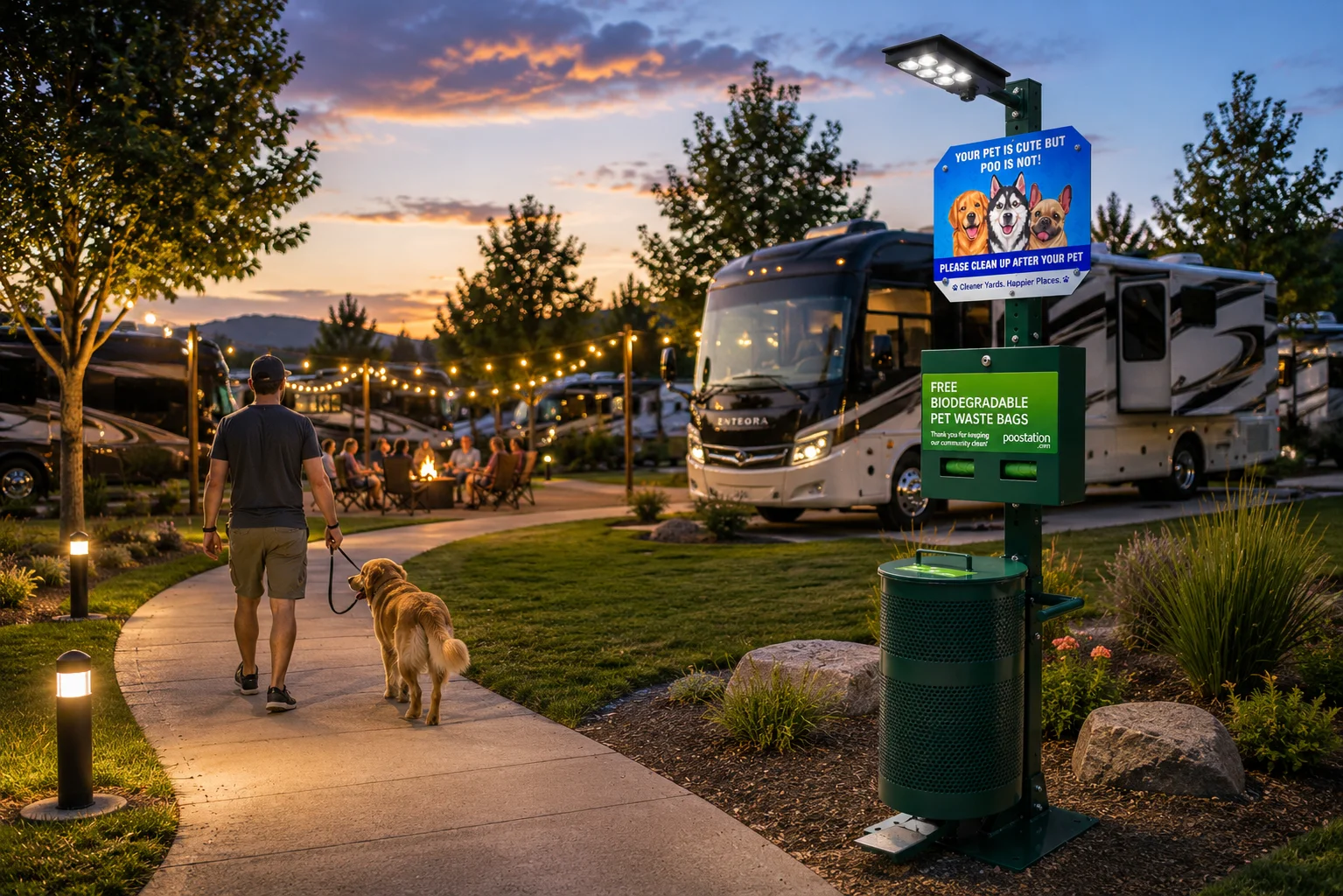

As more campers travel with dogs, outdoor hospitality has an opportunity to rethink what “pet-friendly” really means.
By Avi Koschitzki, Founder & CEO, NEXGEN DNA, Inc.
Somewhere along the way, the American camping trip changed. The RV got bigger and more sophisticated. The campsite got Wi-Fi. Campgrounds added upgraded bathhouses, swimming pools, patios, cabins, organized activities, dog parks and, in some cases, amenities that would have seemed completely out of place at the campground many of us remember from years ago. The industry itself increasingly uses the term outdoor hospitality, and I think that description says a lot about what has happened. These properties aren’t simply providing a place to park anymore. They’re providing an experience.
But while I was looking at this market recently, another change caught my attention. Somewhere during that evolution, another guest climbed into the RV: the dog. According to RV Industry Association reporting based on KOA research, more than 64% of America’s campers now travel with dogs. When KOA began its annual camping surveys in 2012, that number was below 40%. That’s an extraordinary change in a relatively short period of time, and it made me start thinking about what it actually means for the campground operator.
It would be easy to look at that statistic and conclude that campgrounds should allow dogs. The industry has already figured that out. Pet-friendly policies are common, fenced dog parks have become recognizable amenities, and some properties have gone considerably further with private pet areas and premium sites designed around guests traveling with dogs. But I think the more interesting question begins after the campground decides to welcome the dog. If the guest has changed this much, has all of the infrastructure supporting that guest changed with them?
Pet-Friendly Begins After the Dog Gets Out of the RV
Think about what happens after an RV pulls into a campground late in the afternoon. The site gets set up, the chairs come out, maybe somebody starts the grill, kids get on bicycles and neighbors begin talking between sites. That’s one of the things that makes outdoor hospitality different from so many other forms of travel. When evening arrives, everybody doesn’t necessarily disappear behind a hotel-room door. Being outside is part of what they came for, and that can continue well after dark.
Meanwhile, the dog needs to be walked. Maybe the property has invested in a beautiful fenced dog park, but the dog doesn’t teleport from the RV to the dog park. Its owner clips on a leash and walks there, perhaps passing dozens of campsites, roads, cabins and common areas along the way. If the dog does its business halfway there, the questions become remarkably practical. Is there a bag nearby? Where does the tied bag go? How far does someone have to carry it? What happens if the dispenser is empty? And because campground life doesn’t end at sunset, can the guest even find and comfortably use that station later at night?
Those may sound like small details compared with building a swimming pool or adding premium RV sites, but hospitality has always fascinated me because so much of it is built on small details. KOA’s 2026 Camping & Outdoor Hospitality Report says more than 52 million North American households camped in 2025, contributing to an estimated $66 billion economic footprint. Earlier KOA research found that 29% of campers considered whether a campground allowed pets and provided pet areas when choosing where to stay. Interestingly, the same percentage identified clean and well-maintained bathhouses and restrooms as an important consideration.
That comparison caught my attention because I don’t think those two things are as unrelated as they initially appear. A clean restroom and a well-maintained pet area are very different facilities, but they’re both telling the guest essentially the same thing: someone thought about your experience before you arrived. The guest may pull in with an RV instead of checking into a hotel room, but cleanliness, convenience and attention to detail are still part of hospitality.
The Dog Park Is an Amenity. The Walk to It Is Part of the Experience.
Outdoor Hospitality Industry benchmarking has found that 42% of surveyed campground properties offered a fenced pet area. That’s a meaningful indication of how much operators have already adapted to travelers with dogs. But the more I thought about it, the more I realized that focusing only on the dog park can miss what happens everywhere between the campsite and that park.
Dogs are being walked around RV sites, cabins, green spaces, roads and trails. They’re going out first thing in the morning, throughout the day and again before bed. On a large RV resort, those routes can cover a lot of ground. Instead of looking only at where pet amenities appear on a site plan, I think operators can learn a great deal by watching how guests actually move through the property. Where are dogs being walked? Which bag dispensers empty fastest? Where does maintenance repeatedly find pet waste? Which receptacles fill first? What happens along the routes between campsites and pet areas?
And those receptacles raise another practical issue. A pet waste station in a campground probably isn’t going to contain only pet waste. People are outside, congregating, eating and drinking. Put a convenient outdoor receptacle along a well-traveled route and sooner or later a soda can goes into it. Then a water bottle, an ice-cream wrapper, a beer bottle or some miscellaneous campsite trash. Human beings tend to use the garbage can that’s convenient, regardless of what somebody originally intended it to hold. That means waste capacity that looks perfectly adequate on paper may behave very differently on a busy campground weekend.
Nighttime changes the equation as well. Campground guests are often still outside long after sunset, which makes visibility much more relevant here than it might be in another setting. Someone walking a dog at 10 p.m. shouldn’t have to search in the darkness for the place management expects the waste to go. Lighting isn’t simply an aesthetic feature in that situation; it can become part of making the infrastructure usable during the hours guests are actually using the property.
None of this requires an operator to guess. Maintenance teams already see much of it every day. They know which areas need more attention, which receptacles fill quickly and where guests tend to walk. A campground operator can combine those observations with the guest experience and start asking better questions. A campground map shows where the amenities are. The guest shows you whether they’re in the right places.
One campground review we found during our research illustrated the point in a very ordinary way. The guest liked the property overall but described finding numerous piles of dog waste in an otherwise attractive dog park and suggested that the area be checked more regularly. One guest review is obviously not industry research, and I wouldn’t pretend that it is. What it does illustrate is something anyone who has spent time around hospitality understands: building the pet amenity is only the beginning; maintaining the experience is what makes it an amenity.
The Part of Pet-Friendly Hospitality Guests Shouldn’t Have to Think About
Behind every clean campground is a maintenance operation the guest rarely sees. Someone empties receptacles, cleans bathhouses, maintains landscaping, restocks supplies and gets everything ready to do it all again the following day. As campgrounds welcome more dogs, the infrastructure supporting those dogs becomes part of that operation too. That’s why I think pet waste equipment should be considered from both sides of the experience: how easily the guest can use it and how efficiently the property can maintain it.
That thinking is also what influenced the development of PooStation by NEXGEN DNA, Inc. Rather than looking at a pet waste station simply as a post with a bag dispenser and garbage can attached to it, we tried to look at the interaction around it. A campground is a particularly good example. A guest may approach with a leash in one hand and a tied waste bag in the other. PooStation’s foot pedal allows hands-free opening of the covered waste bin, while an accessible hand lever provides another means of operation. The objective isn’t to claim that equipment can turn an irresponsible guest into a responsible one. It can’t. The objective is much simpler: if you want people to do the right thing, don’t make the right thing unnecessarily difficult.
Other features take on different importance when viewed through campground operations. The integrated LED matters when guests remain outside and walk their dogs after dark. A 1,200-bag capacity can reduce refill trips and the likelihood of running out during busy periods, while a visible EMPTY indicator helps both guests and maintenance recognize when bags are gone. And the 20-gallon covered waste bin provides additional operating capacity when real-world use inevitably includes more than pet waste. The goal isn’t to let 20 gallons of dog waste accumulate; it’s to give maintenance some margin when bottles, cans, wrappers and other trash begin sharing the same receptacle.
Those aren’t glamorous parts of outdoor hospitality, but neither is changing a trash liner or restocking a restroom. Some of the most successful hospitality infrastructure is the infrastructure a guest barely notices because it simply works when it’s needed.
The growth in campers traveling with dogs suggests that the industry has already done the hardest part: it recognized that the modern camping party has changed. Moving from fewer than 40% traveling with dogs in 2012 to more than 64% today isn’t a minor shift. It changes how properties are used, where guests walk and what maintenance teams are being asked to support. The next step doesn’t have to mean rebuilding a campground around dogs. It may simply mean looking at the campground through the eyes of the guest who is actually arriving today.
Walk the property after dark. Follow the route from the RV sites to the dog park. Ask maintenance what they’re seeing. Look at what ends up in the receptacles and how quickly they fill on a holiday weekend. Notice whether bags are available where guests actually need them rather than only where they were easiest to install. A small family campground and a 500-site destination RV resort won’t need the same solution, nor should they. But both can ask the same question: are we operating for the guest we used to have, or the guest arriving today?
Because pet-friendly is increasingly more than a checkbox on a reservation website. It’s the guest who chose the property partly because the dog could come. It’s the first walk after the RV is parked, the available bag when someone forgot one, the clean dog park the following morning, the receptacle that isn’t overflowing after a busy Saturday night, the light that makes the station visible after dark, and the maintenance employee who has to make sure the experience is ready to happen again tomorrow.
The American campground has evolved. The RV has evolved. The amenities have evolved. And the traveler has evolved with them. Increasingly, that traveler has a dog walking beside them.
Outdoor hospitality has already opened the gate. Now it’s time to make sure the experience on the other side of it keeps up.
Learn more about PooStation by NEXGEN DNA, Inc. at PooStation.com.
For RV parks, campgrounds and outdoor-hospitality properties looking to rethink how pet waste infrastructure fits into the guest experience, visit PooStation.com to learn more about the next generation of commercial pet waste management.
Cleaner Spaces Happier Places™
Sources
- Kampgrounds of America (KOA) — 2026 Camping & Outdoor Hospitality Report. Research on North American camping participation, outdoor-hospitality trends and the economic footprint of camping.
- RV Industry Association / Go RVing — Research and trend reporting on campers traveling with pets, including the growth in campers traveling with dogs since KOA’s annual surveys began.
- RV Industry Association — 2026 travel-intention research concerning RV travel and traveling with pets.
- Kampgrounds of America (KOA) — North American Camping Report research examining campground-selection considerations, including pet policies, pet areas and campground cleanliness.
- Outdoor Hospitality Industry (OHI) — Campground benchmarking research covering amenities, including fenced pet areas.
- Good Sam — Campground rating guidelines addressing cleanliness, physical condition, maintenance and facility quality.
- Kampgrounds of America guest-review data — Real-world guest feedback concerning pet-area cleanliness and maintenance.