COMING FALL 2026 THE FUTURE OF PET WASTE STATIONS Now Accepting Pre-Order and Distributor Inquiries

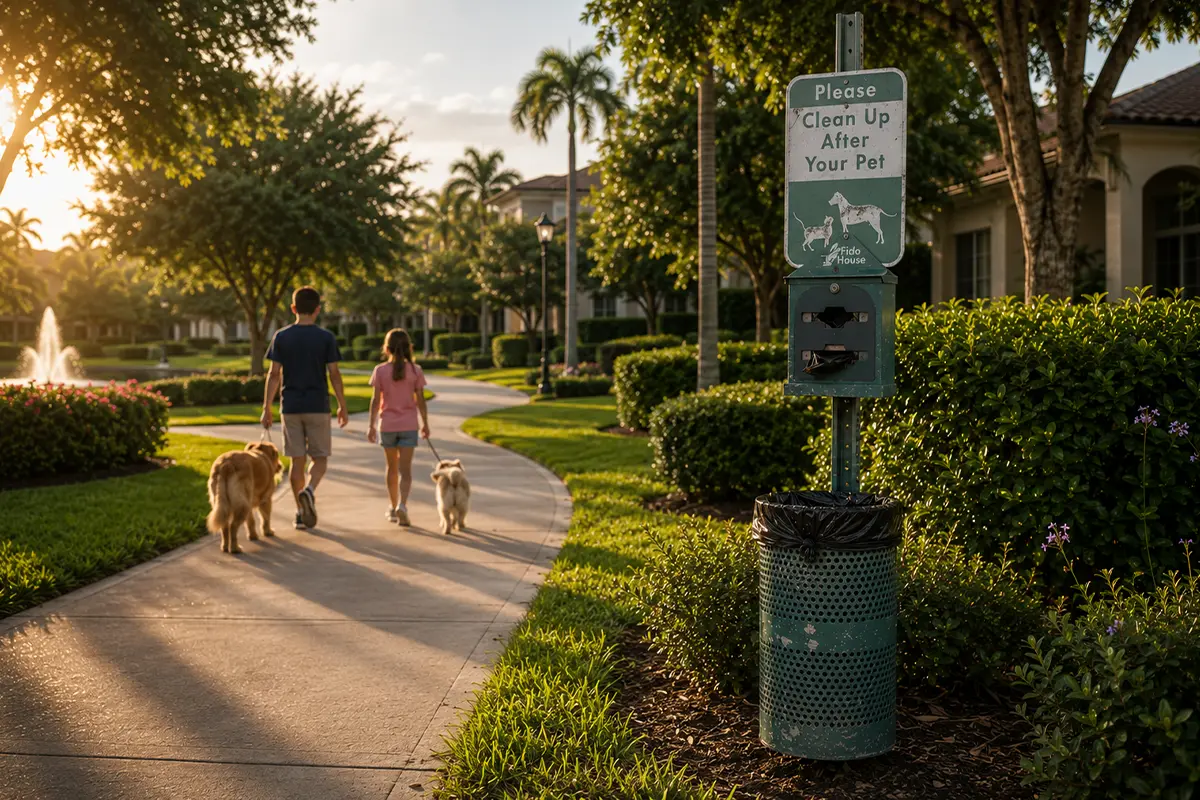

Sometimes the Most Important Signs Aren’t the Ones We Notice First.
Walk through almost any apartment community, condominium property, homeowners association, or municipal park, and you’ll probably pass a commercial pet waste station without giving it much thought. They have become such a familiar part of our shared outdoor spaces that they often disappear into the background. Residents expect bags to be available. Maintenance teams expect to refill them. Property managers expect them to quietly do their job day after day, year after year. Like a park bench, a light fixture, or a community trash receptacle, they are most successful when nobody notices them at all.
When I first began researching this article, I assumed I would be writing about replacement schedules, maintenance costs, and lifecycle planning. Organizations such as the International Facility Management Association (IFMA) have spent decades encouraging facility professionals to evaluate assets based on total lifecycle cost rather than simply their age, and I expected those same principles to apply to commercial pet waste stations. Before opening another research paper, however, I decided to do something much simpler. I took a walk through my own community, not to compare products or manufacturers, but simply to look more carefully at something I had walked past hundreds of times without ever truly examining.
That walk completely changed the direction of this article.
At first glance, every station appeared to be functioning. Residents continued retrieving bags. Waste was still being collected. Dogs continued their daily walks. Nothing suggested an immediate problem. Had I driven past them in a car, I probably would have concluded that every station was doing exactly what it had been designed to do.
The closer I looked, however, the more interesting the story became.
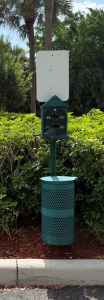
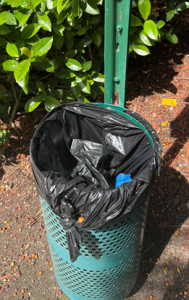
One station had developed significant corrosion around the hinge supporting the waste receptacle lid. Years of exposure to Florida’s heat, humidity, rain, and the repeated stress of opening and closing had slowly begun attacking one of the station’s hardest-working structural components. Another station had lost its lid entirely, leaving the waste receptacle permanently exposed to rainwater, leaves, insects, and other debris. A third looked structurally complete until I noticed that years of ultraviolet exposure had erased nearly every word and graphic from the instructional sign, leaving little more than a blank white panel.What surprised me most was that none of these stations had completely failed.
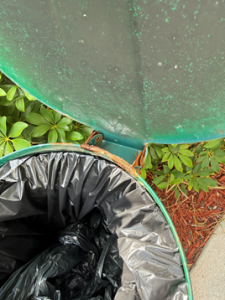
Residents could still retrieve bags. Waste could still be deposited. From a purely functional standpoint, every station technically continued working. Yet each one had quietly lost something that originally made it effective. That realization caused me to stop thinking about equipment failure and begin thinking about something entirely different: how gradual deterioration influences the way people interact with public amenities.
We often assume maintenance is simply about protecting equipment, but in reality, good maintenance protects the user experience. A commercial pet waste station isn’t just a steel structure holding bags and a waste receptacle. It is an invitation for residents to do the right thing. Every part of its design—the visibility of the sign, the accessibility of the dispenser, the ease of opening the receptacle, and the overall appearance of the station—works together to reduce friction and encourage responsible behavior.
When those elements begin deteriorating, the effects extend far beyond the equipment itself.
Consider a waste receptacle that no longer has a lid. While it may still collect pet waste, an open container can become more susceptible to rainwater, unpleasant odors, and flies, particularly during warmer months or between scheduled maintenance visits. For a resident approaching with a dog on a leash, those details matter. Few people are enthusiastic about placing a used waste bag into an open container buzzing with insects. Others may simply continue walking until they find another station. If another station isn’t conveniently located, some may dispose of the bag in a nearby personal garbage can, while others may make poor decisions altogether. The station hasn’t stopped functioning mechanically, but it has become less successful at encouraging the very behavior it was installed to support.
The same principle applies to deteriorating hardware. A heavily rusted lid that must be lifted by hand or a handle that has become difficult to operate introduces hesitation where there should be none. Long-time residents often adapt because they have watched the station age gradually over several years. New residents don’t have that perspective. They don’t compare today’s station to how it looked when it was first installed. They judge it exactly as they find it on the day they move into the community. Their first impression is the only impression they have. That distinction is important because communities are constantly changing. Residents move in and out. New families arrive. Buildings are renovated. Landscaping matures. Clubhouses are modernized. Walking paths are resurfaced. Expectations continue evolving, even when certain amenities remain unchanged. A commercial pet waste station that looked modern ten years ago may now appear neglected, not because it suddenly failed, but because everything around it has continued improving while it quietly aged in place.
Research from the National Recreation and Park Association has consistently shown that visitors associate clean, attractive, and well-maintained amenities with higher-quality public spaces. Likewise, Project for Public Spaces has long emphasized that thoughtful public amenities influence how people behave within shared environments. These findings help explain why appearance matters even when equipment remains technically functional. People naturally gravitate toward amenities that feel clean, accessible, and cared for. Conversely, amenities that appear neglected subtly discourage interaction, even when they continue serving their basic purpose.
Perhaps that was the most valuable lesson from my walk. Every station had aged differently. One exhibited structural deterioration. Another demonstrated mechanical failure. A third illustrated the long-term effects of ultraviolet exposure. None had completely stopped working, yet all had begun drifting away from the level of performance they were originally designed to provide. Their deterioration had become so gradual that it was easy to overlook until I intentionally stopped to examine them.
Facility managers understand this phenomenon well. Few replacement decisions are made because of one broken hinge or one faded sign. Instead, they result from recognizing patterns. Maintenance visits become slightly longer. Repairs become more frequent. Components require increasing attention. The appearance of the equipment begins affecting how residents perceive the surrounding property. Eventually, the combined cost of recurring maintenance, replacement parts, labor, and diminished user experience outweighs the benefits of continuing to repair aging equipment. Facilities Dive has frequently discussed this principle in the broader context of lifecycle asset management: the true cost of ownership extends far beyond the original purchase price.
Commercial pet waste stations deserve the same thoughtful evaluation.
Replacing a station should never be viewed simply as buying newer equipment. It is an investment in maintenance efficiency, resident satisfaction, community appearance, and responsible pet ownership. More importantly, it recognizes that public amenities are successful not merely because they exist, but because people choose to use them.
As I finished my walk, I realized I hadn’t discovered a collection of broken pet waste stations. I had discovered something far more interesting: a series of small changes that had quietly accumulated over time. None demanded immediate attention on their own. Together, however, they told the story of outdoor equipment gradually falling behind the expectations of the communities it served.
Perhaps that’s the better question for every property manager.
Not whether a commercial pet waste station still works.
But whether it still inspires people to use it.
Because when public amenities become easier, cleaner, safer, and more inviting to use, responsible behavior often follows naturally. And sometimes the difference between a clean community and one struggling with pet waste isn’t found in the residents themselves. Sometimes it’s found in the condition of the amenity asking them to do the right thing.
—
Cleaner Spaces Happier Places™
Sources
- International Facility Management Association (IFMA). Resources on lifecycle asset management, preventive maintenance, total cost of ownership, and long-term facility planning.
- Facilities Dive. Articles discussing lifecycle costing, deferred maintenance, repair-versus-replacement strategies, and operational efficiency.
- National Recreation and Park Association (NRPA). Research regarding public expectations for clean, attractive, and well-maintained community amenities.
- Project for Public Spaces (PPS). Publications on human-centered public spaces, environmental design, usability, and community engagement.
- Original Field Observations by the Author. Photographs documenting corrosion, ultraviolet deterioration, structural wear, and aging commercial pet waste stations observed within an active residential community.