COMING FALL 2026 THE FUTURE OF PET WASTE STATIONS Now Accepting Pre-Order and Distributor Inquiries

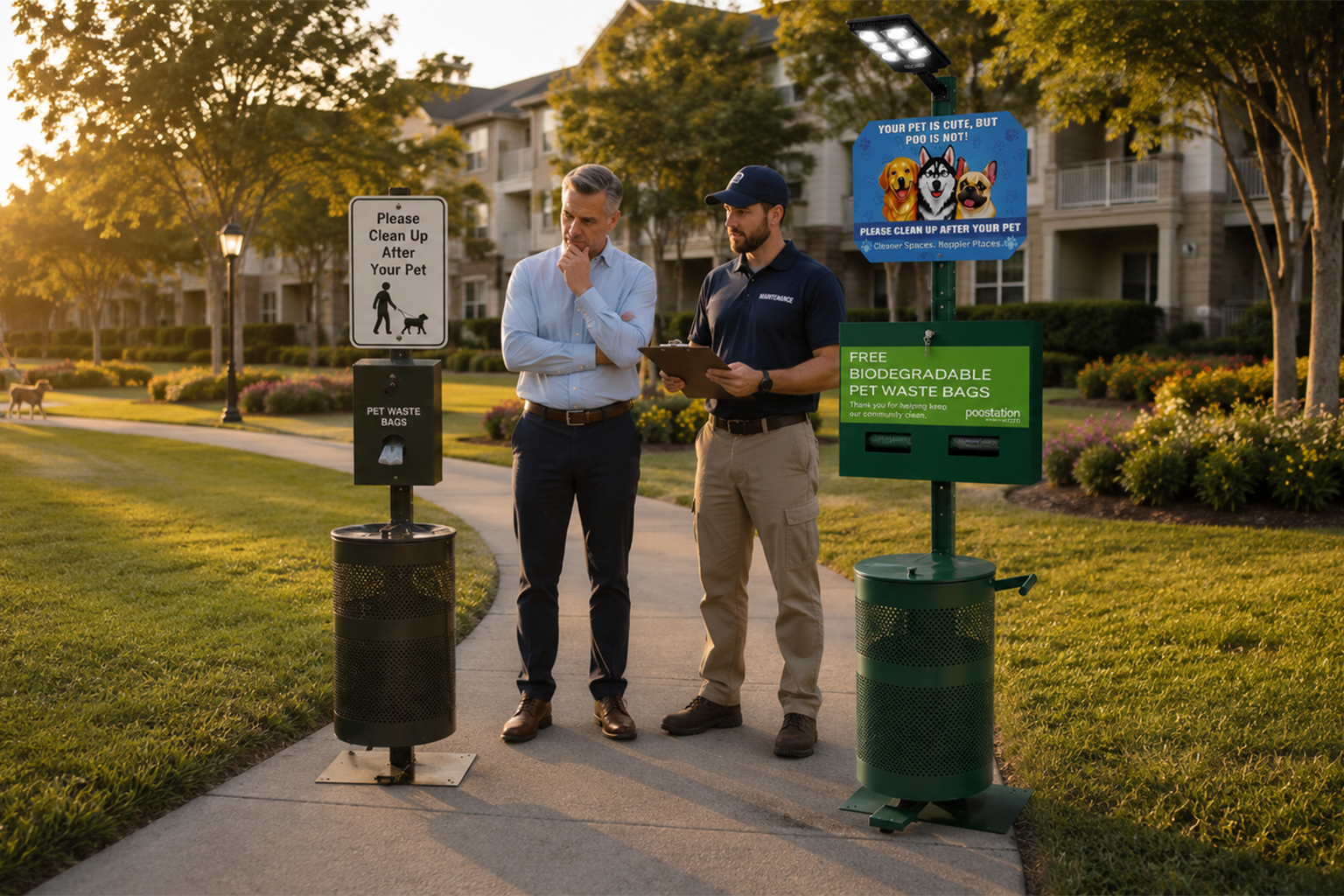

Commercial pet waste stations are no exception.
At first glance, most stations appear to accomplish the same task. They dispense bags, collect pet waste, and encourage responsible pet ownership. Because of that apparent simplicity, many homeowners associations, apartment communities, municipalities, and property managers evaluate them primarily by price, appearance, or a list of specifications.
The real differences emerge long after the purchase order has been signed.
Every commercial pet waste station becomes part of a community’s daily operating system. Bags must remain stocked. Waste must be removed before receptacles overflow. Doors must close properly. Locks must continue working. Components must withstand rain, sunlight, landscaping equipment, repeated handling, and years of outdoor exposure. What initially appears to be a simple amenity quickly becomes an ongoing maintenance responsibility.
The stations that perform best over time are not necessarily those with the longest feature list. They are the ones that continue working reliably after years of routine maintenance and everyday use.
Begin with the Community
Every property is different.
A condominium with one designated pet relief area has very different needs than a large apartment community with multiple walking paths. A municipal park experiences
different traffic than a gated neighborhood. Even within the same property, some locations naturally receive far more use than others.
Choosing the right commercial pet waste station begins by understanding how residents actually use the community rather than selecting equipment from a catalog.
The U.S. Environmental Protection Agency recommends placing pet waste stations equipped with bags and disposal receptacles along common walking routes where they are visible and convenient. The agency also emphasizes that resident education, accessibility, and regular maintenance all work together to encourage responsible disposal habits.
Community Associations Institute guidance reaches a similar conclusion. Its publications recognize pet waste as one of the recurring operational concerns facing community associations and emphasize that convenient disposal options, clear policies, and consistent maintenance are generally more effective than relying solely on enforcement.
These recommendations reflect an important principle: infrastructure should support human behavior rather than expect human behavior to adapt to inconvenient infrastructure.
Capacity Is More Important Than It Appears
Capacity often receives less attention than price, yet it directly influences day-to-day operations.
A lower-capacity bag dispenser serving a busy dog walking route may require far more frequent refilling than expected. When maintenance schedules fall behind, bags disappear, residents lose confidence in the station, and complaints often increase.
The same is true for waste receptacles. When liners reach capacity too quickly, overflowing waste, unpleasant odors, insects, and scattered litter become visible long before maintenance personnel return. The problem quickly becomes a community issue rather than simply a maintenance issue.
The Centers for Disease Control and Prevention advises that pet waste should always be collected and disposed of properly because it can contain bacteria and parasites capable of affecting both people and animals. Their guidance reinforces that dependable disposal systems contribute not only to appearance but also to public health.
Property managers understand that maintenance resources are never unlimited. A station with greater capacity does not eliminate servicing, but it provides additional flexibility during weekends, holidays, staffing shortages, severe weather, or other periods when routine schedules may be interrupted.
When Small Problems Become Large Complaints
Consider a situation familiar to many community managers.
It is Monday morning following a busy weekend. A maintenance technician begins the week’s inspections and discovers that one pet waste station has been out of bags since Saturday afternoon while another has an overflowing receptacle. Before either station can be serviced, several resident emails have already arrived complaining about pet waste throughout the property.
The residents did not suddenly become less responsible.
The infrastructure simply failed to keep pace with demand.
Situations like this illustrate why recurring complaints are often solved more effectively through thoughtful maintenance planning, appropriate capacity, and strategic station placement than through additional reminder notices or stricter enforcement. Communities function best when doing the right thing is also the easiest thing.
Maintenance Reveals the Quality of the Design
A product can appear impressive in a brochure while proving unnecessarily difficult to maintain.
Every maintenance visit follows a sequence. A technician unlocks the dispenser, replenishes bags, replaces the liner, removes waste, secures the receptacle, closes the dispenser, and moves to the next location. Individually these tasks are simple. Repeated hundreds or thousands of times, they become an important operational consideration.
Human Factors Engineering has demonstrated that reducing unnecessary steps improves consistency while reducing opportunities for mistakes. Industries ranging from aviation and healthcare to manufacturing have embraced this principle because they understand that good systems should support human performance rather than rely upon perfection.
Commercial pet waste stations deserve the same philosophy.
When evaluating a station, buyers should ask practical questions. Can bags be replenished quickly? Is the locking system intuitive? Can liners be changed safely? Are components protected against weather and repeated use? Does the design simplify maintenance rather than complicate it?
Thoughtful engineering often removes unnecessary actions instead of adding new features. A self-locking dispenser, for example, automatically secures itself when properly closed, eliminating an additional maintenance step while reducing the likelihood that a dispenser will accidentally remain open.
The best maintenance feature is often the one that quietly eliminates work without anyone noticing.
Durability Is Measured in Years
Outdoor equipment operates in conditions that indoor products never experience.
Sunlight, moisture, temperature changes, landscaping equipment, dirt, salt air, fertilizers, repeated handling, and everyday wear all influence long-term performance. Materials, finishes, hinges, locks, welds, fasteners, and moving components all contribute to how a station performs over time.
Buyers should evaluate whether a commercial dog waste station has been designed for the environment in which it will operate. Coastal communities may prioritize corrosion resistance. High-traffic parks may require stronger construction. Communities exposed to intense sunlight may focus on finish durability and ultraviolet protection.
Purchase price should never be evaluated independently from expected service life. The least expensive station can become the most expensive choice if repairs, replacement parts, repainting, or premature replacement become routine expenses.
Placement Matters
Even the highest-quality commercial pet waste station cannot succeed if residents rarely encounter it.
Stations are generally most effective near dog parks, trail intersections, building entrances, sidewalks, residential clusters, and frequently traveled walking routes. Larger communities often benefit from multiple conveniently located stations rather than one centrally located unit that residents seldom pass.
Visibility also influences participation. Residents should be able to locate stations easily while walking their dogs. At the same time, stations should complement the property’s appearance through thoughtful placement, attractive installation, and professional design.
Convenience encourages compliance.
Ask Better Questions Before Buying
The most productive purchasing discussions move beyond asking, “How much does it cost?”
Property managers and HOA boards should instead ask: How many bags does the station hold? How frequently will it require servicing? How durable are its materials? Can maintenance personnel refill and service it efficiently? Will replacement components be
available years from now? How will it perform after thousands of maintenance cycles rather than simply during installation?
These questions shift the conversation from purchase price to operational performance.
Commercial pet waste stations rarely receive the same attention as clubhouses, pools, or landscaping. Yet their condition sends a clear message about the standards of the community. A stocked, clean, properly maintained station reflects thoughtful management. An empty dispenser or overflowing receptacle communicates neglect almost immediately.
The concepts discussed throughout this article did not originate in a conference room. They developed from years of observing how commercial pet waste stations actually perform in residential communities and asking a simple question: Why do the same maintenance problems continue to occur?
That question ultimately helped shape PooStation.
Rather than beginning with a list of features, PooStation was designed by examining the operational challenges property managers face every day—maintenance efficiency, bag capacity, sanitation, nighttime visibility, durability, and the repeated human interactions that determine whether equipment continues working reliably years after installation. Features such as a 1,200-bag dispenser, 20-gallon waste collection bin, automatic self-locking dispenser, integrated LED safety light, hand lever, and foot-operated opening system were developed to address those real-world operational needs rather than simply add specifications to a brochure.
No single feature determines whether a commercial pet waste station succeeds. Long-term performance comes from understanding how capacity, maintenance, durability, placement, accessibility, visibility, and human behavior work together. When those principles are combined with thoughtful engineering, a pet waste station becomes more than a dispenser and receptacle. It becomes dependable community infrastructure.
That is the standard PooStation was created to deliver.
Cleaner Spaces Happier Places™
References
Centers for Disease Control and Prevention. Dogs: Healthy Pets, Healthy People.
Centers for Disease Control and Prevention. Hygiene Practices Around Animals.
Centers for Disease Control and Prevention. About Zoonotic Diseases Associated with Pets.
Community Associations Institute. Why Scoop the Poop?
Community Associations Institute. Ruff Reality: Five Ways to Resolve Your Pet Waste Problems.
Community Associations Institute. Wag More, Bark Less: Developing Reasonable and Enforceable Pet Policies.
Community Associations Institute, Utah Chapter. Solving the Pet Waste Problem: A Practical Guide for HOAs.
U.S. Environmental Protection Agency. Best Management Practices for Pet Waste Management.