COMING FALL 2026 THE FUTURE OF PET WASTE STATIONS Now Accepting Pre-Order and Distributor Inquiries

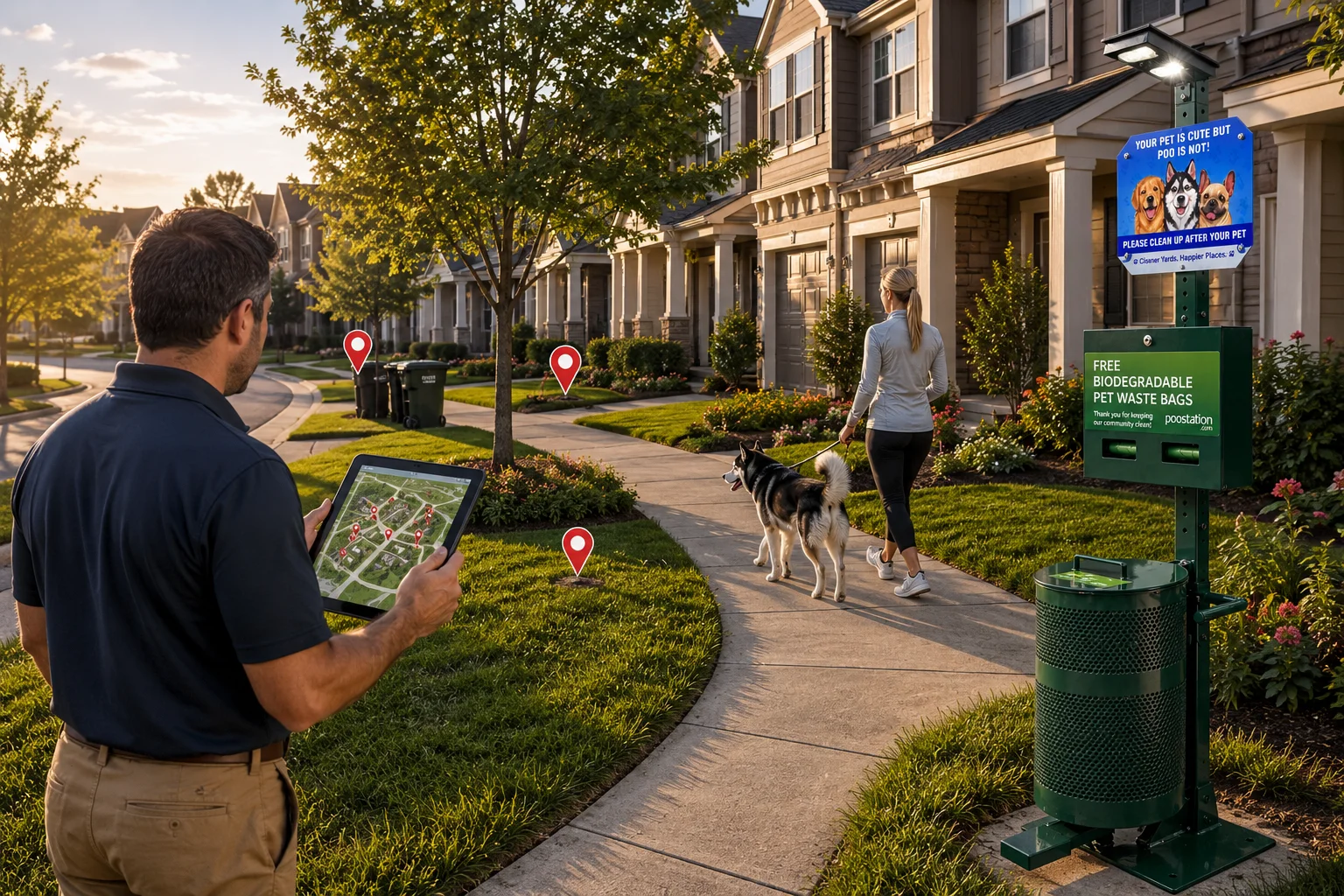

When the same complaint keeps coming back, another reminder may not be the answer.
By Avi Kosch
Founder & CEO
NEXGEN DNA, Inc.
Every few months, a familiar email arrives from the management office at my own residential community. The wording changes, but the message is essentially the same: please clean up after your dog, please use the pet waste stations provided throughout the property, and please do not put pet waste into another resident’s garbage can.
The email is reasonable. Dog owners have a responsibility to clean up after their pets, and living in a community means respecting neighbors and shared spaces. But after receiving versions of the same message repeatedly, I started looking at the email differently.
If management has to keep sending the same reminder about the same problem, perhaps the problem is providing information that the email cannot.
Maybe some residents are simply irresponsible. No amount of planning, equipment or communication will eliminate that entirely. But when the same complaint keeps returning, management no longer has an isolated incident. It has the beginning of a pattern.
And patterns, collected over time, become data.
That distinction matters. Walking a property once and finding dog waste in one location doesn’t tell a property manager very much. It is a snapshot. One resident could have been responsible. A normally stocked dispenser might have temporarily run out. A maintenance schedule might have been interrupted.
The value comes from what happens next. Instead of simply sending another reminder and starting over, what if management began keeping track?
The Property Is Creating a Map
Urban planners have a term for unofficial trails people create when they repeatedly cut across grass rather than following the sidewalk: “desire paths.” Over time, footsteps create a visible record of the difference between where people were expected to walk and where they actually wanted to go.
Residential communities create their own behavioral maps, although they aren’t always as easy to see.
A property manager could mark the location of a pet-waste complaint on a property map. When another complaint arrives, mark that one too. Maintenance finds recurring uncollected waste behind a particular building? Add it. Residents repeatedly report bags being deposited in private garbage cans along one street? Note that. One pet waste station constantly needs bags while another rarely does? That belongs on the map as well.
Then don’t draw a conclusion from Tuesday morning. Keep collecting.
After several weeks or months, look at the map again.
Maybe there is no pattern at all. That is useful information too. But perhaps a cluster begins to appear around one section of the community. Maybe complaints consistently occur along a popular dog-walking route with no nearby station. Perhaps one dispenser repeatedly runs empty because it serves far more residents than management realized, while a station a few hundred yards away is barely used.
One incident is an anecdote. Repeated behavior in the same place is a data point.
Research supports the importance of looking beyond education alone. A Florida study examining pet-waste management identified convenience as a significant barrier to proper disposal and recommended studying where dog waste actually concentrates when determining where disposal containers and bag dispensers should be located. Other research into dog-owner behavior has found that attitudes, social expectations, education and enforcement can also matter. There is no single explanation for every person who fails to clean up after a dog.
That is precisely why management shouldn’t assume it knows the answer before collecting the information.
What Is the Garbage Can Telling You?
The part of my community’s recurring email that caught my attention most was the reminder not to put pet waste into other residents’ garbage cans.
Obviously, that’s inconsiderate. I wouldn’t want someone repeatedly putting tied bags of dog waste into my personal garbage can either. But if the behavior is happening frequently enough to become part of repeated community-wide emails, it is worth asking why.
Maybe the answer is simply poor behavior. But perhaps a resident finishes walking the dog with a tied bag in hand and there is no pet waste station along the route home. Maybe the closest receptacle is inconveniently located or full. Maybe the resident simply sees a garbage can first.
None of those possibilities should be assumed. They should be investigated.
And time matters. If one resident’s garbage can receives a pet-waste bag once, that tells management virtually nothing. If residents on the same street complain repeatedly over several months while uncollected waste is also being reported nearby, the information becomes more meaningful.
That is the difference between reacting to a complaint and learning from complaints.
Research into neighborhood perceptions gives property managers another reason to pay attention. Studies have found that dog fouling can become associated with broader perceptions of neglect and disrespect for shared spaces. A property manager may see an isolated sanitation complaint. A resident can experience it as something larger: Is anyone paying attention to what is happening in my community?
Infrastructure has an interesting characteristic: when it works properly, people barely notice it. Nobody emails management because the pet waste dispenser had a bag available exactly when they needed one. Nobody writes a five-star review because a waste receptacle wasn’t overflowing.
When infrastructure works, it disappears. When it fails, everybody notices.
When the Data Says You Need Another Station
Suppose several months of observations begin showing a pattern. Complaints cluster around one section of the property. Maintenance consistently finds waste there. Residents walking dogs naturally pass through that area, but the closest pet waste station sits somewhere else.
Now management has something much more useful than an assumption.
Perhaps the answer is to relocate an existing station. Perhaps servicing needs to change. Perhaps residents need another reminder or stronger enforcement. Or perhaps the property genuinely needs another pet waste station.
But if the evidence points toward adding one, there is another question worth asking:
Should management automatically buy another copy of what it already has?
Sometimes the answer will be yes. If the existing equipment performs well and the problem is simply coverage, duplicating it may make perfect sense. But the decision to add infrastructure is also an opportunity to reconsider it.
Commercial pet waste stations have traditionally been simple products: a bag dispenser, signage and a waste receptacle attached to a post. If management is already responding to a recurring problem, it can ask whether the station itself creates unnecessary friction.
Does it carry enough bags for the location’s actual traffic? Can maintenance tell when those bags are gone? Is the waste capacity appropriate? Is the receptacle covered? Is it easy to service? Is it accessible to different users? What happens after dark?
And there is an even simpler question: why should a resident have to touch the waste receptacle at all?
Imagine the interaction. One hand may be holding a leash. The other is holding a tied bag of dog waste. The resident reaches a communal receptacle used by hundreds of other people.
That interaction was one of the things we reconsidered when developing PooStation by NEXGEN DNA, Inc.
PooStation incorporates a foot pedal for hands-free opening of its covered waste bin, along with an accessible hand lever so the station doesn’t depend on someone’s ability to operate the pedal. We didn’t design the foot pedal because research told us it would suddenly make irresponsible dog owners responsible. There is no evidence establishing that, and I wouldn’t make that claim.
We designed it because good design should make responsible behavior easier, cleaner and more convenient—not harder.
The same thinking influenced PooStation’s 1,200-bag capacity, covered 20-gallon waste bin and visible EMPTY indicator. Greater bag capacity can reduce refill frequency and the likelihood of a resident encountering an empty dispenser. Additional waste capacity gives maintenance more operational margin before a receptacle reaches practical capacity. The EMPTY indicator lets residents know immediately that bags are gone while allowing maintenance to identify the condition more easily.
None of those features replaces responsible dog ownership. They address friction in the system around it.
The Email Isn’t the Problem
The lesson isn’t that property managers should stop sending reminders. Communication matters. Community rules matter. Enforcement may be necessary. Some people will ignore all three.
The mistake is assuming that because a problem involves resident behavior, resident behavior must be its only cause.
If a dispenser repeatedly runs out of bags, another email doesn’t refill it. If a receptacle continually overflows, another reminder doesn’t increase its capacity. If waste repeatedly appears far from the nearest station, an email doesn’t shorten the distance. And if residents repeatedly choose another place to dispose of tied bags, management should at least become curious about why.
The fifth complaint about the same problem isn’t just another complaint. It’s data.
But only if somebody records it.
Properties don’t need sophisticated technology to begin learning from these patterns. Start with a map. Record complaints and maintenance observations. Date them. Revisit the information periodically rather than drawing conclusions from a single walk-through. Look for clusters, repeated locations and differences in how existing stations are being used.
Then walk the property with the accumulated information in hand.
The worn grass may show where residents actually walk. Maintenance may know which station always empties first. Residents’ complaints may reveal where the system repeatedly fails. A private garbage can receiving pet-waste bags may be an act of inconsideration—or, when the same thing happens repeatedly in the same area, it may point management toward a question worth investigating.
Sometimes residents are breaking a rule. Sometimes they’re showing management where the property’s design and their daily lives don’t quite meet.
The difference becomes easier to see when management stops treating every incident as though it happened in isolation.
So the next time another community-wide pet-waste reminder is being prepared, perhaps it should still be sent. Residents remain responsible for cleaning up after their dogs and respecting their neighbors.
But don’t let the information disappear when the email goes out.
Mark the complaint. Add it to the others. Talk to maintenance. Keep the map. Look at it again in a month or two. Then put on a pair of walking shoes and see whether the pattern on paper matches what is happening on the ground.
Maybe the answer will be another reminder. Maybe it will be enforcement. Maybe servicing needs to change. Maybe a station needs to move or another needs to be added. And if another station is necessary, perhaps that is the moment to ask whether the property wants another version of what it already has—or whether there is an opportunity to make the system better.
Your residents may already be telling you where your property doesn’t work. The question is whether anyone is listening long enough to see the pattern.
Learn more about PooStation by NEXGEN DNA, Inc. at PooStation.com.
Cleaner Spaces Happier Places™
Sources
- Southwest Florida Water Management District — Pet Waste Management: A Review of Issues and Programs. Research addressing convenience, education, disposal infrastructure, field observation and pet-waste behavior.
- Journal of Applied Social Psychology — Observational research examining dog-fouling behavior and differences in attitudes among dog owners who did and did not clean up.
- Applied Environmental Education & Communication — Research examining dog-owner pet-waste collection behavior and factors associated with behavior change.
- Public Health — Systematic review examining interventions intended to reduce dog fouling and limitations in the available evidence.
- Journal of Park and Recreation Administration — Observational and survey research concerning pet-waste disposal behavior in public open-space settings.
- University of Waterloo — Planning research concerning pedestrian desire paths and differences between planned routes and observed human movement.
- Peer-reviewed neighborhood research — Qualitative research examining dog-fouling complaints and their relationship to perceptions of neighborhood neglect and shared-space conditions.
- U.S. Access Board — Accessibility guidance concerning operable parts and accessible operation.