COMING FALL 2026 THE FUTURE OF PET WASTE STATIONS Now Accepting Pre-Order and Distributor Inquiries

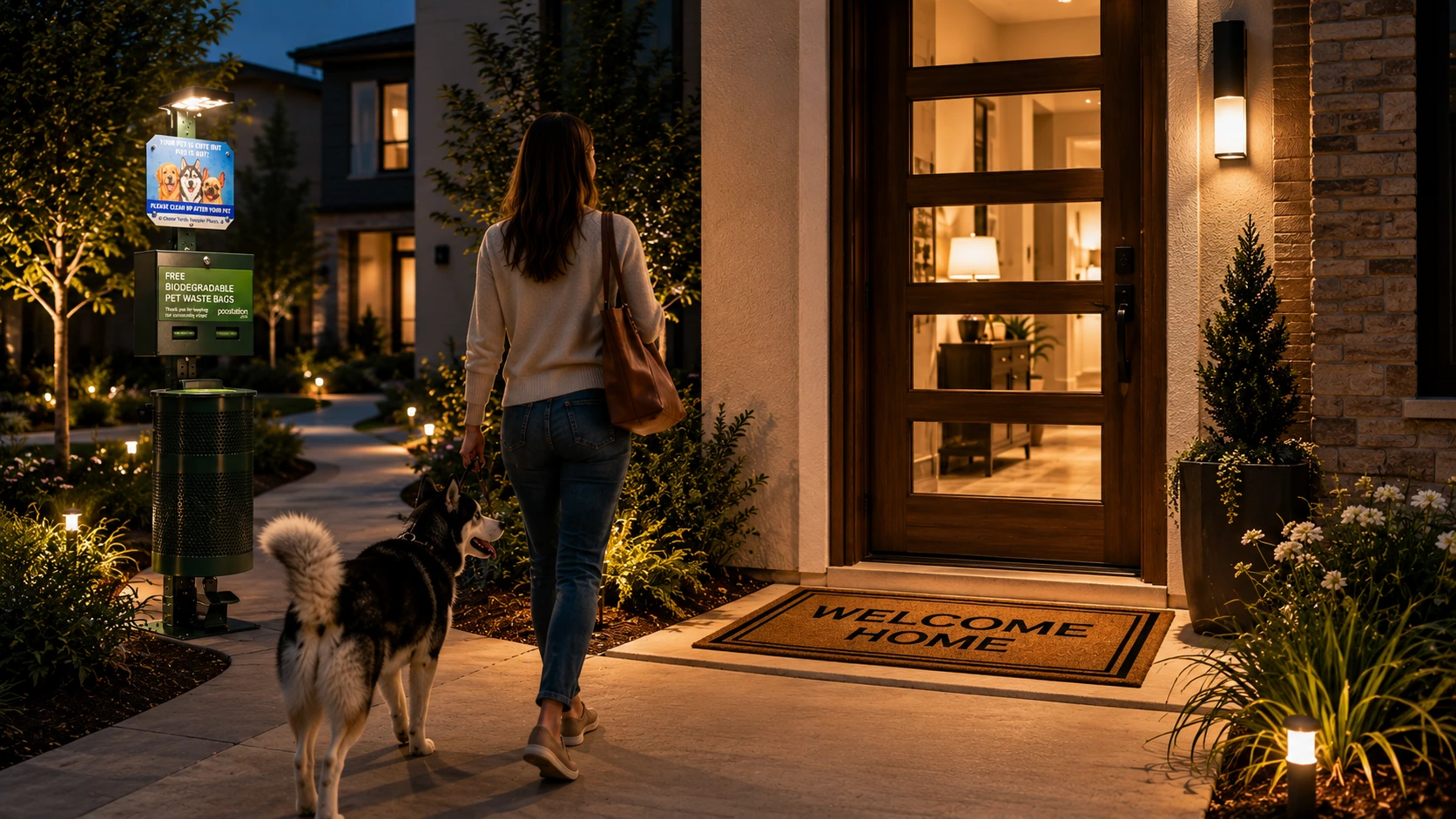

How pets became part of the family—and part of the housing decision.
By Avi Kosch
Founder, PooStation
A NEXGEN DNA, Inc. Company
For much of the last century, the image of the American household was remarkably consistent: a married couple, children, a home and, quite often, a dog in the backyard. It was more than a cultural image. It reflected assumptions about who lived in American homes, how families were organized and, to some extent, how housing was designed and marketed.
That picture has changed considerably. In 1975, nearly two-thirds of U.S. households were married-couple households. Fifty years later, according to the U.S. Census Bureau, that figure had fallen to 47 percent. By 2025, the country had 39.7 million one-person households, representing 29 percent of all households, compared with 20 percent in 1975. Americans are marrying later, and among married couples, the share with children under 18 living at home has declined significantly.
Those numbers tell an important demographic story, but they do not capture everything that has changed inside the American home. As households became smaller and family structures more varied, another member became increasingly embedded in everyday family life. The dog that once symbolized life in the backyard increasingly moved inside—not merely into the house, but into the household itself.
The American Housing Survey provides an unusually revealing look at the scale of that change. Sponsored by the U.S. Department of Housing and Urban Development and conducted by the Census Bureau, the survey found that in 2021 approximately 63.8 million occupied U.S. housing units—49.6 percent of the total—had at least one pet. Dogs were by far the most common, present in approximately 49 million households.
The numbers become even more interesting when viewed alongside traditional family structure. Households with children were more likely to have pets, at 57 percent, but 46 percent of households without children also had them. Pets crossed age groups, housing types and living arrangements. Homeowners were more likely than renters to have pets, but 38 percent of renter households reported having them as well.
The pet, in other words, is increasingly difficult to define as an accessory to one particular kind of American family. Its role has evolved along with its prevalence. National research has found that an overwhelming majority of pet owners consider their animals part of the family, with particularly strong attachment among some adults who are unmarried or do not have children living at home. Housing statistics necessarily count people. The experience of a household, however, increasingly includes the animals living alongside them.
That distinction matters to residential real estate because pets are not simply occupying American homes; they are influencing which homes people choose. Zillow’s 2025 Consumer Housing Trends Report found that among renter households surveyed, 59 percent reported having at least one pet, compared with 37 percent that included children under 18. Forty percent reported having a dog, and 65 percent of renters considered allowing pets essential to their rental decision.
A separate Zillow analysis of more than 11 million rental listings found evidence of how that preference translates into the marketplace. Rentals allowing pets were typically leased eight days faster than those that did not. Pet-friendly listings also generated more views, saves and shares, while nearly half of renters surveyed said they had passed on a property because it was not pet friendly. For owners, developers and property managers, the implication extends beyond whether a lease contains a pet clause. Pets are no longer merely a housing-policy question. They have become part of the housing decision itself.
That shift is visible in the way communities now compete. “Pet friendly” once largely meant permission: dogs were allowed, subject to whatever deposits, fees, breed restrictions or weight limits a property imposed. Today, many communities promote dog parks, pet washing areas, walking trails, relief areas and other features intended specifically for residents living with animals. The language is moving gradually from pet permission toward pet accommodation.
That progression makes sense because allowing a dog inside a residence addresses only one part of what it means to live with one. A dog also moves through elevators, hallways, sidewalks, lawns, trails and common spaces. It creates daily routines throughout a property, requiring places to walk, opportunities for exercise and convenient ways to manage waste. In multifamily, condominium, HOA and other shared residential environments, needs once handled within a private backyard increasingly become part of the common environment. The more useful question is no longer simply whether a community permits pets, but whether the physical property acknowledges the reality that they live there.
Research into pet-inclusive housing shows how consequential that distinction can become. Studies of renters seeking housing with animals have documented the effects of pet fees, restrictions and availability on where people are willing or able to live. Research in Houston found that renters could face significant difficulties locating affordable housing that accommodated their animals, while separate research examining rental listings across major Texas cities found that pet-related fees and policies could create additional housing burdens.
Those studies primarily address affordability and housing access, but they reinforce a broader principle: when animals are part of the household, decisions involving those animals become housing decisions. For residential communities, that creates an opportunity to think beyond permission and toward thoughtful integration.
That does not mean transforming every residential property into a playground for dogs. Residents without pets are equally important, and successful community design must work for everyone. In fact, some of the strongest arguments for thoughtful pet infrastructure concern people who do not own pets. Clean lawns, well-maintained walking areas and responsible waste management are shared community interests.
Good pet infrastructure can help reconcile those interests. Green spaces give owners appropriate places to take their dogs. Convenient access to waste bags makes responsible cleanup easier, while appropriately located collection points help keep pet waste away from sidewalks, lawns and other common areas. The objective is not to make the animal the center of the community. It is to recognize that the animal is already part of it.
The quality of that infrastructure also deserves greater attention. Residential communities routinely specify outdoor equipment expected to remain in service through years of sun, rain, irrigation, humidity and repeated use. Yet pet waste stations have historically been treated as relatively simple pieces of equipment. As communities become more sophisticated, there is a case for applying the same material and design considerations to pet infrastructure that are expected elsewhere on the property.
That philosophy is part of the thinking behind PooStation. Rather than simply recreating the traditional commercial pet waste station, PooStation was developed around the needs of contemporary residential environments, including capacity, accessibility, maintenance, nighttime use, appearance and long-term outdoor exposure.
Material selection is part of that approach. Components particularly vulnerable to moisture and corrosion—including the waste collection bin, lid, foot pedal and other exposed elements—benefit from galvanized steel rather than relying solely on conventional steel. Protective finishes and powder coating provide additional barriers against the outdoor environment, while signage and other exposed surfaces require protection from sunlight and UV exposure. These details may be largely invisible to a resident walking past the station, but they matter when equipment is expected to remain outdoors year after year.
The same thinking extends throughout PooStation. Its 1,200-bag capacity is intended for communities where pet waste infrastructure is used repeatedly rather than occasionally, while its 20-gallon covered waste collection bin provides substantial collection capacity. Oversized biodegradable pet waste bags address the practical reality of cleanup. ADA-accessible hand operation and foot-pedal access provide multiple methods of use, and motion-activated LED lighting recognizes that dog ownership does not operate according to daylight hours alone.
Even the bag dispenser and signage reflect a broader design consideration: outdoor community infrastructure has to perform while continuing to look appropriate within the property around it. UV exposure, moisture, corrosion and repeated handling are not theoretical concerns for equipment permanently installed outside. Modern pet infrastructure should be engineered for the environment in which it actually lives.
PooStation represents one approach to that evolution, bringing together capacity, accessibility, materials, lighting and contemporary design in a commercial pet waste station developed for modern communities. Product information and specifications are available at PooStation.com.
The larger principle extends beyond any one product. Residential communities have always adapted their infrastructure as household behavior changes. Package rooms evolved as online shopping became part of daily life. Coworking spaces appeared as work became less tied to a traditional office. Electric-vehicle charging is increasingly considered as transportation changes. Fitness and outdoor spaces continue to evolve as resident expectations change. Pet infrastructure belongs in that same conversation. If the household has changed, the infrastructure serving that household should be willing to change with it.
That does not mean every development needs more pet amenities. It means pet-related decisions deserve the same intentional thinking applied elsewhere in community life. Who lives here? How do they use the property? What routines occur every day? What creates unnecessary friction? What helps keep shared spaces cleaner? What will residents expect five or ten years from now?
The Census Bureau’s changing portrait of the American household reminds us that housing has never served a fixed population. Families evolve, living arrangements evolve, expectations evolve, and the definition of home evolves with them. The dog did not suddenly become a new American invention. What changed is the role it occupies in millions of households—and the extent to which people increasingly expect their housing choices to acknowledge that relationship.
The next generation of residential communities will still be designed for people. But understanding those people increasingly means understanding the households they have chosen to create. And in millions of those households, someone is waiting at the door with four legs, a leash and every expectation of coming along.
Cleaner Spaces Happier Places™
Sources
- U.S. Census Bureau — America’s Families and Living Arrangements, 2025. Current Population Survey data examining married-couple households, one-person households, children and changing American living arrangements.
- U.S. Census Bureau & U.S. Department of Housing and Urban Development — 2021 American Housing Survey: Household Pets. National housing data examining pet ownership, dogs, children, renters, homeowners and housing characteristics.
- Zillow — Consumer Housing Trends Report 2025. National renter research examining household composition, pets and housing priorities.
- Zillow Research — Pet-Friendly Rentals, 2025. Analysis of more than 11 million rental listings examining leasing speed and renter engagement.
- Peer-reviewed research — Pet-Friendly for Whom? Analysis of rental pet policies and pet-related costs across the 20 most populous Texas cities.
- Peer-reviewed research — Barriers to Finding and Maintaining Pet-Inclusive Affordable Housing. Research examining renter experiences, restrictions, pet fees and housing availability in Houston.