COMING FALL 2026 THE FUTURE OF PET WASTE STATIONS Now Accepting Pre-Order and Distributor Inquiries

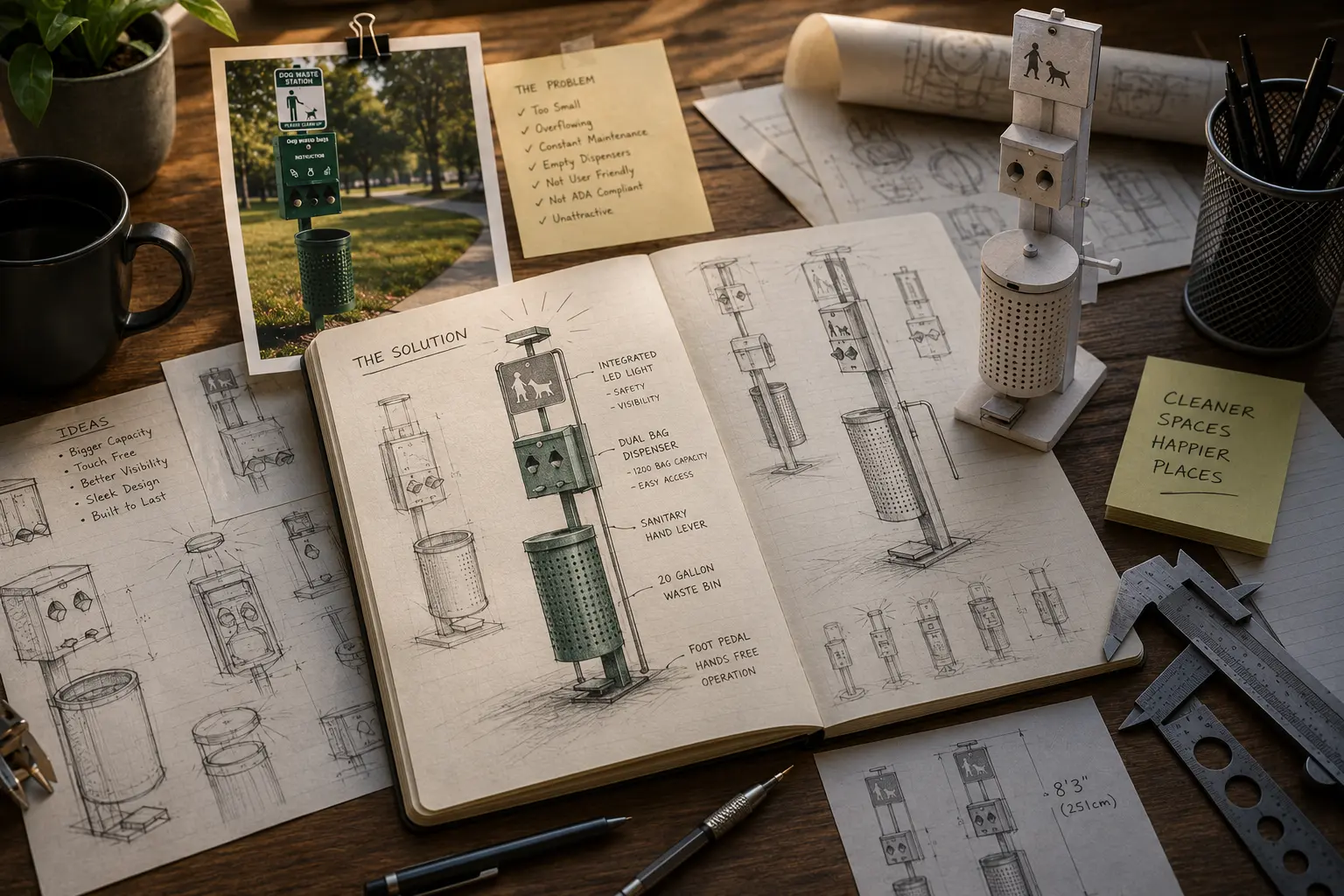

What HOA boards, property managers, municipalities, and residents have been saying for years—and how listening to those frustrations inspired a different approach.
It’s a beautiful Saturday morning. A family is enjoying a walk with their dog through the neighborhood. As they finish their walk, the inevitable happens. Their dog stops, and the owner instinctively reaches into a pocket for a waste bag. Empty. Like most responsible pet owners, they normally carry bags. This time, they simply ran out at the worst possible moment.
Fortunately, there’s a community pet waste station just ahead. Relieved, they walk over expecting an easy solution. The dispenser is empty. Looking down, they notice several tied bags of pet waste lying beside the station. Another hangs over the edge of the receptacle because the lid can no longer close. The container is already full.
By Monday morning, someone will likely send an email to the HOA or property manager. A maintenance employee will make another unscheduled service visit. Residents will once again complain about overflowing stations, unpleasant odors, or bags left beside the receptacle—not because they wanted to, but because there was nowhere else to put them. For many communities, this isn’t an unusual scene. It’s a familiar one.
The Conversations Communities Have Been Having
Was this simply bad luck, or was it happening everywhere? That question led to months of research—not into products, but into people. Public HOA discussion forums, official community newsletters, municipal guidance, environmental agencies, property management publications, and conversations among residents and maintenance professionals all revealed remarkably similar concerns.
In one public HOA discussion, a resident described pet waste bags “overflowing the can and scattered all around the ground,” explaining that the area had become an ongoing source of frustration because of flies and unpleasant odors. The concern wasn’t directed at responsible pet owners. It was directed at equipment that was no longer serving the community effectively.
An official HOA newsletter in Texas reminded residents not to dispose of pet waste collected at home into the community’s pet waste stations because doing so was causing receptacles to overflow and, in some cases, damage the containers. Property managers described another side of the problem, including the unpleasant experience of servicing overfilled stations when collection liners failed. These were not isolated stories. They were recurring themes.
More Than A Maintenance Issue
The U.S. Environmental Protection Agency (EPA) identifies proper pet waste management as an important part of protecting stormwater quality and reducing bacteria and other pollutants entering local waterways. The EPA recommends providing pet waste stations in common walking areas while emphasizing routine maintenance, public education, and responsible pet ownership.
The Rhode Island Department of Environmental Management echoes that approach, encouraging communities to combine pet waste stations with education and ongoing maintenance. The City of Orlando similarly reminds residents that pet waste left on the ground can introduce harmful bacteria and nutrients into lakes, ponds, and waterways. Taken together, these sources point toward the same conclusion: communities don’t simply need pet waste stations—they need pet waste stations that continue to work when people need them most.
Asking A Different Question
If communities have been describing these same frustrations for years, why are so many pet waste stations still designed the same way? Rather than creating a checklist of product features, the research produced a list of design principles.
If overflowing receptacles are among the most common complaints, capacity matters. If responsible pet owners routinely discover empty dispensers after busy weekends, bag capacity matters. If people hesitate to touch a public lid that hundreds of others have already handled, hands-free operation matters. If equipment is expected to remain outdoors every day of the year, durability matters. If the goal is encouraging responsible pet ownership, accessibility matters. These were practical responses to problems communities had already identified.
When Listening Shapes Design
One finding stood out above almost everything else: capacity. A review of twelve leading commercial pet waste station brands conducted during PooStation’s development found that the standard waste receptacle was consistently a 10-gallon container. The resulting design incorporated a 20-gallon waste collection bin—double the standard capacity reviewed during development—to help reduce overflow and extend the time between service visits.
Many commonly installed pet waste stations hold approximately 400 bags, while some higher-capacity models hold around 600 bags. PooStation was designed to hold approximately 1,200 bags—roughly three times the capacity of a typical 400-bag station—to reduce refill frequency and improve the experience for responsible pet owners, particularly during weekends and other periods of heavy use. Hands-free operation through both a foot pedal and an accessible hand lever addressed another common frustration: few people want to touch a public waste lid that has already been handled by countless others throughout the day.
Every major design decision followed the same principle: Listen first. Design second.
A Better Way Forward
No product can eliminate every challenge associated with responsible pet ownership. Communities will always depend on residents doing the right thing, thoughtful policies, and consistent maintenance. But thoughtful design can remove many of the frustrations that have surrounded traditional pet waste stations for years.
What began as one person’s observation eventually became months of research. That research led through HOA forums, community newsletters, environmental guidance, municipal resources, property management discussions, and countless public conversations. Communities weren’t asking for more pet waste stations. They were asking for pet waste stations that worked better. That philosophy eventually became PooStation. Not because the goal was to build another pet waste station, but because the goal was to build one that listened before it was ever designed.
Sometimes the best innovations don’t begin with a blueprint. They begin with a question. And they succeed because someone took the time to listen before looking for the answer.
Cleaner Spaces Happier Places ™
Sources & Further Reading
- S. Environmental Protection Agency guidance on pet waste management, stormwater quality, and public education.
- Rhode Island Department of Environmental Management resources on community pet waste programs.
- City of Orlando environmental education materials regarding pet waste and water quality.
- Official HOA community communications.
- Public HOA discussion forums.
- Property management discussions.
- Publicly available commercial product specifications from leading industry manufacturers and retailers.