COMING FALL 2026 THE FUTURE OF PET WASTE STATIONS Now Accepting Pre-Order and Distributor Inquiries

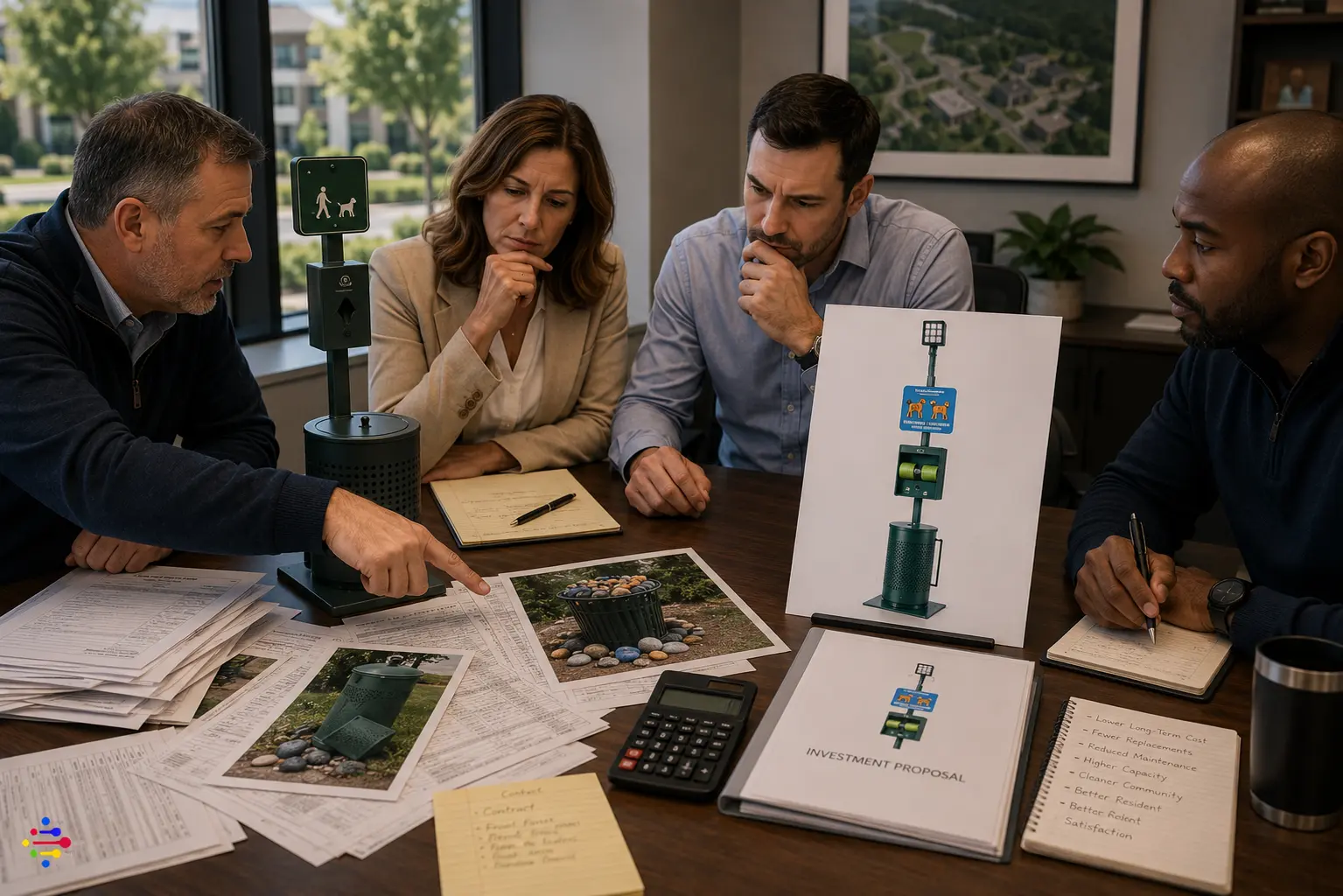

What Human Factors Engineering Can Teach Us About Better Pet Waste Station Design
Innovation has always captured our attention. Maintenance rarely does.
When a new product is introduced, conversations naturally focus on performance, capacity, appearance, technology, and price. Brochures highlight specifications. Sales presentations emphasize features. Buyers compare warranties and construction. Yet the question that ultimately determines whether a product succeeds is often the one asked least often.
How will this product perform after thousands of routine maintenance cycles over the next decade?
For engineers, psychologists, and operations researchers, that question has become increasingly important. Across industries ranging from aviation and healthcare to manufacturing and public infrastructure, decades of research have led to a remarkably consistent conclusion: long-term reliability depends as much on human behavior as it does on mechanical design.
People are not machines.
They become distracted. They are interrupted. They answer a phone call midway through a routine task. A resident asks a question. Weather changes. Priorities shift. Fat andigue accumulates over a long day. None of these realities indicate poor performance. They simply reflect the way people work.
Rather than expecting perfect attention and flawless memory, modern engineering has increasingly adopted a different philosophy. Products should be designed around the people who use them, not around the unrealistic expectation that every maintenance procedure will be completed perfectly every single time.
Human Factors Engineering has spent decades studying this relationship between people and the systems they interact with. James Reason, whose work fundamentally changed modern safety science, argued that recurring errors are often symptoms of system design rather than individual carelessness. Around the same time, industrial engineer Shigeo Shingo introduced the concept of Poka-Yoke, or mistake-proofing, within the Toyota Production System. His premise was elegantly simple: whenever possible, products should be designed so that predictable mistakes become difficult—or impossible—to make.
That philosophy quietly transformed entire industries.
Aircraft maintenance procedures were redesigned to reduce overlooked steps. Medical equipment incorporated connectors that physically prevent incorrect assembly. Automobile manufacturers added warning systems for doors left open, headlights left on, and seat belts left unfastened. The lesson was never that people had suddenly become less capable.
The lesson was that great engineering anticipates ordinary human behavior.
Oddly enough, this conversation has received relatively little attention within one of the fastest-growing amenities found throughout homeowner associations, condominium communities, apartment complexes, parks, and walking trails.
The neighborhood pet waste station.
Maintaining a pet waste station appears deceptively simple. Refill the waste bags. Replace the receptacle liner. Empty the waste container. Close the access doors. Move on to the next station. Each individual task requires only a few moments. Repeated hundreds—or even thousands—of times over the life of a community, however, those few moments become a maintenance system deserving of the same thoughtful design principles applied elsewhere.
One Saturday evening, while walking through my own community, I stopped at a neighborhood pet waste station. Routine maintenance is generally completed before the weekend unless an emergency arises, so I knew the station had most likely been serviced the previous Friday afternoon.
At first glance, everything appeared normal.
The station was standing upright. Nothing was broken. There was no obvious vandalism.
But as I looked closer, the story changed.
The bag dispenser was completely empty.
The receptacle liner had been folded over the outside rim of the container rather than secured neatly inside, leaving the exposed liner visible and giving the station an unfinished appearance. A partially used waste bag remained hanging from the receptacle itself, suggesting the servicing had been completed hurriedly—or interrupted before the final details had been finished.
Most residents probably would have reached a simple conclusion.
Someone forgot.
Perhaps.
Standing there, however, I found myself asking a different question.
Why was it so easy to forget?
That question lies at the heart of Human Factors Engineering. When the same maintenance oversight appears repeatedly—not once, but across different technicians, different communities, and different products—it becomes increasingly difficult to blame the individual. Eventually, attention turns toward the system itself.
Could the product have been designed differently?
Could it have quietly guided the maintenance technician through the final steps?
Could it have reduced the opportunity for a predictable oversight?
Research suggests these questions are worth asking.
Studies published in the Journal of Quality in Maintenance Engineering have consistently shown that maintenance quality improves when equipment is designed to support the people responsible for servicing it. Likewise, research appearing in Reliability Engineering & System Safety has demonstrated that interruptions, repetitive tasks, and cognitive overload significantly increase the likelihood of routine maintenance errors. The conclusion is not that technicians require more discipline. It is that better systems reduce opportunities for predictable mistakes.
Community management research points toward a similar conclusion from another perspective.
The Community Associations Institute has long recognized that residents evaluate their communities through the cumulative condition of shared spaces. Landscaping, sidewalks, lighting, signage, recreational facilities, and everyday maintenance all contribute to residents’ overall perception of quality. Rarely does one overlooked detail define a neighborhood. Collectively, however, hundreds of small details shape whether a community feels clean, organized, professionally managed, and welcoming.
Pet waste stations are part of that experience.
Behavioral studies examining pet waste compliance have repeatedly demonstrated that dog owners are substantially more likely to clean up after their pets when waste bags are consistently available and conveniently located. When dispensers remain empty, compliance declines—not necessarily because residents become less responsible, but because the environment has become less supportive of responsible behavior. Good design influences good behavior.
The public health implications extend even further.
The United States Environmental Protection Agency has identified unmanaged pet waste as a contributor to bacteria, parasites, and nutrient pollution affecting local waterways and stormwater systems. Guidance from the Centers for Disease Control and Prevention likewise recognizes that improperly managed animal waste may contribute to environmental contamination and zoonotic disease exposure. What begins as an overlooked maintenance detail ultimately affects sanitation, environmental stewardship, resident satisfaction, and community appearance.
Viewed separately, each observation seems insignificant.
Viewed together, they reveal a larger truth.
The effectiveness of a pet waste station is not determined solely by the quality of its materials or the number of bags it holds.
It is determined by whether it continues performing reliably under ordinary, everyday conditions, maintained by real people with real workloads and real interruptions.
That realization fundamentally changes the way we should evaluate these products.
Instead of asking which station costs less, perhaps we should ask which station has been engineered to minimize predictable maintenance oversights over the next ten years.
Instead of assuming every final step will always be remembered, perhaps we should ask why any product still depends upon perfect memory in the first place.
Those questions became one of the guiding principles behind the engineering philosophy of PooStation.
Rather than focusing solely on capacity, appearance, or manufacturing cost, PooStation was developed with the understanding that the smallest maintenance details often determine the overall experience residents have with a community. Every routine service visit represents another opportunity either to preserve that experience—or unintentionally diminish it.
Great engineering rarely calls attention to itself.
Instead, it quietly reduces friction, simplifies maintenance, and helps ordinary people perform ordinary tasks more consistently.
The goal has never been to eliminate human error.
No product can.
The goal is to design products that acknowledge human behavior and reduce the consequences of predictable mistakes before they occur.
Because perhaps the most expensive maintenance mistake is not the one someone makes.
Perhaps it is the one a product quietly allows to happen again tomorrow.
And the day after that.
And the year after that.
Cleaner Spaces Happier Places.
⸻
References
- Reason, James. Human Error. Cambridge University Press, 1990.
- Shingo, Shigeo. Zero Quality Control: Source Inspection and the Poka-Yoke System. Productivity Press, 1986.
- Community Associations Institute. Best Practices Reports on community maintenance, reserve planning, and resident satisfaction.
- Journal of Quality in Maintenance Engineering. Research on maintenance reliability, human factors, and maintenance management.
- Reliability Engineering & System Safety. Peer-reviewed studies on maintenance error, system reliability, and human performance.
- International Ergonomics Association. Human Factors and Ergonomics principles.
- United States Environmental Protection Agency. Research and guidance on pet waste management and stormwater protection.
- Centers for Disease Control and Prevention. Guidance on environmental sanitation and zoonotic disease prevention.
- National Recreation and Park Association. Best practices for park maintenance and public space stewardship.
- Academic studies on pet waste compliance, environmental behavior, and the relationship between dispenser availability and responsible pet owner behavior.