COMING FALL 2026 THE FUTURE OF PET WASTE STATIONS Now Accepting Pre-Order and Distributor Inquiries

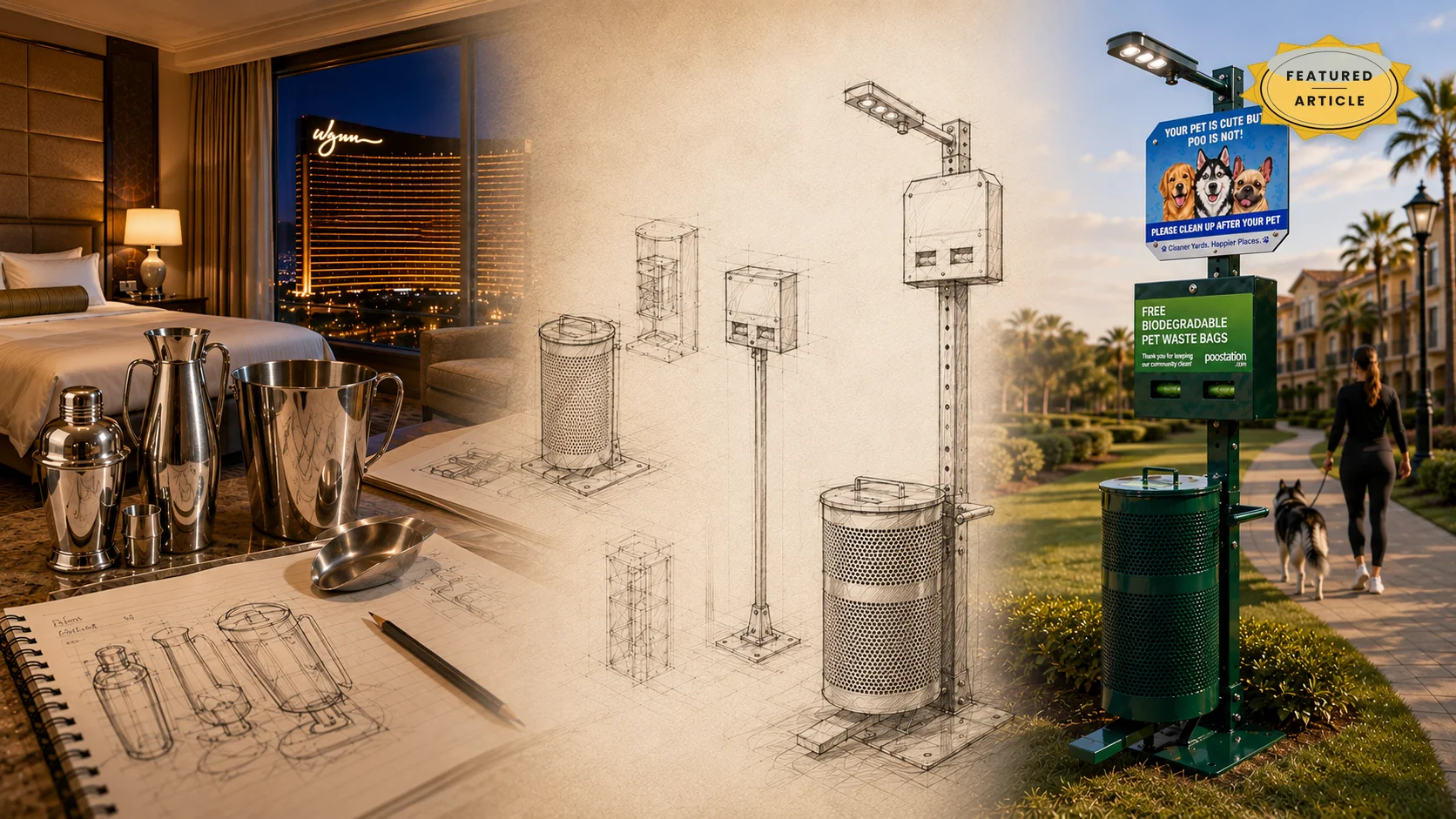

From luxury hotel rooms to community dog walks, the same question kept returning: what should come next?
By Avi Kosch
Founder, PooStation
A NEXGEN DNA, Inc. Company
In 2008, I was sitting in a conference room at Wynn Design & Development in Las Vegas with roughly two dozen designers and purchasing executives. Encore, the approximately 2,700-room resort being built alongside Wynn Las Vegas, was still under development, and the room was filled with products being considered for the guestrooms. I was the only supplier and manufacturer invited to the meeting.
By then, my company had been working with Wynn for several years, and I had developed a close relationship with Roger Thomas and his design team. It gave me an unusual seat at the table. I wasn’t simply receiving drawings and specifications after decisions had been made. I was often in the room while those decisions were still being debated, watching how one of the most influential hospitality design teams in the world thought about products that most people would barely notice.
Roger noticed them. A tissue box mattered. An amenity tray mattered. A desk accessory mattered. If a guest was going to see it, touch it or live with it during a stay, it was part of the experience.
That afternoon, samples were spread across the table for review when Roger picked up a bamboo-style tissue box and asked where it had come from. One of the purchasers explained that she had found it at Bloomingdale’s. It was from their newest collection, she said, and one of the big looks of the season. Roger dropped it onto the floor and moved on. The box cracked, and I remember thinking that somebody had just destroyed a roughly $220 tissue box that probably wasn’t returnable anymore.
What he said next stayed with me much longer than the tissue box. We weren’t designing for today, he reminded everyone. Encore would open the following year. We were designing for what guests would see after that. Wynn wasn’t supposed to follow whatever happened to be fashionable in a department store. We were supposed to help establish what came next. Other hotels would eventually walk through, see what had been done and respond to it.
The lesson was simple: if something is already the trend, we may already be too late.
I had no idea that nearly two decades later I would find myself applying that same lesson to a product about as far removed from a Wynn guestroom as I could have imagined: a pet waste station.
On the surface, the two worlds have very little in common. One is associated with luxury, design and experience. The other is a piece of outdoor infrastructure most people would prefer not to think about at all. But when I eventually began looking closely at traditional pet waste stations, I found myself asking essentially the same question Roger had taught me to ask years earlier: Why are we still designing them this way?
Hospitality had already taught me that good design was never simply about making something attractive. Some of the most valuable lessons came when a product looked perfectly good but might not survive the environment in which it was expected to live.
Shortly after our exclusivity agreement with Wynn expired in early 2006, I received a call from Greg Sheets, who was working on Red Rock Resort in Las Vegas. Greg knew some of the glassware we had developed for Wynn and wanted us to create something incorporating Red Rock’s distinctive striped design language. The original concept used multiple colors from the resort’s palette wrapped around the glass. We could make it, and my first reaction was that we would work on it.
Then I took the concept to our manufacturing and quality-control team in China. Chuck Bell, who handled quality control for me, raised a concern. We could reproduce the colors, but he wasn’t confident the decoration would withstand repeated high-temperature commercial washing. A sample could look beautiful when it arrived and still be the wrong product if the finish began failing after it went into daily hotel service.
We developed what the client had requested, but I also developed another version. Instead of reproducing the stripes literally in color, we interpreted the same pattern through alternating clear and frosted glass. It preserved the character of the design without depending on the surface treatment we were concerned would not hold up. When I brought both concepts to the meeting and explained the issue, they immediately preferred the clear-and-frosted version. It was better, they told me, than what they had originally envisioned.
That experience changed the way I thought about giving clients what they asked for. Listening to a client is essential, but giving someone exactly what they request is not necessarily the same thing as giving them the best solution. Sometimes the greater responsibility is understanding what they are actually trying to accomplish and finding a better way to get there.
Hospitality also taught me that following a design problem far enough can take you somewhere you never intended to go.
During the original development of Wynn Las Vegas, I had worked on the presentation of products for the in-room minibar. One concept incorporated brown tins inspired by packaging I had seen at Dean & DeLuca in New York, and the design was approved. About a year later, I received a call telling me that I had created a problem. The established minibar companies could not produce the approved presentation. There were issues involving the tins, the equipment and the ability to repackage branded products.
I wasn’t in the minibar business, but that apparently did not matter very much. There was an initial commitment of approximately 130,000 pieces for the first year, and the message was essentially that this was what Roger had approved, this was what they wanted, and I needed to figure out how to make it happen. So I did. We worked through manufacturing, packaging and production, built a clean packaging operation and eventually opened a dedicated minibar packaging facility in Las Vegas. I had never planned to become a minibar manufacturer. Solving the problem took me there.
Years later, another problem would take me somewhere just as unexpected.
The beginnings of NEXGEN DNA, Inc. came from a frustration much closer to home. Pet waste had become an ongoing issue in my own community, and like most people looking at that problem, my first instinct centered on accountability. If someone does not clean up after their dog, how do you identify who is responsible? That thinking eventually led me toward DNA-based solutions and the ideas that became PooDNA and PALDNA. Later came ChowDNA, exploring another application of DNA technology through more personalized pet nutrition.
At that point, I was thinking about pets, technology, identification and accountability. I was not thinking about designing a pet waste station.
Then my perspective changed for reasons that had nothing to do with design or business. After a serious accident, I spent a period navigating everyday life from a wheelchair and later with a cane. When your mobility changes, ordinary products stop being ordinary. A door suddenly has a weight. A handle has a reach. A few inches of height matter. Whether something requires one hand or two matters. So does balance, and so does the assumption built into so many products that everyone approaching them will do so in exactly the way the designer imagined.
That experience did not suddenly turn me into an accessibility expert. It simply made me notice things I had not noticed before, and pet waste stations began to look different to me.
A person walking a dog is already holding a leash. Then there is the waste bag. Why should disposing of it require touching the lid of a public waste receptacle with your hand? What if that person is using a cane? What if an older resident has limited mobility? What if someone is managing two dogs at once? Once I started asking those questions, more followed. Why were the bag dispensers so limited in capacity? Why were many of the waste receptacles relatively small? Why was nighttime visibility rarely part of the design when people routinely walk their dogs before sunrise and after dark? What happened to the bottom of a station after years of irrigation, rain and humidity? How easy was it to service? How often did somebody have to refill it?
I had spent much of my career designing products people were meant to notice. PooStation taught me to care just as much about designing something people should hardly have to think about.
That change in perspective began shaping the product naturally. The foot pedal and accessible hand lever came from thinking about the person standing in front of the station with a leash in one hand and a waste bag in the other. Greater capacity came from thinking about the maintenance team that has to keep the station functioning long after the purchase order is forgotten. Integrated LED illumination came from thinking about the resident using it at night. Galvanized steel and protective finishes came from thinking about what happens after years of exposure to weather and irrigation. They were not features added simply to make a specification sheet longer. Each one traced back to a question about how someone would actually use, maintain or live with the product.
And as I had learned repeatedly in hospitality, the full-scale product tells you things a drawing cannot. When we moved from individual components and drawings to a complete PooStation sample, we found details we wanted to change. Some involved alignment and assembly. Others involved hardware, materials or structural connections. Even the anchoring system forced us to think differently about the very different job of a six-inch concrete anchor compared with a 16-inch stake going into grass or soil.
None of those details makes for a dramatic invention story, but perhaps that is part of the point. Innovation does not always arrive as one enormous breakthrough. Sometimes it happens through dozens of smaller decisions made because someone is willing to keep asking whether familiar is really the same thing as finished.
Looking back now, I don’t think the most important lesson I carried out of luxury hospitality was really about hotels. It was about curiosity. Roger Thomas taught me not to design around what was already fashionable. Red Rock taught me that a client’s first idea is not necessarily the final answer. The Wynn minibar project taught me that solving a problem may require stepping outside the business you thought you were in. PooStation brought those lessons together in a place I never would have predicted.
I didn’t begin by asking how to make a slightly different pet waste station. I began by asking why the category had stopped where it had. That distinction matters because innovation does not always mean inventing something the world has never seen before. Sometimes it means looking closely at something everyone has seen for years and refusing to assume that familiarity means it cannot be improved.
I never intended to become a minibar manufacturer, and I certainly never expected to become a pet waste station designer. But perhaps the transition from luxury hospitality to pet waste management is not as strange as it sounds. The surroundings changed, the users changed and the problems changed. The responsibility did not: understand how people will actually experience a product, anticipate what can go wrong and keep questioning the assumptions everyone else has learned to accept.
Nearly twenty years after that meeting at Wynn Design & Development, I still think about the $220 tissue box Roger Thomas dropped on the floor. Not because it broke, but because of what he said before we moved on: we weren’t designing for today.
I could not have known then where that lesson would eventually take me. It followed me from luxury hotel guestrooms to manufacturing floors, from a minibar packaging operation I never expected to build to a period of my life when a wheelchair and a cane changed the way I experienced ordinary objects. Eventually, it followed me onto a community dog-walking path and into a product category I had never imagined entering.
The product was different. The question was not.
What should come next?
For me, one answer became PooStation, and with it the opportunity to apply everything those very different experiences had taught me toward something much simpler but no less worthwhile: Cleaner Spaces, Happier Places™.