COMING FALL 2026 THE FUTURE OF PET WASTE STATIONS Now Accepting Pre-Order and Distributor Inquiries

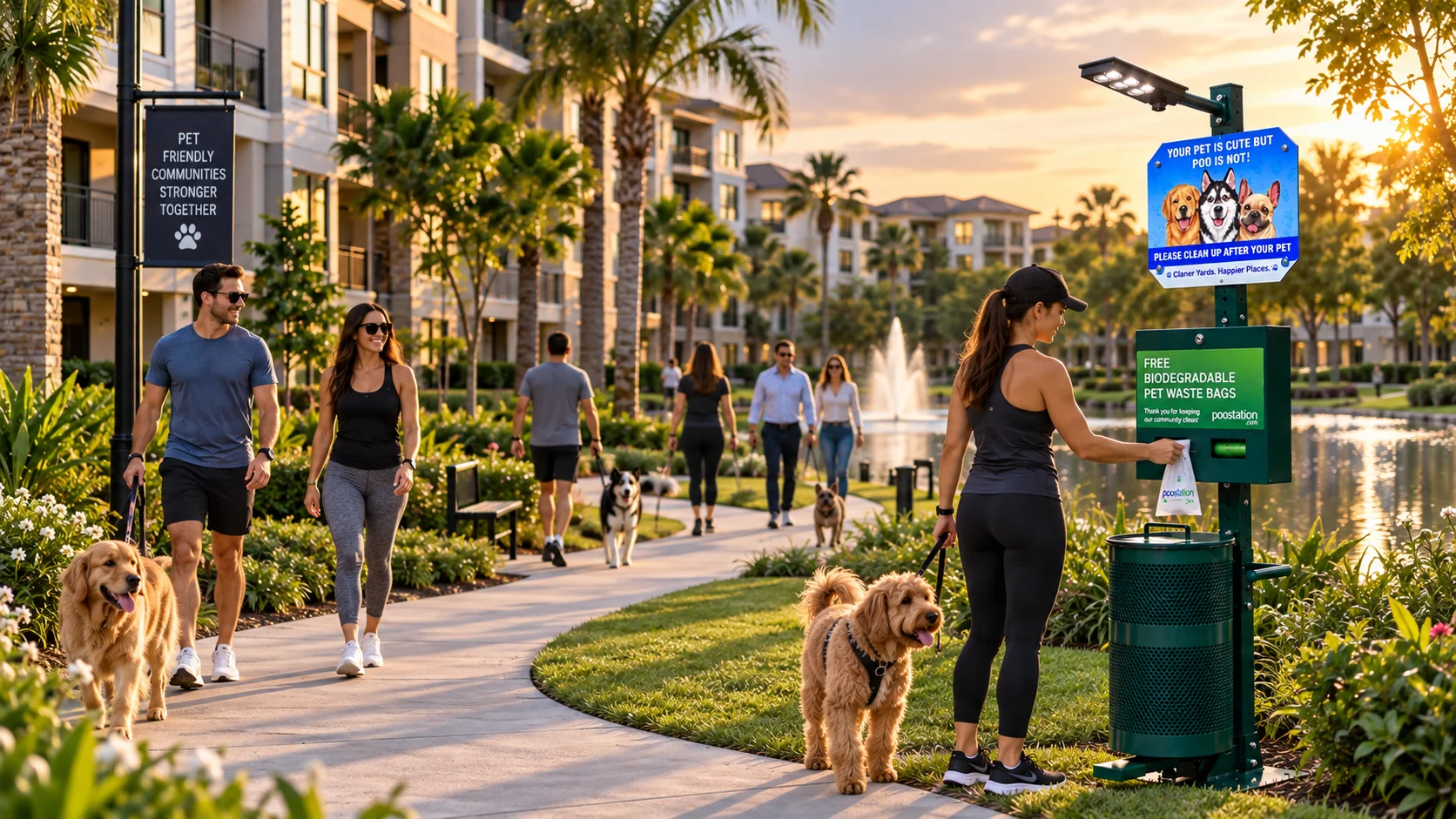

New 2026 research suggests multifamily communities are welcoming more pets than ever. The bigger question is whether their data, infrastructure and operations are keeping pace.
By Avi Kosch
Founder & CEO
NEXGEN DNA, Inc.
A multifamily property may believe it has 125 dogs living in the community. It may be collecting pet fees based on that number, stocking pet waste bags around that number and setting maintenance schedules around that number. But what if there are actually 175?
That 50-dog gap is more than a registration problem. It can mean lost pet-related revenue, greater waste volume than management anticipated, faster bag consumption, heavier use of common areas and pet infrastructure that was never sized for the population it is actually serving.
PetScreening’s 2026 State of Pets in Rental Housing Report identifies unauthorized pets as the number-one pet-related challenge reported by onsite teams, while 81% of operators say pet ownership is increasing across their portfolios. At the same time, Zillow reports that 77.3% of U.S. rental listings now allow pets. Fifty-nine percent of renter households have at least one pet, and 65% of renters consider pet-friendliness essential when choosing where to live. Among renters who stayed in their homes, 62% said pet-friendly policies were a factor in their decision to remain.
Taken together, those findings point to a new challenge for multifamily housing. For years, much of the industry focused on becoming more pet-friendly. The next question may be whether communities are becoming pet-ready at the same pace.
A property can welcome pets according to its lease while still struggling with unauthorized animals, pet waste, empty bag dispensers, undersized receptacles, poorly placed stations, landscaping pressure and maintenance teams managing more pet-related activity than the property was designed to support.
Pet-friendly policies may be growing faster than pet infrastructure.
The Pet Population You Know May Not Be the Pet Population You Have
Unauthorized pets are usually discussed as a lease-compliance, screening or revenue issue, but there is another consequence that deserves more attention: inaccurate pet counts make infrastructure planning more difficult.
If a community believes it has 125 dogs but actually has 175, management may be making operational decisions using the wrong denominator. Bag consumption can be higher than projected, waste volume can increase, popular walking areas can receive more traffic, landscaping can experience greater pressure and existing pet waste stations may require service more frequently than anticipated.
It is difficult to design an effective pet-management system when you do not know the size of the population that system must support. That is why pet registration and pet infrastructure should not necessarily be treated as separate issues. Better population information can help operators make better decisions about station count, placement, bag capacity, waste capacity and maintenance schedules.
Registration tells you who you are serving, while infrastructure determines how effectively you serve them.
Having Pet Waste Stations Is Not the Same as Having a Pet Waste Management System
Commercial pet waste stations are hardly unusual anymore. A 2026 Multifamily Executive report found that pet waste stations were the most commonly reported pet amenity among survey respondents, offered by 45.4%, ahead of pet parks at 32.1%. Yet the same research found that pet waste remained an ongoing challenge for property teams, along with unauthorized pets, property damage, off-leash animals and noise.
That raises an important question: if pet waste stations are already one of the most common pet amenities, why does pet waste remain such a persistent problem?
Perhaps the issue is no longer simply whether a property has a station. The more useful questions are whether there are enough stations, whether they are located where residents actually walk their dogs, whether they have sufficient bag and waste capacity and whether maintenance teams can service them efficiently.
Installation is only the beginning. Equipment still has to perform when usage increases, maintenance schedules change and people use it in ways nobody expected. Installing equipment is not necessarily the same as designing a system.
The Trash Can Tells You How People Really Behave
One of the easiest mistakes in commercial product design is building around how people are supposed to behave rather than observing what they actually do. Pet waste receptacle capacity is a perfect example.
On paper, the receptacle beneath a pet waste station has one job: hold filled dog-waste bags. If that were its only use, estimating capacity would be straightforward. But people do not necessarily look at an outdoor trash receptacle and consider its intended waste stream. They see a trash can.
Residents clean out their cars. Bottles and drink cups get thrown away. Fast-food wrappers, takeout containers and food packaging find their way inside. Visitors discard whatever they happen to be carrying into the nearest available receptacle.
I was reminded of that one morning while walking my own dog. I went to dispose of her waste and looked inside the pet waste container. Sitting there was a large Chipotle takeout bag filled with foil and food packaging. That single bag occupied a surprisingly large portion of a receptacle intended primarily for pet waste.
It was a small observation, but it illustrated something important: rated capacity and usable pet-waste capacity are not necessarily the same thing.
A 10- or 13-gallon receptacle does not guarantee 10 or 13 gallons of available pet-waste capacity because some of that space will inevitably be consumed by unrelated trash. Multiply that behavior across hundreds of residents and visitors over thousands of days of use, and containers fill sooner, maintenance visits become more frequent and overflow becomes more likely.
Once the container is full, even the resident who picked up after a dog and is trying to behave responsibly may have nowhere appropriate to put the bag.
Greater capacity is therefore not simply about holding more dog waste. It provides operational headroom for real human behavior. Good commercial infrastructure should be designed around the world as it actually exists, not the world as an instruction label assumes it will exist.
Every Pet Amenity Creates a Maintenance Responsibility
Bag dispensers present a similar issue. A dispenser may function perfectly while still creating unnecessary work if its capacity requires constant replenishment. One additional service visit may seem insignificant, but multiply that across numerous stations, multiple properties and an entire portfolio, and small inefficiencies begin consuming meaningful amounts of staff time.
That matters because maintenance is not simply a back-of-house expense. It is part of the resident experience. Buildium’s 2026 Renters’ Report found that maintenance had the strongest direct and measurable impact on satisfaction among the factors it studied. Renters satisfied with maintenance were 57% more likely to plan to renew and 48% more likely to perceive their rental as providing good value, while 24% identified maintenance as their top source of rental stress.
Labor-market data adds another dimension. The National Apartment Association reported that apartment-industry job postings increased 13.7% year over year in the second quarter of 2026. Demand for maintenance supervisors rose 12.7%, while maintenance-technician postings increased 8.9%. Maintenance technicians also recorded 3.8% annual wage growth, the strongest among the major apartment occupations tracked.
Pet waste stations are obviously not driving maintenance hiring, but the data reinforces a larger point: skilled onsite labor has real value. A maintenance technician’s time can be spent addressing HVAC systems, plumbing, apartment turns, preventive maintenance and resident work orders, or making avoidable service trips because a dispenser repeatedly runs empty or an undersized receptacle fills prematurely.
Better infrastructure does not eliminate maintenance. It should make maintenance more efficient.
That same operational thinking influenced the development of PooStation. Rather than approaching the category as simply a bag dispenser attached to a waste receptacle, we focused on recurring problems property teams actually manage: limited bag capacity, undersized waste bins, unnecessary service checks, outdoor corrosion, nighttime visibility and the need for more sanitary operation. Those observations helped shape features such as a 1,200-bag dispenser, a 20-gallon waste receptacle, an EMPTY indicator, integrated LED lighting, galvanized and powder-coated construction, and both a foot pedal and accessible hand lever. The goal was not to add features for their own sake, but to reduce the small operational friction points that accumulate over years of use.
Stop Measuring Pet Infrastructure by Whether It Exists
This may be one of the larger opportunities for owners and property managers. Instead of asking, “Do we have pet waste stations?” the better question may be, “How well is our pet waste system performing?”
How frequently are dispensers running empty? Which receptacles routinely fill first? Which stations receive the heaviest use? Which barely get used? Where are complaints occurring? How much staff time is required to service each location? Does the maintenance schedule reflect actual usage, or has the same schedule simply been followed for years?
Those questions transform an amenity into measurable property infrastructure. A dispenser that continually runs out may require greater capacity or more frequent service. A receptacle repeatedly reaching capacity early may be undersized for that location. A station receiving almost no use may not indicate low demand at all; it may simply be installed in the wrong place.
The goal should not automatically be more stations. It should be better-performing stations in the right locations.
Pet Waste Station Placement Is Part of the Infrastructure
People generally follow the path of least resistance. If a dog owner has to walk several hundred additional feet to find a bag or disposal point, the property has made responsible behavior less convenient. If a station is hidden behind landscaping, difficult to see after dark or disconnected from normal dog-walking routes, it may technically be available while remaining functionally inconvenient.
Multifamily communities already think this way about other infrastructure. Developers carefully consider where to locate package rooms, elevators, trash collection areas, parking entrances, pools and fitness centers. Pet infrastructure deserves similar planning discipline.
Where do residents leave buildings with their dogs? Where are the natural walking loops? Where are the grassy relief areas? Where do paths intersect? Where are the longest gaps between disposal points? Which locations can maintenance employees service efficiently?
There is no universal answer. A dense apartment community, a sprawling master-planned development and a senior-living campus do not operate the same way. Good placement begins with observing the property rather than simply dividing acreage by an arbitrary number.
Outdoor Equipment Has to Survive Outdoor Life
Pet waste stations have another unavoidable characteristic: they live outside. In South Florida, equipment may experience temperatures around or above 100 degrees, intense UV exposure, high humidity, heavy rain and constant landscaping irrigation. In northern climates, outdoor equipment may face below-zero temperatures, accumulated snow, ice and repeated freeze-thaw cycles.
The station still has to work. Hinges have to move, pedals have to operate, lids have to open, posts and receptacles have to resist corrosion and hardware has to continue doing its job after years of exposure. That makes materials, corrosion resistance, protective coatings and structural design much more than cosmetic considerations.
It is also an appearance issue. Modern residential communities invest significantly in landscaping, entrances, clubhouses, pools, walking paths and architectural finishes. A rusting, faded or deteriorating pet waste station becomes part of that environment whether management considers it an amenity or not.
Outdoor infrastructure should not be evaluated only by how it looks when it arrives. The better question is how it is likely to look and function after years of heat, rain, snow, ice, irrigation and daily public use.
The Best Pet Infrastructure May Be the Kind Residents Barely Notice
When a pet system works properly, the experience is almost uneventful. A resident approaches a station, finds bags available, uses equipment that is visible and conveniently located, disposes of the waste into a receptacle with sufficient capacity and continues walking through a clean surrounding area.
Nothing remarkable happens, and that is the point.
Residents tend to notice infrastructure when it fails. They notice the empty dispenser, the overflowing receptacle, the broken lid, rusted hardware or waste accumulating nearby. Good infrastructure works quietly in the background. We expect that from elevators, plumbing, package systems and dozens of other property systems, and pet infrastructure should be no different.
From Pet-Friendly Policy to Pet-Ready Operations
The first generation of pet-friendly housing was largely about permission. Properties decided whether to allow pets, established restrictions, created deposits and fees, and wrote policies into their leases. Those things still matter, but they are no longer the entire conversation.
The next phase may be about operations. How many pets actually live within the community? Where do residents walk them? How much waste does that population generate? Are receptacles large enough for both pet waste and the unrelated trash that inevitably finds its way inside? How frequently are bags replenished? Are stations located where residents naturally need them? How much maintenance labor does the system consume? Will the equipment survive the climate where it is installed?
Most importantly, is the property making responsible pet ownership easier or harder?
Those questions become increasingly important when more than three-quarters of rental listings already welcome pets. In that environment, pet-friendly may be becoming the starting point rather than the differentiator. The next competitive standard may be whether a property has built the infrastructure and operational systems required to support the pets it welcomes.
Because allowing pets is a policy, but being prepared for them is a strategy.
Happier Places, Cleaner Spaces™
Sources
Zillow Research — 2026 — Research on pet-friendly rental listings, renter pet ownership, pet-friendliness as an essential housing consideration and the role pet-friendly policies play in renter retention.
PetScreening — 2026 State of Pets in Rental Housing Report — Industry research on rising pet ownership across rental portfolios and the continuing challenge of unauthorized pets.
Buildium — 2026 Renters’ Report — Research based on U.S. renters examining maintenance satisfaction, renewal intent, perceived rental value and renter stress.
Multifamily Executive — 2026 — Industry reporting on pet amenities and the ongoing operational challenges associated with pet waste, unauthorized pets and pet-related property management.
National Apartment Association — Apartment Jobs Snapshot, Q2 2026 — Apartment-industry labor-market research examining hiring demand and wage trends for maintenance technicians, maintenance supervisors and other onsite positions.
About the Author
 |
Avi Kosch
Founder and CEO, NEXGEN DNA, Inc. | Creator of PooStation Avi Kosch is the founder and CEO of NEXGEN DNA, Inc. and the creator of PooStation, a next-generation commercial pet waste management system developed for multifamily communities, HOAs, municipalities, parks and other pet-friendly environments. Drawing on more than two decades of experience designing and manufacturing commercial products for four- and five-diamond hospitality properties, Kosch brings a hospitality-inspired approach to product development focused on durability, usability, maintenance efficiency and the resident experience. His work with PooStation applies those principles to an often-overlooked category of outdoor community infrastructure, with the goal of making responsible pet ownership easier while helping properties operate cleaner, more efficiently and more effectively. |