COMING FALL 2026 THE FUTURE OF PET WASTE STATIONS Now Accepting Pre-Order and Distributor Inquiries

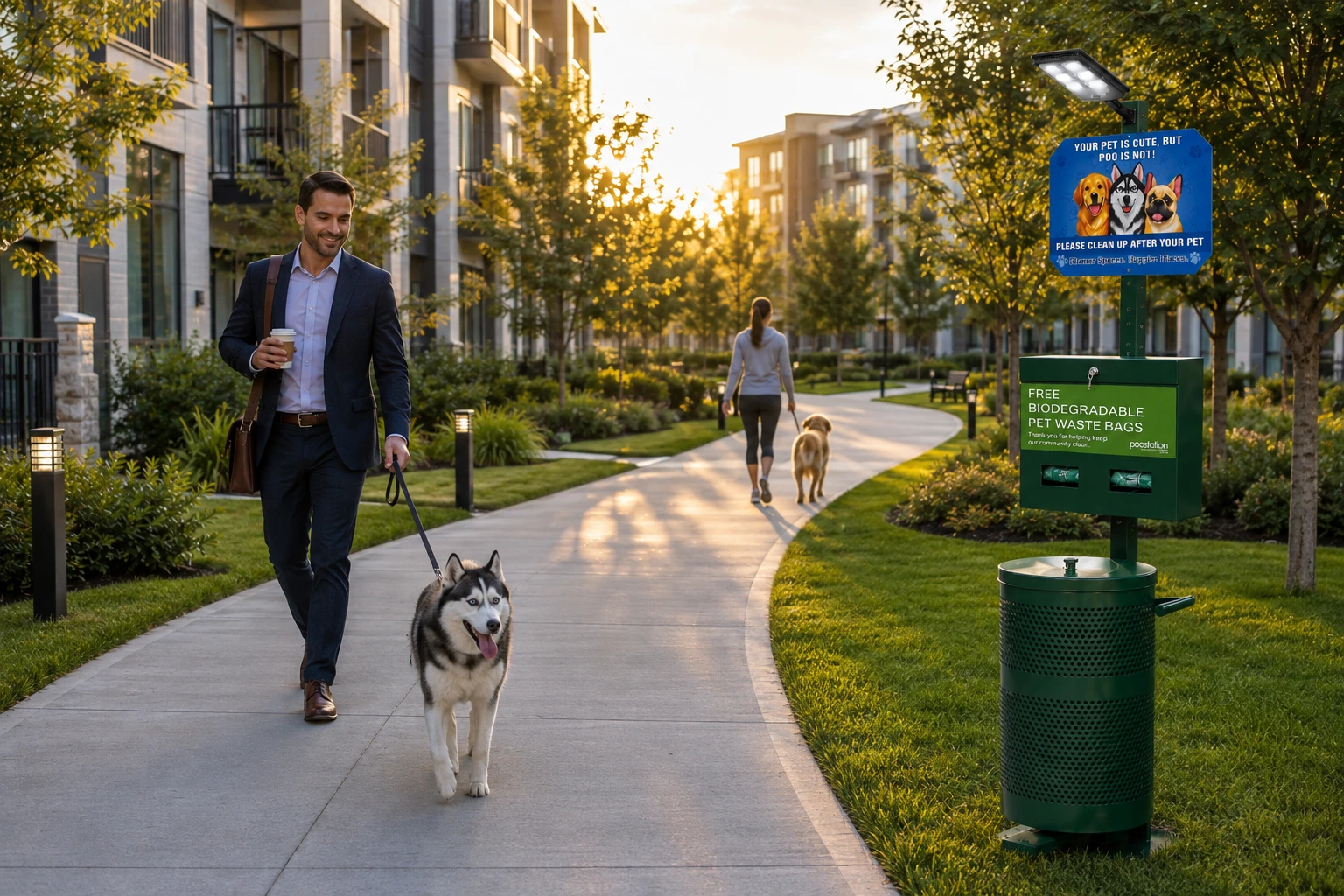

The amenities that sell a community are not always the ones that define everyday life within it.
By Avi Kosch
Founder, PooStation
A NEXGEN DNA, Inc. Company
Walk into almost any new premium residential community and it is easy to see where developers have invested their attention. The clubhouse is larger than the one down the road. The fitness center has the latest equipment. The pool resembles something from a resort. There may be coworking spaces, outdoor kitchens, pickleball courts, lounges, game rooms, and beautifully landscaped gathering areas designed to make an immediate impression on prospective residents.
These amenities matter. They help establish a community’s identity, create memorable first impressions, and increasingly influence how residential properties compete. Yet there is another category of amenities that rarely receives the same attention during a leasing presentation or in a marketing brochure. Residents may never photograph them, mention them during a property tour, or list them among the reasons they initially chose the community. They simply use them, often every single day.
For millions of dog owners, that experience begins the moment they walk outside.
Dog ownership creates a remarkably repetitive relationship between residents and the outdoor environment surrounding their homes. Research from the Dog Aging Project, based on nearly 20,000 participants, found that 36 percent of respondents reported on-leash activity with their dogs more than once per day, while another 18 percent reported it once daily. The median reported duration of on-leash activity was approximately 40 minutes. What may appear to be an occasional recreational activity is, for many households, a repeated daily interaction with the community around them.
Frequency changes the way an amenity should be understood. A resident might visit the clubhouse occasionally. The pool may be heavily used on weekends and seasonally. The fitness center might become part of one resident’s daily routine while another rarely enters it. Dog owners, however, do not have the same flexibility about whether their dogs need to go outside. The result is hundreds of encounters each year with sidewalks, walking trails, landscaping, green spaces, lighting, and other pieces of community infrastructure that may receive considerably less attention than the amenities showcased during a property tour.
What residents encounter on those walks becomes part of how they experience where they live. Is the sidewalk comfortable and well maintained? Does the landscaping feel cared for? Is there adequate shade in warmer months? Are common areas clean? Is the route sufficiently illuminated before sunrise or after sunset? Are pet waste bags available where they are actually needed? Is disposal convenient? Are dog parks and green spaces naturally connected to walking routes, or do they feel isolated from the way residents really move through the property?
Individually, these questions may seem minor. Collectively, they describe everyday life.
Research examining dog walking and residential environments helps explain why. One study involving 2,199 adults living in 32 neighborhoods in the Seattle and Baltimore regions found that dog owners who walked their dogs were more likely to live in highly walkable neighborhoods than dog owners who did not. Another study found that attractive and walkable neighborhood environments were associated with more frequent dog walking among owners who already walked their dogs. The physical environment does not simply surround the activity; it can help support it.
Perhaps even more striking is how much neighborhood walking can be connected to dogs. In one residential study, dog walking accounted for approximately 65 percent of all neighborhood walking sessions reported by dog owners and about 93 percent of their recreational walking sessions within the neighborhood. Those figures are specific to the population studied, but they illustrate an important principle: for many dog owners, walking the dog is not a minor use of the community’s outdoor environment. It is one of the primary reasons they use it.
The implications extend beyond exercise. Dogs bring residents outside, and being outside creates opportunities for interaction. A study of adults age 50 and older found that frequent dog walkers were more likely than people without dogs to report a heightened sense of community. Other research has found that dog owners were more likely to meet neighbors, with increasing dog-walking frequency associated with greater neighborhood interaction. More recent research continues to examine dogs as catalysts for relationships and social connection within neighborhoods.
The explanation is familiar to anyone who regularly walks a dog. People who might never speak while passing one another in a hallway often stop when their dogs meet on a sidewalk. Familiar walking schedules create familiar faces. Residents sometimes learn a dog’s name before learning its owner’s. Over time, ordinary walks can become part of the social rhythm of a community.
That changes the way we should think about outdoor residential space. For residents with dogs, the walkway between buildings is not merely circulation. The landscaped path is not simply decorative. The green space is not simply unused land with grass on it. These places can become some of the most frequently experienced amenities on the property.
That distinction deserves greater attention as residential communities continue competing through increasingly impressive amenities. The industry understandably focuses enormous energy on what prospective residents see during a tour. First impressions matter. A beautiful entrance, sophisticated clubhouse, modern fitness center, and resort-style pool communicate quality immediately and help answer an important question: Do I want to live here?
Everyday infrastructure answers a different question after the lease is signed or the home is purchased: How does it feel to actually live here?
One is about attraction. The other is about experience, and the strongest communities should be able to answer both.
Dog walking makes that distinction particularly visible because it often happens at predictable points throughout the day. Research examining owned dogs and dog-walking patterns has found activity concentrated in morning and late-afternoon or early-evening periods. A broader review of dog-walking research notes that roughly half or more of dog walking takes place within residential neighborhoods, making neighborhood design especially relevant to the activity.
That means the walking trail that seems secondary during a midday property tour may become essential before work or after dinner. Lighting takes on greater importance when residents are outside before sunrise or after dusk. Landscaping influences the quality of the walk. Cleanliness becomes something residents encounter repeatedly rather than occasionally. Pet waste infrastructure becomes part of a daily system instead of an isolated piece of equipment.
Commercial pet waste stations are rarely the feature that closes a real estate transaction, nor should they be. A prospective resident is unlikely to choose a community solely because of a waste station. Once that resident begins walking a dog every day, however, the station’s availability, placement, cleanliness, capacity, and ease of use can become part of hundreds of interactions with the property.
When that infrastructure does not work, the friction appears at precisely the wrong moment. An empty dispenser matters when a dog has already stopped. An overflowing receptacle changes the experience of the surrounding area. A poorly placed station can technically exist while doing very little to support the route residents actually use. Small inconveniences become more meaningful when they are repeated.
Conversely, good infrastructure often becomes almost invisible. The bag is available when needed. Disposal is convenient. The walking area remains cleaner. Maintenance personnel can service the station efficiently, and the resident continues the walk without giving the equipment much thought. There is something valuable about an amenity working so consistently that nobody has to think about it.
That philosophy has been central to the development of PooStation. Rather than viewing a commercial pet waste station simply as another product beside a sidewalk, PooStation was designed around the repeated interactions among residents, dogs, maintenance professionals, and the communities they share.
Its 1,200-bag capacity helps support active walking environments and can reduce refill frequency compared with smaller-capacity dispensers. A 20-gallon covered waste collection bin provides substantial collection capacity, while oversized biodegradable pet waste bags are intended to make an unavoidable task easier. ADA-accessible hand operation and foot-pedal operation provide multiple ways to use the receptacle, and motion-activated LED lighting recognizes a basic reality of dog ownership: residents do not walk their dogs only when the sun is shining.
Those features solve individual problems, but together they reflect a broader principle behind PooStation.com: amenities that residents encounter repeatedly deserve thoughtful design precisely because they are encountered repeatedly.
That principle extends far beyond pet waste management. Communities are experienced through repetition—the entrance residents drive through every morning, the elevator they take each evening, the landscaping they pass on the way home, the sidewalk they walk after dinner, the lighting that makes a path more comfortable, the dog park visited before work, and the ordinary pieces of infrastructure encountered along the way.
None of those moments may seem significant in isolation. Add them together over a year, however, and they become the lived experience of a community.
Perhaps the next generation of residential amenity planning should therefore consider not only which features create the greatest first impression, but which ones create the greatest number of impressions. The clubhouse may introduce residents to a community, and the resort-style pool may help them fall in love with it. But the everyday spaces surrounding their homes are what residents experience again and again, before work, after dinner, and throughout the ordinary routines that eventually turn a property into home.
Sometimes the most important amenities are not the ones residents notice most. They are the ones that work so well, and so consistently, that residents never have to think about them at all.
Cleaner Spaces Happier Places™
Sources
- Dog Aging Project. Large-scale research examining neighborhood characteristics and on-leash dog-walking frequency among nearly 20,000 participants.
- American Journal of Preventive Medicine. Research involving 2,199 adults across Seattle and Baltimore neighborhoods examining dog walking, physical activity, and neighborhood walkability.
- RESIDE Study. Research examining dog ownership, neighborhood walking, recreational walking, and physical activity among residential populations.
- Canadian neighborhood built-environment research examining walkability, aesthetics, and frequency of dog walking.
- Health & Place. Research examining dog walking, neighborhood recreational walking, and sense of community among adults age 50 and older.
- University of Massachusetts research examining dog walking and neighborhood social interaction.
- PLOS ONE. Research examining dog ownership, neighborhood relationships, and sense of community.
- Peer-reviewed review literature examining dog walking, neighborhood design, built environments, and the role of residential neighborhoods in supporting regular dog walking.