COMING FALL 2026 THE FUTURE OF PET WASTE STATIONS Now Accepting Pre-Order and Distributor Inquiries

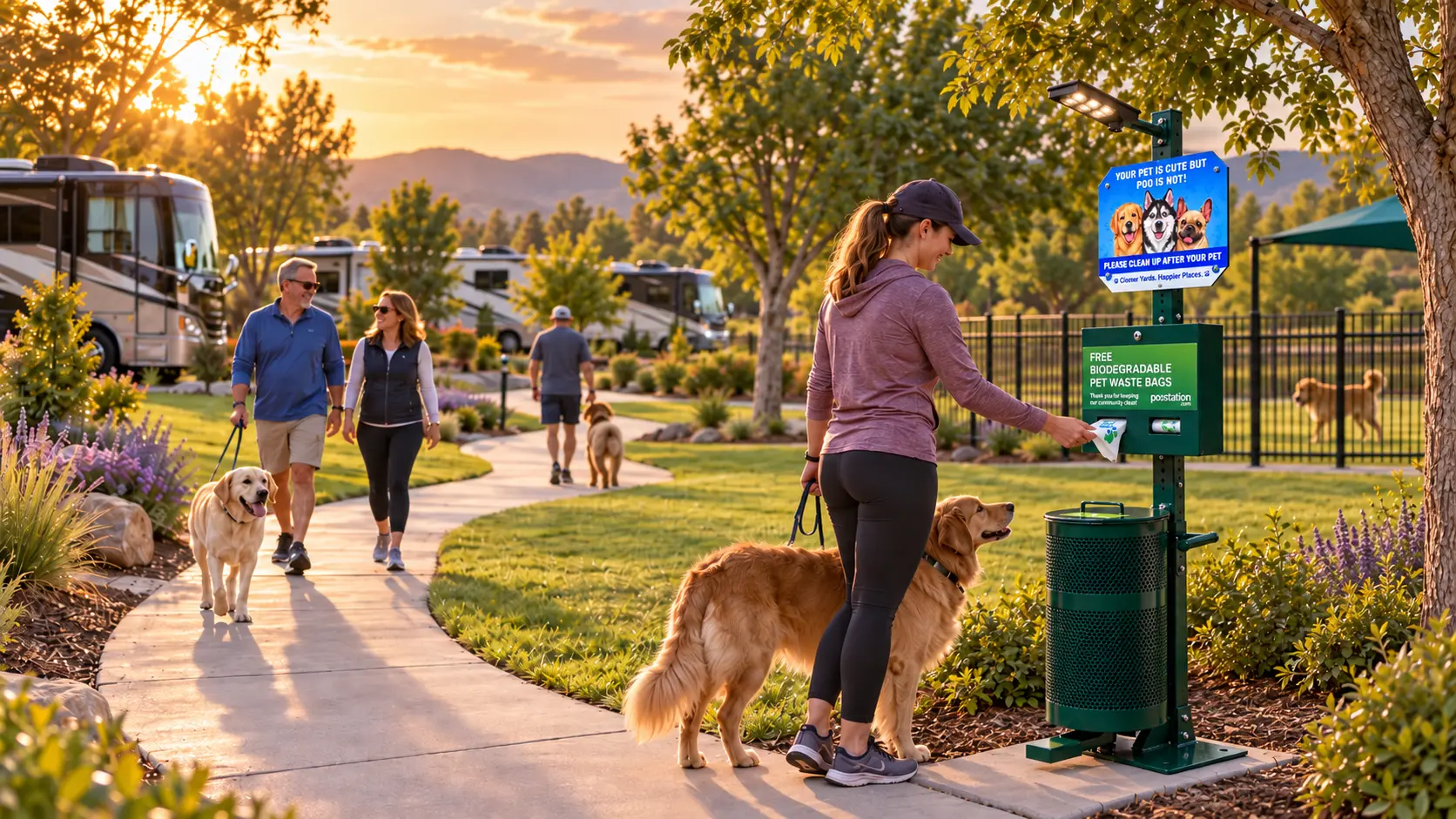

From campgrounds and RV resorts to municipal parks and recreation areas, new research shows pets are increasingly part of how Americans travel and spend time outdoors. The infrastructure supporting them may need to catch up.
By Avi Kosch
Founder & CEO
NEXGEN DNA, Inc.
More than seven in ten Americans planning an RV trip this fall expect to bring their pets. Meanwhile, an estimated 227 million U.S. adults, or someone in their household, visited a local park or recreation facility in 2025.
Those numbers come from different corners of outdoor recreation, but they point to the same reality: pets increasingly go where people go. They travel in RVs, stay at campgrounds, walk trails, visit municipal parks and accompany their owners through public spaces that were once designed primarily around people.
The question is whether the infrastructure serving those spaces is evolving as quickly.
Campgrounds and public parks operate differently, yet they share many of the same pet-related challenges. Traffic changes by season, day of the week and even hour of the day. Dogs arrive with visitors whose presence may never have been known in advance. Waste volumes fluctuate, maintenance teams have limited time, and equipment is expected to keep working through heat, rain, snow, ice and constant public use. Outdoor pet infrastructure, therefore, is not simply about installing a dispenser and receptacle. It is about preparing for demand that can change quickly.
Pets Have Become Part of Outdoor America Camping and outdoor hospitality are no longer niche activities. KOA’s 2026 Camping & Outdoor Hospitality Report says more than 52 million North American households camped during 2025, generating an estimated $66 billion economic footprint.
RV travel makes the pet connection even clearer. Research released by the RV Industry Association throughout 2026 consistently shows that pets are deeply woven into RV travel. More than half of spring leisure travelers expected to travel with pets, roughly two-thirds of winter RV travelers planned to bring them, and more than seven in ten Americans planning a fall RV trip said their pets would be coming along.
For campground and RV-resort operators, those animals are not simply another occupant inside the vehicle. Dogs are being walked along campground roads, through grassy areas and around shared amenities, creating demand for bags, disposal capacity, lighting and maintenance throughout the property.
The cultural shift extends beyond travel. Zillow’s 2026 research found that 59% of renter households have at least one pet, compared with 37% that have a child. Although that finding comes from housing, it illustrates how deeply pets have become integrated into everyday household life. When people travel and recreate, many of those pets come with them.
Outdoor Demand Rarely Arrives Evenly One of the greatest challenges for parks and campgrounds is that demand is rarely constant.
A campground can be half-empty during the week and full for a holiday weekend. A municipal park may be quiet on Tuesday morning and packed on a beautiful Saturday because youth sports, community events and recreational users all arrive within the same window.
Peak demand does not necessarily wait for the weekend, either. At the dog park I use, evenings are often noticeably busier than mornings. People return from work, take their dogs outside and converge on the park within a relatively short period. What was a quiet area a few hours earlier can suddenly have dogs and owners arriving continuously.
That is why daily averages can be misleading. The average visitor count over 24 hours tells an operator very little about what happens during the busiest two-hour period.
Outdoor pet infrastructure has to absorb those surges. Design for Peak Use, Not Average Use
A pet waste station that performs adequately when a campground is at half capacity but runs out of bags when every campsite is occupied is not really meeting the property’s needs.
The same applies in a park. A dispenser might perform perfectly during quiet weekday mornings and fail when dozens of dogs arrive over a weekend or during the evening rush.
Capacity is therefore more than a product specification. It is an operating buffer.
Greater bag capacity extends the time between refills. Greater waste capacity gives maintenance teams more room before collection becomes necessary. Both help properties absorb unexpected increases in traffic without immediately requiring staff intervention.
That matters most during peak periods. An empty dispenser or overflowing receptacle makes responsible behavior harder precisely when the property is experiencing its highest demand.
A Pet Waste Bin Becomes Everyone’s Trash Can
Waste capacity is even more complicated because outdoor receptacles rarely receive only the waste they were intended to collect.
People see a trash can and use it.
At parks, bottles, coffee cups, snack wrappers, food containers and picnic waste end up inside pet waste receptacles. At campgrounds, those same bins may collect food packaging, campsite debris and whatever someone happens to be carrying while walking past.
A 10- or 13-gallon pet waste receptacle therefore does not necessarily provide 10 or 13 gallons of usable pet-waste capacity. A single bulky takeout bag can consume a surprising percentage of a small container.
Repeated throughout a busy day, that behavior can fill a bin much sooner than expected. Once it is full, even the visitor who picked up after a dog and wants to dispose of the waste properly may have nowhere appropriate to put it.
Larger capacity is not simply about holding more dog waste. It provides operational headroom for real human behavior.
Good outdoor infrastructure should be designed around how people actually behave, not how we hope they will behave.
Placement Should Follow Movement
Capacity cannot compensate for poor placement.
At campgrounds, guests naturally move along campsite loops, internal roads, restroom routes, trail entrances and common areas. At municipal parks, visitors may concentrate around parking lots, walking paths, athletic fields, waterfronts, playgrounds, trailheads and dog parks.
Stations should follow those movements.
A pet waste station placed where few dog owners naturally travel may technically satisfy a site plan while accomplishing very little. Meanwhile, another heavily traveled route may have no convenient bags or disposal point at all.
Convenience matters because picking up after a pet is ultimately a behavior we are asking visitors to perform. The farther someone has to walk or the harder a station is to locate, the more friction is introduced.
Good placement starts with observation: Where are people entering? Where do dog walkers naturally travel? Where does evening traffic develop? Where are the longest gaps between disposal points?
Those questions can be far more useful than simply dividing acreage by a fixed formula.
Evening Use and Accessibility Matter Too
The evening rush creates another challenge: visibility.
Campgrounds, RV resorts and parks frequently remain active after sunset. Campers walk dogs before bed, residents head to dog parks after work, and during the winter months ordinary evening activity may take place well after dark.
Lighting therefore becomes part of usability. Visitors need to locate the station, find the bag dispenser and interact safely with the equipment.
Accessibility deserves the same consideration. CDC information published in 2026 reports that more than one in four U.S. adults has some type of disability, with mobility disabilities affecting 12.2% of adults. Public recreational spaces serve all of those people, including dog owners and visitors who may not be able to interact with equipment in exactly the same way.
That is why giving users more than one practical way to operate outdoor equipment matters. A sanitary foot-operated option can reduce unnecessary hand contact for many users, while an accessible hand-operated alternative broadens usability for people who cannot comfortably operate a pedal.
Pet-friendly infrastructure should work for the people who actually use the space.
Outdoor Equipment Has a Difficult Job
Pet waste infrastructure lives outdoors permanently, often in punishing conditions.
A station in Florida may face temperatures around or above 100 degrees, intense ultraviolet exposure, humidity, heavy rain and frequent irrigation. In northern climates, equipment can encounter below-zero temperatures, accumulated snow, ice and repeated freeze-thaw cycles. Coastal environments add corrosion concerns, while public parks may expose equipment to accidental impact, vandalism and unpredictable daily use.
Yet lids still need to open, hinges need to move, pedals need to operate, posts need to remain stable and receptacles need to resist deterioration.
Materials, coatings and hardware are therefore operational considerations, not merely cosmetic ones.
Appearance also matters. Campground operators invest in landscaping, cabins, signage and guest amenities, while municipalities devote significant resources to parks, trails and recreation facilities. A rusting or deteriorating waste station becomes part of that environment just as surely as a damaged bench or light fixture.
Outdoor equipment should be evaluated not only by how it looks when installed, but by how it will function years later.
Pet-Friendly Should Describe the Experience
There is a meaningful difference between allowing pets and designing for them.
A campground may advertise itself as pet-friendly, but guests experience that promise through small details. Can they conveniently walk their dog? Are bags available? Are receptacles overflowing? Is the area clean? Can they locate a station after dark?
Municipal parks face a similar test. Visitors may never list pet waste infrastructure among their favorite amenities, but they notice quickly when dog waste accumulates or heavily used routes lack basic disposal options.
NRPA’s 2026 research underscores the scale of that responsibility: an estimated 227 million U.S. adults, or someone in their household, used a local park or recreation facility in 2025, and the organization emphasizes the importance of making parks welcoming and accessible to the public.
The best infrastructure often works so smoothly that visitors barely think about it. They find a bag, dispose of the waste and continue enjoying their surroundings.
That quiet reliability is part of the experience.
Designing PooStation Around Outdoor Reality
Those same conditions helped shape the development of PooStation.
Rather than treating a commercial pet waste station as simply a bag dispenser mounted above a small waste receptacle, we looked at the realities of outdoor use: fluctuating traffic, limited service time, unrelated trash consuming waste capacity, nighttime use, accessibility and equipment that may spend years exposed to difficult weather.
That thinking influenced PooStation’s 1,200-bag capacity and 20-gallon waste receptacle, providing additional service headroom during high-use periods. An integrated EMPTY indicator helps maintenance personnel identify when bags need attention, while LED lighting supports visibility during early-morning and evening use.
The station incorporates galvanized and powder-coated steel construction in major outdoor components to help address the realities of long-term exposure. It also provides two ways to operate the waste-bin lid: a sanitary foot pedal that allows hands-free operation and an accessible hand lever for users who cannot or prefer not to operate the pedal.
Those choices are particularly important in parks, campgrounds and other public environments because there is no single type of user. A parent may be holding a leash while managing children. An older adult may have limited mobility. A visitor may use a wheelchair or another mobility aid. Someone else may simply want to avoid touching a public waste-bin lid with their hand.
The objective was not to add features simply to make a specification sheet longer. It was to remove small points of friction that become much more meaningful when equipment serves thousands of users over years of outdoor use.
Design for the Moment Everyone Shows Up
The continued growth of pet-friendly travel and outdoor recreation gives campground operators, RV resorts, municipalities and recreation departments an opportunity to reconsider what pet infrastructure is expected to accomplish.
It needs sufficient capacity for busy periods, placement that reflects how people actually move through a property, visibility after dark, accessibility for different users, materials capable of enduring the local climate and a maintenance model that does not demand constant attention.
Most importantly, it has to be designed for variation.
A station should not be judged only by how it performs on a quiet Tuesday morning. It also has to work when every campground site is occupied for a three-day weekend, when a park fills on a beautiful Saturday afternoon or when dozens of dog owners arrive during the evening rush after work.
Pets have become part of how Americans live, travel and recreate. The outdoor infrastructure supporting them needs to reflect that reality.
Outdoor pet infrastructure should not be designed around the average moment. It should be ready for the moment everyone shows up.
Happier Places, Cleaner Places™
Sources
Kampgrounds of America — 2026 Camping & Outdoor Hospitality Report — Research examining North American camping participation, outdoor hospitality trends and the economic impact of camping.
RV Industry Association / Go RVing — 2025–2026 Travel Research — Seasonal research examining RV travel intentions, destinations and the significant share of RV travelers planning to bring pets.
National Recreation and Park Association — 2026 Research and Agency Performance Data — Research examining local park and recreation participation, public recreation infrastructure and dog-park availability.
Centers for Disease Control and Prevention — Disability Impacts All of Us, 2026 — National disability data examining disability prevalence among U.S. adults, including mobility-related disabilities.
Zillow Research — 2026 — Housing research examining pet ownership among renter households and the growing role pets play in American household life.

About the Author
Avi Kosch
Founder and CEO, NEXGEN DNA, Inc. | Creator of PooStation
Avi Kosch is the founder and CEO of NEXGEN DNA, Inc. and the creator of PooStation, a next-generation commercial pet waste management system developed for campgrounds, RV resorts, municipal parks, multifamily communities, HOAs and other pet-friendly outdoor environments.
Drawing on more than two decades of experience designing and manufacturing commercial products for four- and five-diamond hospitality properties, Kosch brings a hospitality-inspired approach to product development centered on durability, usability, maintenance efficiency and the guest and resident experience. His work with PooStation applies those principles to an often-overlooked category of outdoor infrastructure, with the goal of making responsible pet ownership easier while helping properties and public spaces remain cleaner and easier to maintain.